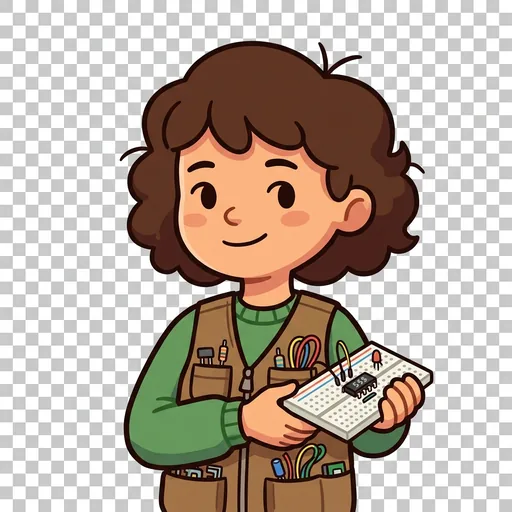
Reck, Lettie, Tad (ensemble)
THREE ROUTES TO ONE RIDDLE — *the same chickens-and-cows riddle solved by Reck's guess-and-check, Lettie's equation, and Tad's smaller-case — three valid roads to the same answer.*
A story read by Reck, Lettie, Tad (ensemble)
Loading audio…
Press play to listen along. The line being read lights up as you go.
Show full transcript
Loading transcript…
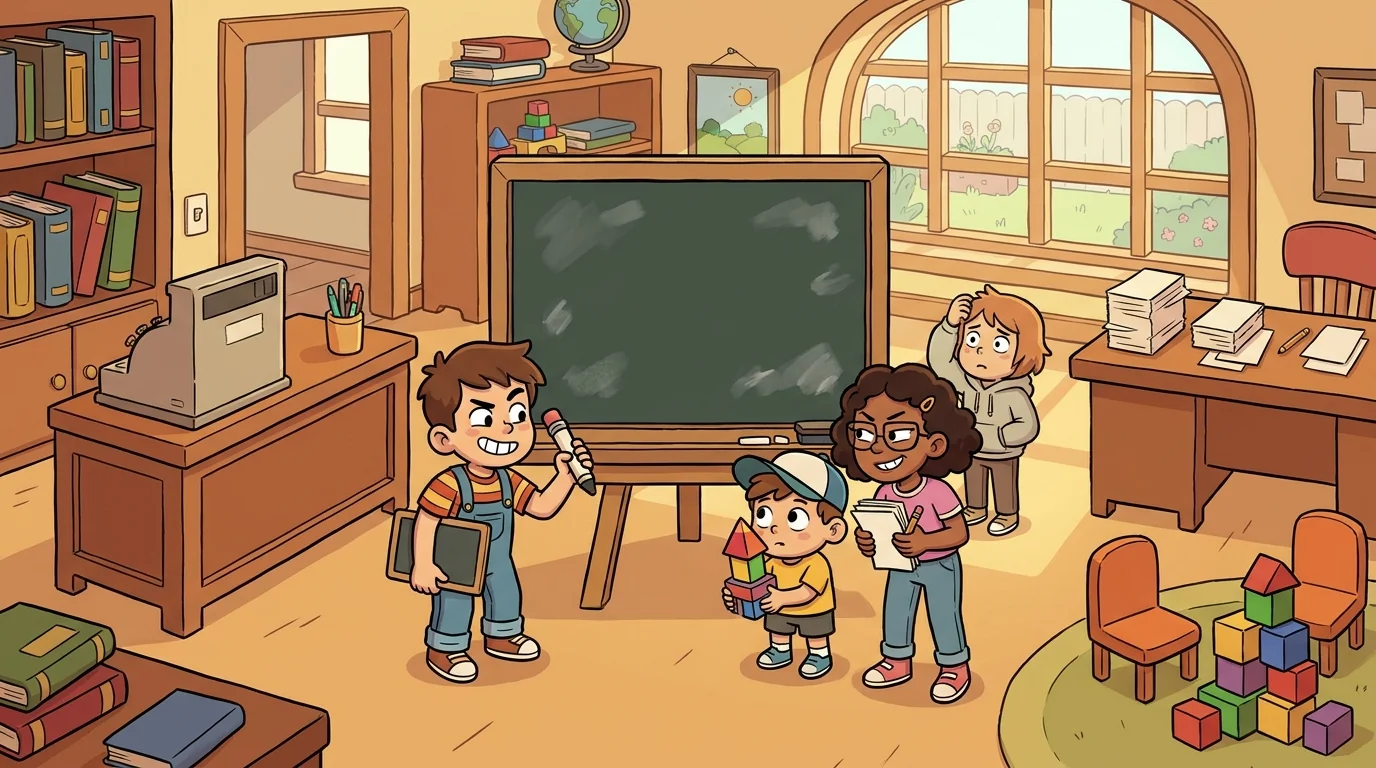
The riddle on the board that afternoon was the oldest one in the workshop, the one every solver eventually meets: A farmer has chickens and cows. Altogether there are 8 heads and 26 legs. How many of each?
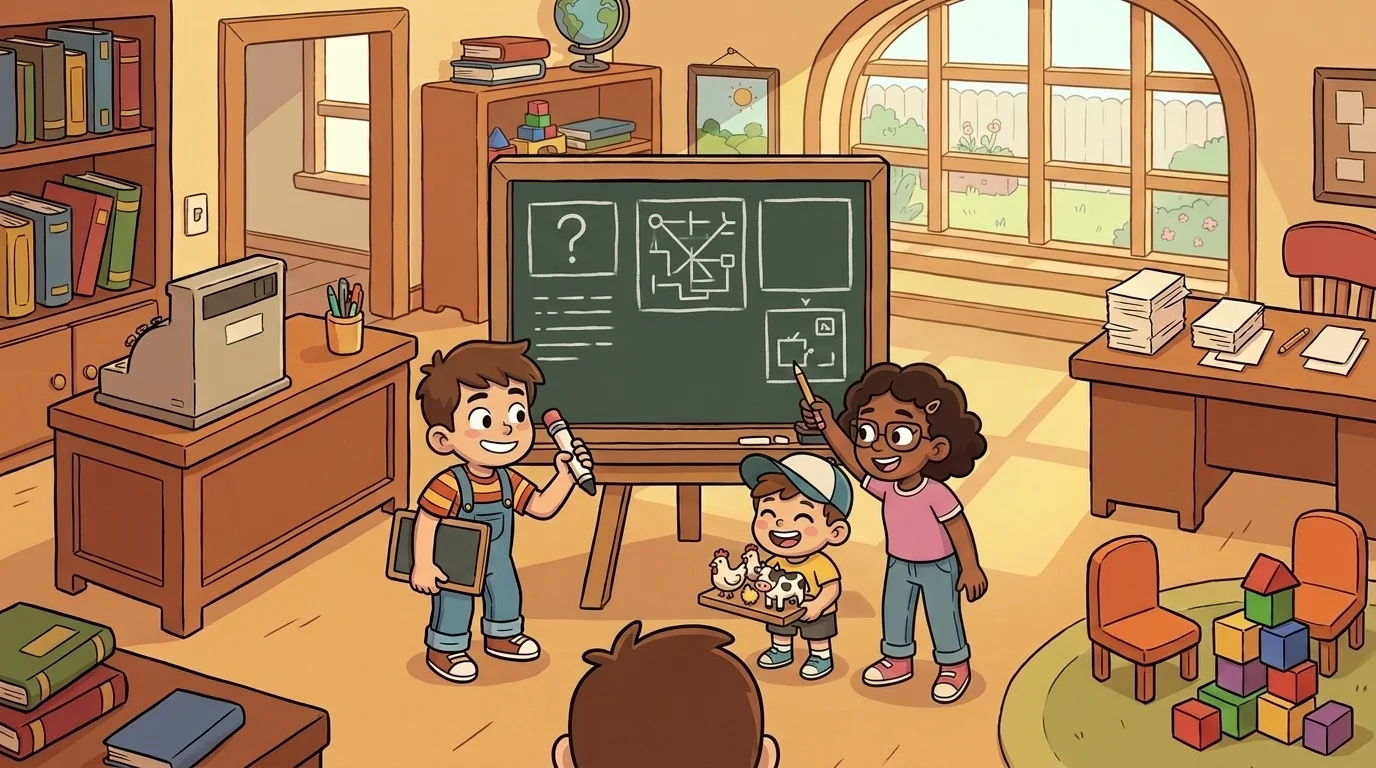
A visiting kid stared at it, stuck at step zero — and, unusually, three cast members drifted over at once: Reck from the front desk, Lettie from her tall desk of Let x be... slips, and small Tad from the shrinking-corner. They looked at the riddle, then at each other, and something mischievous passed between them.
"I'll solve it my way," said Reck.
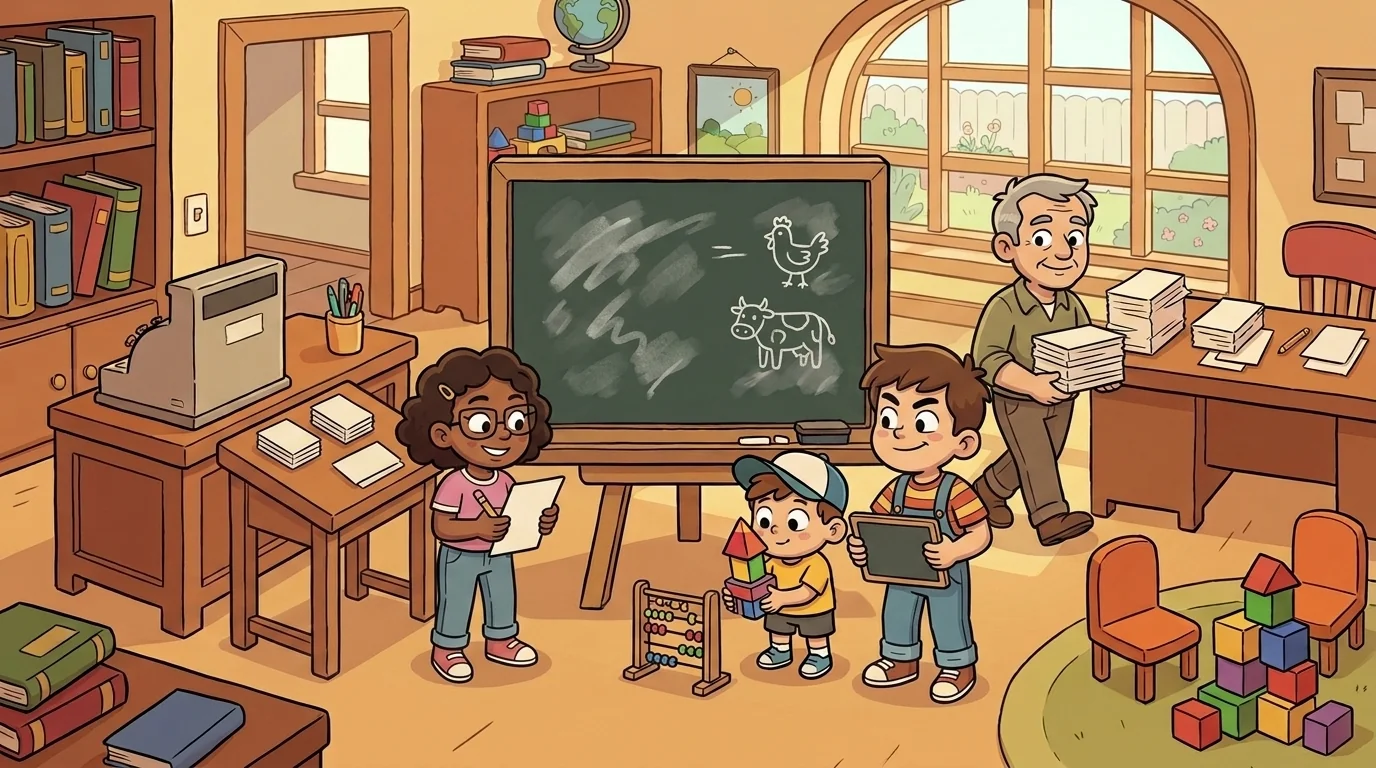
"I'll solve it mine," said Lettie.
"And I'll solve it mine," said Tad. "Same riddle. Three roads. Let's see where we all end up."
Cass, passing with a stack of problem-cards, smiled without stopping. "Twenty says you all land in the same place."
Reck went first, because Reck could never resist a guess.
"I don't need the answer to start — I just need a guess to measure with," Reck said. "Say 4 chickens, 4 cows. Eight heads, good. Legs: 8 plus 16 is 24 — two short of 26. Two short means I've got one too many chickens, because cows carry more legs. So: swap one. Three chickens, five cows. Legs: 6 plus 20, that's 26. There." Reck tapped it, grinning. "Guess, check, let the miss steer me. Two steps and the wrong guess walked me straight to the right one. Three chickens, five cows."
Lettie had already been writing, and looked up with the calm of someone who'd turned the fog into a sentence.
"I don't guess — I name," Lettie said, not unkindly. "Let x be the chickens. Then cows are 8 minus x, since there are 8 heads. Chickens have 2 legs, cows have 4, and the legs total 26 — so 2x plus 4 times (8 minus x) equals 26." Lettie solved the line cleanly: 2x + 32 − 4x = 26, so −2x = −6, so x = 3. "Three chickens. And 8 minus 3 is five cows." Lettie set the pencil down. "Reck felt the way to it. I wrote the way to it. Different roads — but look, the same three and five."
Tad, who barely came up to the desk, had been quietly doing something that looked like playing.
"Twenty-six legs and eight heads made my head hurt," Tad admitted cheerfully, "so I made it tiny first. I pretended it was 2 heads and 6 legs. One chicken, one cow — 2 legs plus 4 legs, that's 6. Easy. And while I did the tiny one, I watched how it worked: start by imagining all chickens, then every cow you add trades in 2 extra legs. So for the real one — 8 chickens would be 16 legs, but we have 26, that's 10 extra legs, and each cow adds 2 extra, so 10 divided by 2 is 5 cows, and 3 chickens." Tad beamed up at the others. "I solved a baby version to learn the trick, then did the trick on the big one. Three chickens, five cows."
The three of them looked at the board: three chickens, five cows, arrived at by a brave guess, a named equation, and a tiny practice-run — three completely different roads, one identical destination.
The visiting kid, who had been braced to be told there was One Correct Way they didn't know, said the thing they were actually feeling: "But... which one is right?"
"All of them," said Lettie.
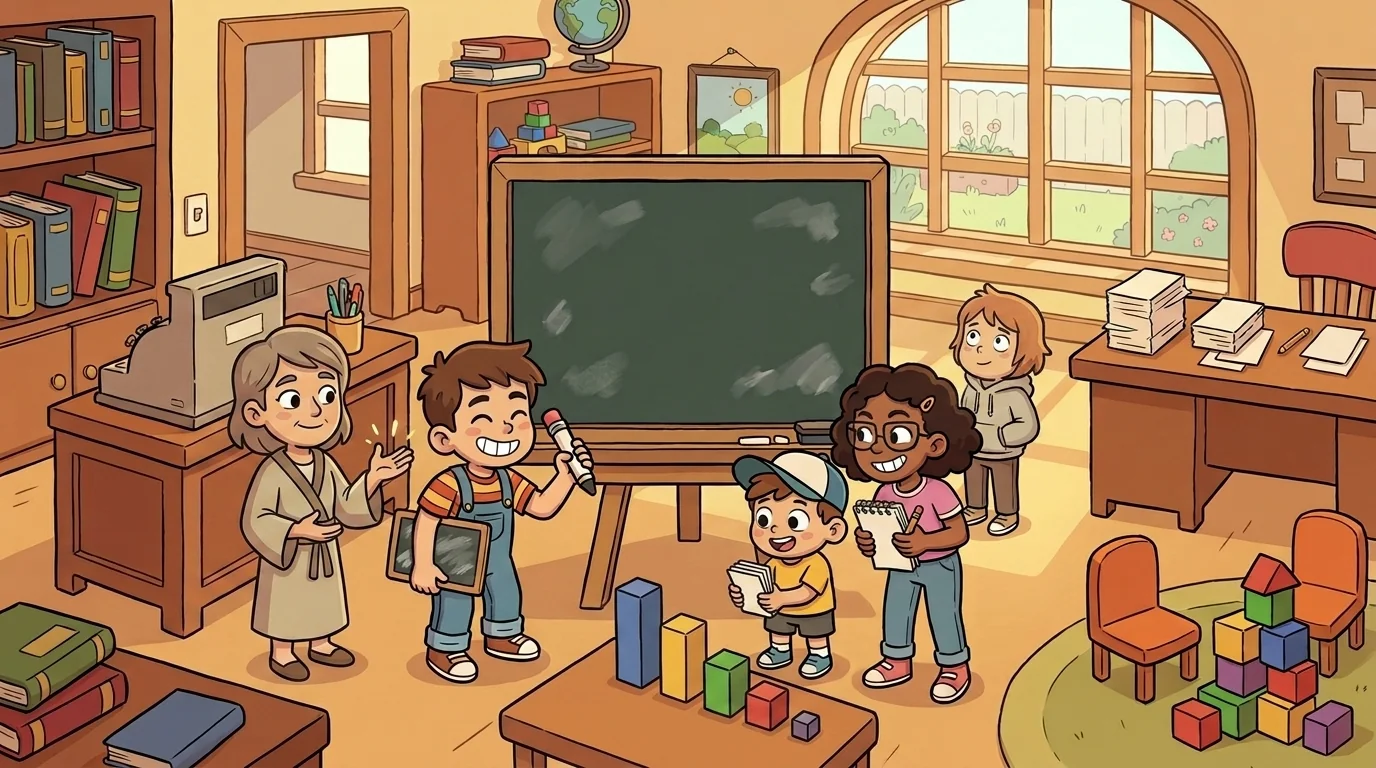
"That's the whole point," said Reck.
"Pick the one that fits your brain," said Tad. "Mine likes tiny. Reck's likes guessing. Lettie's likes writing. The riddle doesn't care which road you take — it only cares that you get there, and there's more than one road."
Cass, drifting back past, collected an imaginary twenty from the air. "Same place. Told you." And then, more gently, to the kid: "There's no secret Correct Method you're missing. There are roads, and different roads suit different travelers, and every one of these three is honest and complete. Your job isn't to find the way. It's to find a way — yours."
The kid looked at the three solutions, and something in their chest — a small, tight belief that they'd been failing because they didn't know the One Right Way — simply let go.
And the feeling that flooded in to replace it was a warm, freeing permission — the glad, spacious relief of learning that being a different kind of thinker wasn't a deficiency but a road of their own, that they got to solve the way their own brain liked best and still arrive exactly where everyone else did. Reck, Lettie, and Tad felt that permission land and grinned at each other, warm and glad, because handing a stuck kid their own road was worth more than handing them an answer. "Three roads, one hundred legs, same destination," said Tad, and the three friends clinked imaginary cups. That freeing permission —there's a road that fits me, and it's just as right — was the very best part of the oldest riddle in the workshop.
The ReckonQuest ensemble
Reck, Lettie, Tad (ensemble) is part of ReckonQuest's distributed-narrative cast. Each character embodies a different curricular primitive; together they teach the full subject.
-

Reck
Systematic guess-and-check — makes a reckoned guess, checks it, makes the next guess smarter (the pre-algebra bridge)
-

Lettie
Set up the equation — names the unknowns ('let x = the chickens') and writes the relationships
-

Retta
Work backwards — starts from the goal and reverses the steps
-

Kindra
Recognize the schema — spots 'this is a coin problem' before solving (schema-based instruction)
-
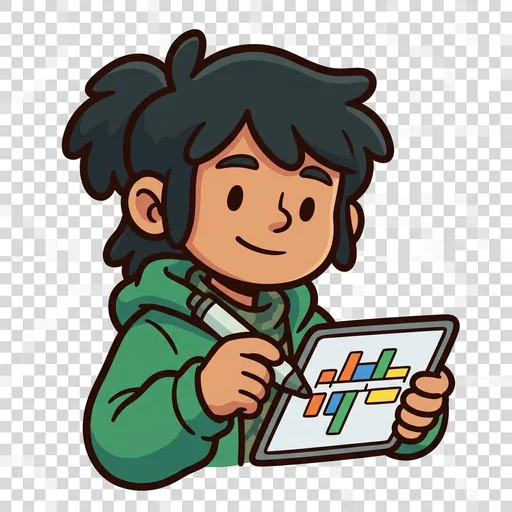
Doodle
Draw a diagram — draws the bar/tape diagram of the relationships
-

Vetta
Look back / check — substitutes the answer back and asks 'does this make sense?'
-
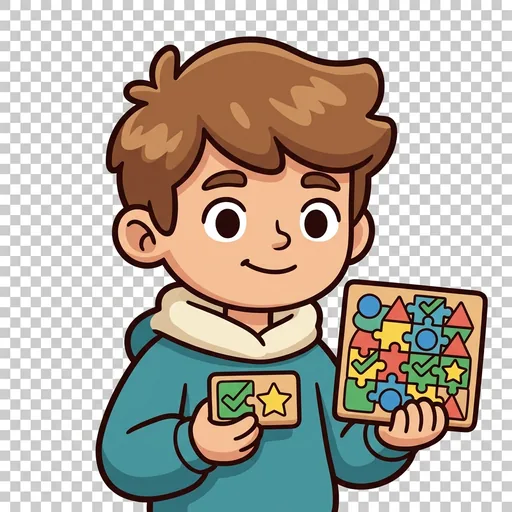
Tad
Simplify to a smaller case — solves a tiny version first (2 heads before 100)
-

Tagg
Track the units — labels every number ('6 = legs, not chickens'), structure over key-words
-
Genny
Generalize — writes the rule that works for any numbers once the specific riddle is solved
-
Cass
The scaffold keeper (mentor) — runs understand→plan→execute→look-back and normalizes not knowing the way in