
Vetta
LOOK BACK / CHECK — *substitute the answer back into the original words and ask "does this actually make sense?" before trusting it.*
Loading audio…
Press play to listen along. The line being read lights up as you go.
Show full transcript
Loading transcript…

The last desk in the workshop sat directly under the high arched window. Solvers reached it only when they believed their work was completely finished. The surface was heavy oak, scarred by decades of dark graphite and sharp compass points. Vetta sat behind this desk every afternoon, armed with a blue pencil and a wooden ruler. A brass lamp cast a pool of warm light across the papers.
Solvers arrived at Vetta's desk in all kinds of moods. Some ran up with breathless excitement, clutching crumpled sheets filled with wild scribbles. Others dragged their feet, tired from two hours of wrestling with fractions at Reck's table. They all expected the same quick motion: a green checkmark, a quick nod, and permission to leave.
Vetta never rushed. Instead, Vetta would look up, adjust a pair of thin round glasses, and ask four gentle words.
"Does this make sense?"
Most young solvers blinked when they heard this. They were used to speed. They thought math was a race toward a final box drawn at the bottom of the page. But Vetta's desk was where speed stopped and reality took over. Getting an answer, Vetta often reminded them, was only three-quarters of the journey. The final move was looking back. It meant taking the number you found and carrying it back into the story to see if it fit.
Without that final walk back, answers could quickly turn absurd.
"You got negative four chickens?" Vetta would ask kindly, looking over a sheet. "Let's pause and picture that farm. How does a negative chicken behave in a coop? Does it un-lay eggs?"
The solver would pause, suddenly visualizing invisible phantom birds floating over the straw.
Or someone would bring a word problem about a field trip.

"Your calculation says we need three and a half buses," Vetta would say, resting a chin on one hand. "How does the half-bus work on the highway? Is it sawed down the middle? Does it carry half a driver?"
The humor was quiet and dry. Vetta never shamed anyone for a strange result. Instead, Vetta simply placed the answer back into the real world and let the real world speak for itself.
"Plug your number back into the original story," Vetta advised. "Read the problem out loud, but put your answer inside the blank spot. If the sentence sounds ridiculous, your math is trying to tell you something went wrong upstream. But if it fits like a key in a solid lock—then you can finally trust it."
Vetta had learned this lesson the hard way. Long ago, as a young solver in the very same workshop, Vetta was famous for working fast. Vetta loved long multiplication and pristine columns of figures.
One morning, Cass handed out a puzzle about planning a large community breakfast. Vetta attacked the problem with speed and energy. Two pages were filled with flawless long division. At the bottom of the sheet, Vetta wrote the final answer with a proud flourish: 42 pancakes per person.
Vetta marched up to Cass's table, chest puffed out, confident and proud. The arithmetic was undeniably perfect. Every single sum was accurate.
Cass picked up the page and read it carefully. Then Cass looked over the top of the wooden clipboard.
"Forty-two pancakes," Cass said mildly. "For every single person at the breakfast."
"Yes," Vetta said with a bright smile. "The calculations are completely clean."
Cass leaned back in the chair. "Vetta, have you ever eaten forty-two pancakes in one sitting?"
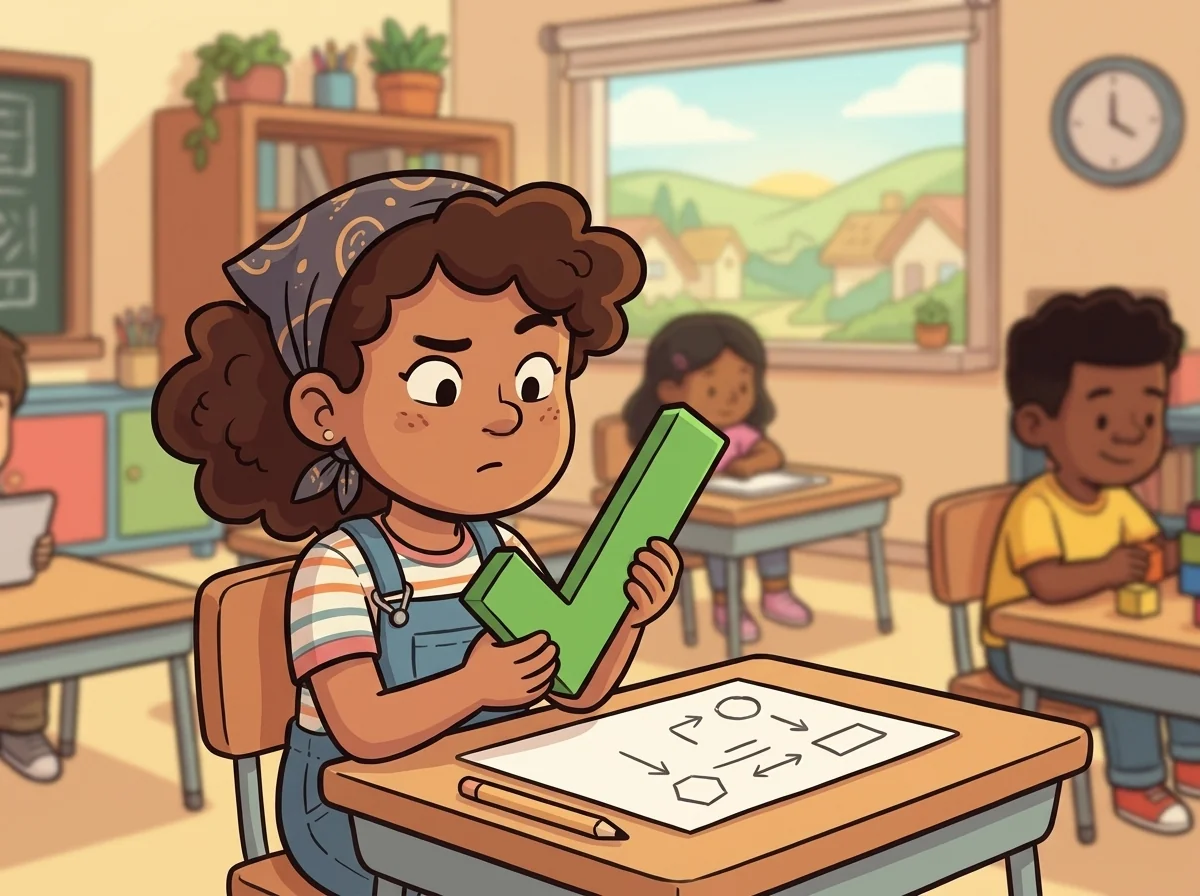
Vetta stopped. The proud look vanished instantly. A vivid picture popped into Vetta's mind: a stack of flapjacks as tall as a floor lamp, dripping maple syrup onto a helpless customer.
"No," Vetta admitted softly, cheeks turning bright red.
Cass did not yell or shake a head in disappointment. Cass simply pulled out a spare stool.
"Your computing was flawless," Cass explained gently. "You didn't make a single error with your multiplication. You just flipped the fraction at the start. A right calculation on a wrong setup gives a confident, tidy, completely wrong answer."
Cass tapped the paper lightly with a pencil stub. "You skipped the very last move. You forgot to carry the number home. Always ask yourself if forty-two pancakes makes sense for a human stomach. If it doesn't, something went wrong upstream. Catching it here saves you from baking eight hundred unwanted pancakes."
From that day forward, Vetta never trusted a number just because the arithmetic looked neat. An answer had to survive the journey back to reality.
In the quiet workshop, a boy named Leo approached the last desk. He had spent half an hour at Reck's station working on a stubborn riddle about barnyard animals.
Leo dropped his paper onto Vetta's blotter with a heavy sigh. Blue ink covered his right thumb.
"I finished it," Leo said, wiping sweat from his forehead. "Three chickens and five cows. That gives eight animals and twenty-six legs."
He stood on his tiptoes, waiting for the green checkmark so he could run outside to join the ballgame.
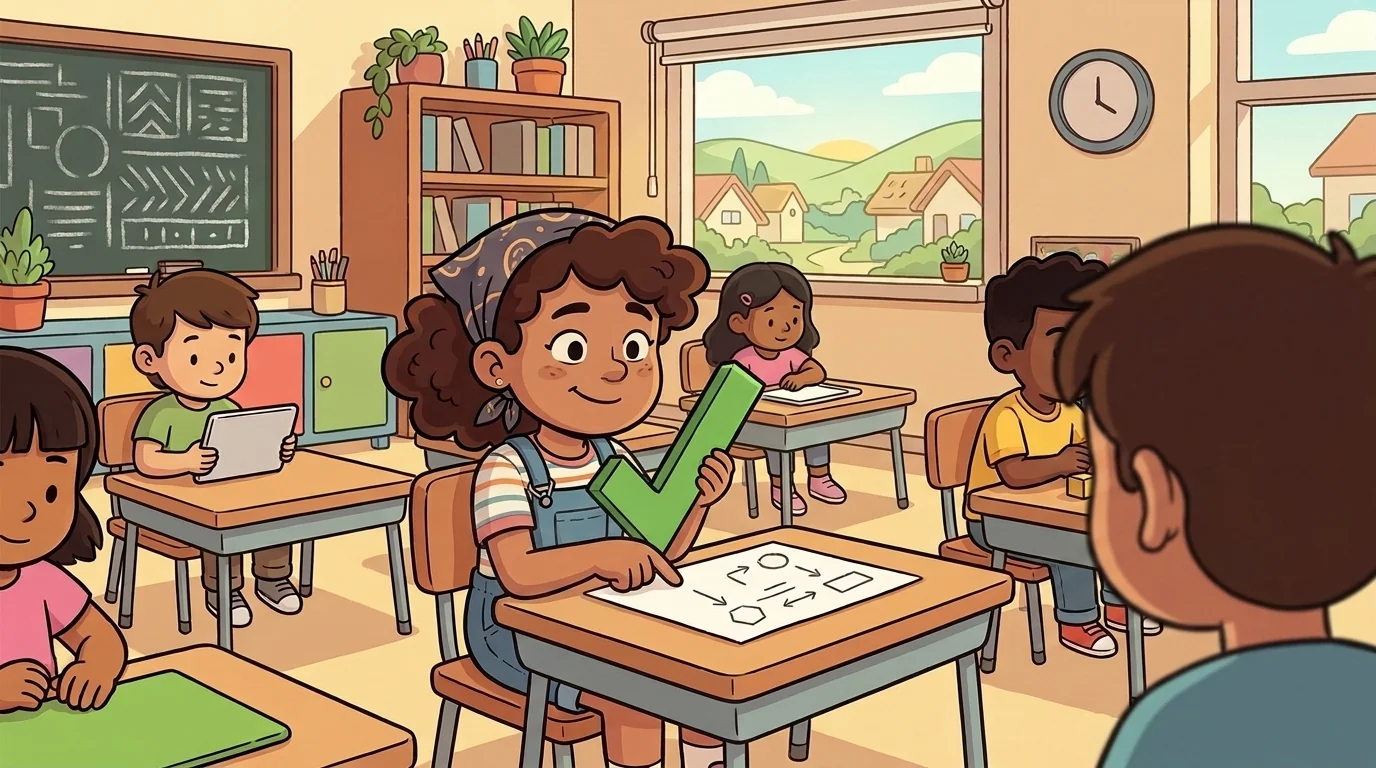
Vetta did not grab the green pencil. Instead, Vetta smoothed out the wrinkled corner of Leo's paper.
"Three chickens and five cows," Vetta repeated warmly. "That sounds like a fine farm. Before we stamp this paper, let's take those numbers for a walk back home."
Leo sighed softly. "Do we have to? The math took forever."
"It only takes a moment," Vetta said with a quick wink. "And it turns a guess into a certainty. Let me ask you this: you say there are three chickens and five cows. What is three plus five?"
"Eight," Leo said, counting quickly on his fingers. "The problem said there were eight animals total."
"So the heads match," Vetta noted. "Now let's count the legs. How many legs does a chicken have?"
"Two," Leo answered, watching Vetta write a faint note on the side.
"And you have three chickens," Vetta said. "Three times two gives us six legs. What about your five cows?"
"Cows have four legs each," Leo said, rubbing his chin. "Five times four is twenty."
"Now add them together," Vetta invited, pointing to the margin. "Six chicken legs plus twenty cow legs."

Leo stared at the paper. "Twenty-six legs."
His eyes widened slightly as the match clicked into place.
"Twenty-six legs," Vetta echoed softly. "That is the exact number from the original riddle."
Vetta reached for the heavy wooden rubber stamp and pressed it onto the bottom corner. The ink dried in a crisp circle.
"Now you know," Vetta said. "You aren't guessing. You aren't hoping I am feeling generous today. You know it is right because every single word fits."
When a check failed, Vetta never treated it like a disaster. In fact, a failed check made Vetta's face light up with genuine interest.
"How wonderful!" Vetta would say, pointing to an impossible total. "Our check just caught an error before it could wander out into the world. Let's trace our steps backward and find where the slip happened."
The solvers gradually learned that Vetta's desk was not a trap. The last check was not a harsh judge waiting to catch them dropping a digit. It was a shield against embarrassment.
When kids left Vetta's desk, they felt a deep and grounded certainty in their chest. It was the difference between turning in work with crossed fingers and handing it over with a calm hand.
"Does this make sense?" Vetta whispered to the empty room as the sun began to set.
It was no longer a question to fear. It was the quiet comfort of knowing you were right.
The ReckonQuest ensemble
Vetta is part of ReckonQuest's distributed-narrative cast. Each character embodies a different curricular primitive; together they teach the full subject.
-

Reck
Systematic guess-and-check — makes a reckoned guess, checks it, makes the next guess smarter (the pre-algebra bridge)
-

Lettie
Set up the equation — names the unknowns ('let x = the chickens') and writes the relationships
-

Retta
Work backwards — starts from the goal and reverses the steps
-

Kindra
Recognize the schema — spots 'this is a coin problem' before solving (schema-based instruction)
-

Doodle
Draw a diagram — draws the bar/tape diagram of the relationships
-

Tad
Simplify to a smaller case — solves a tiny version first (2 heads before 100)
-

Tagg
Track the units — labels every number ('6 = legs, not chickens'), structure over key-words
-

Genny
Generalize — writes the rule that works for any numbers once the specific riddle is solved
-

Cass
The scaffold keeper (mentor) — runs understand→plan→execute→look-back and normalizes not knowing the way in