Rook Hisha
The ROOK (Hisha) — slides any number of empty squares straight along a rank or file, the longest-reaching unpromoted piece, who can reach every square on the board over time
Loading audio…
Press play to listen along. The line being read lights up as you go.
Show full transcript
Loading transcript…
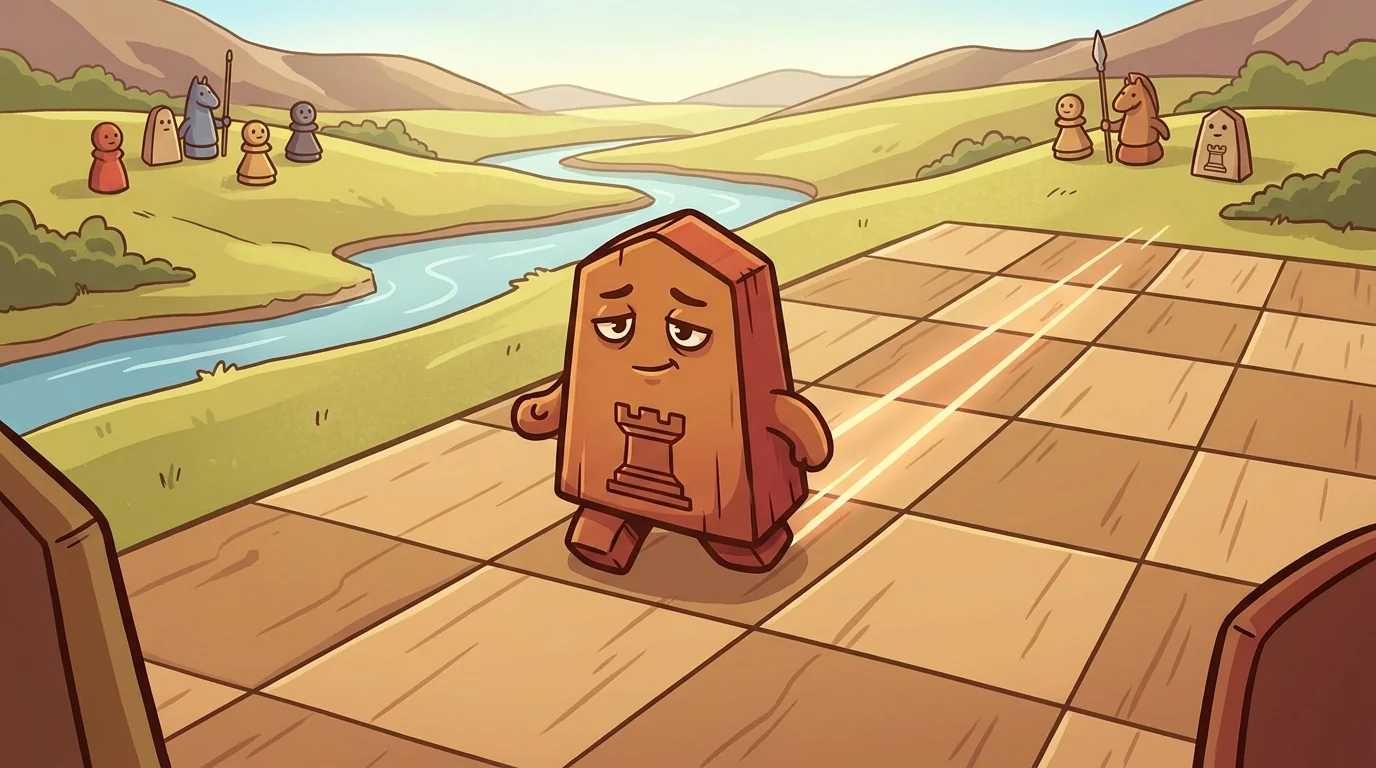
Everyone in the valley of Nine Rivers agreed on one thing: the strongest unpromoted piece on the whole board was the rook, and the rook's name was Hisha.
Hisha swept in straight lines — along any rank, along any file, as far as the road ran clear. Where the bishop was locked to the slants and half the colours, Hisha had no such limit; given enough turns and enough open lanes, she could reach every square in the valley. She was fast, she was far-reaching, she was the piece the enemy feared most and the piece Hisha's own side leaned on hardest. When people drew up their battle plans, they drew them around the rook.
Which was, Hisha would tell you if you got her alone, an exhausting thing to be. "Everyone expects me to win the game single-handed," she said once, sweeping restlessly up and down an empty file. "Strongest piece on the board. As if strongest meant responsible for everything." She was very good. She was also very tired of being the one everyone stood behind and pointed forward.
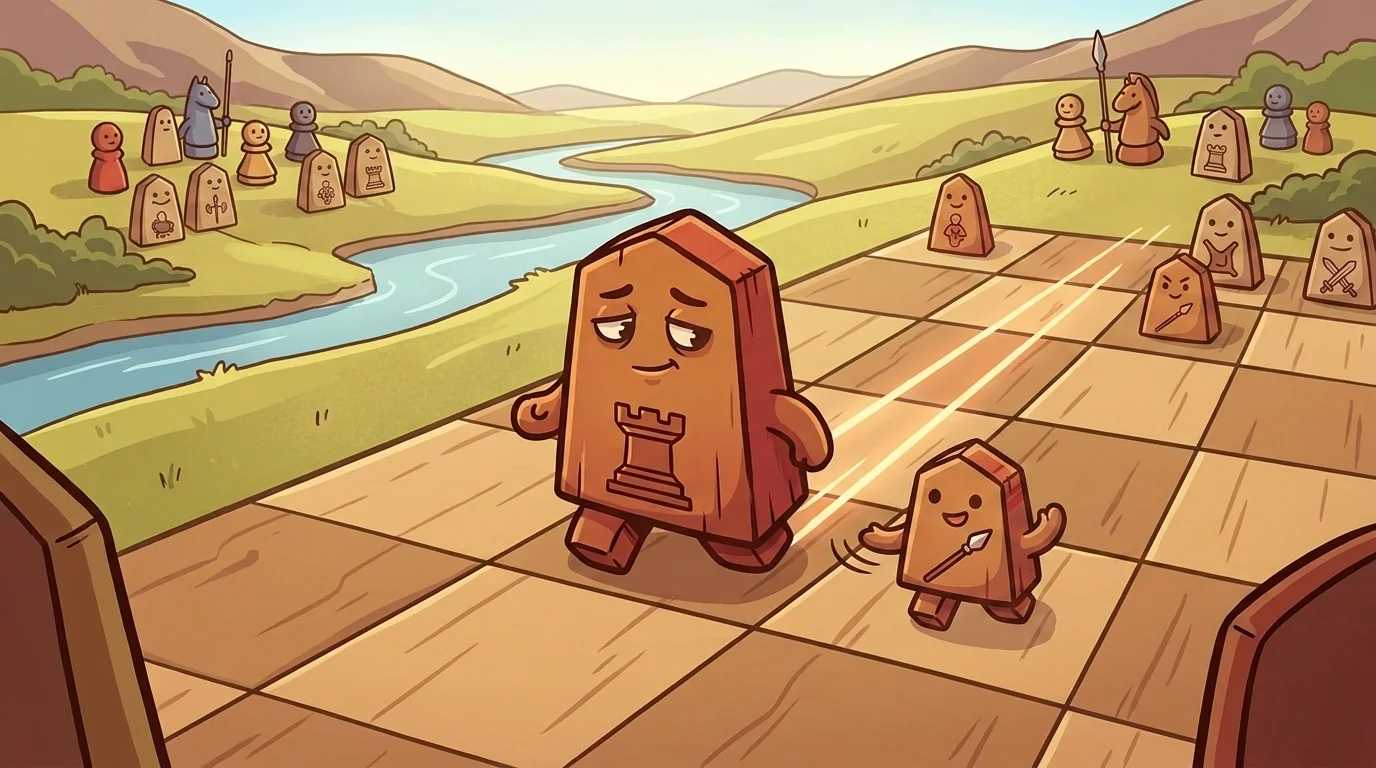
Hisha had learned the limits of being strongest on a day she'd tried to win a game entirely by herself.
She had charged out early — the mightiest piece, why wait? — sweeping deep into enemy territory, capturing a soldier here, threatening a general there, a one-rook army out to end the game alone. For a few turns it was dazzling. Then the enemy simply... surrounded her. One rook, however strong, is still one piece; and a lone strong piece, out ahead of all its friends, is a lone strong piece the whole enemy army can gang up on. They trapped her in the open, far from any help, and took her, and the "strongest piece in the valley" went down having accomplished almost nothing.
Turned around afterward, sweeping slow furious lines in the wrong colours, Hisha met an old rook who had won a hundred games and lost a hundred more. "You went out alone," the old rook said. "Strongest piece on the board, all by herself, and they ate you. Do you know when a rook is truly strongest?" Hisha shook her head. "When a friend clears a file for her. When a soldier trades itself to open a lane, and then the rook comes sweeping down that open road with the whole army behind her. You're not weak in company, child. You're unstoppable in it. Strongest doesn't mean alone. Strongest means the others clear the way, and you finish it."
Hisha turned that over for a long time. She had thought her strength was a thing she carried by herself. It wasn't. It was a thing her friends aimed, by opening the lines she thundered down.
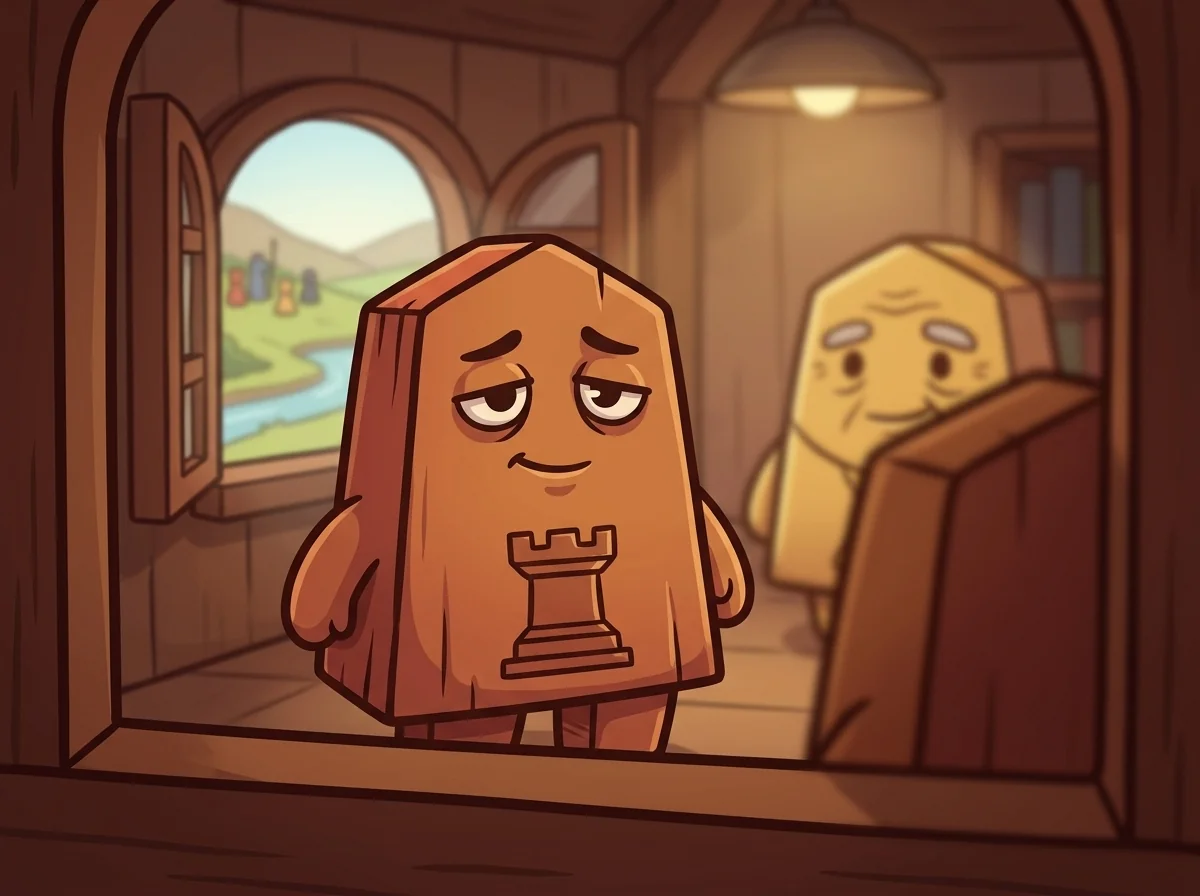
At the House of Study, Hisha swept in along the central file and pulled up before the Head of the House.
"The rook," said the Head. "The strongest piece I could hope to have teaching here. Which is exactly the problem — every young piece who admires you wants to be a one-rook army, and loses every game trying."
"I know," said Hisha, with feeling. "I was that piece. I can teach them the thing that took me a hundred losses to learn: that being the strongest is a trap if you think it means going it alone. A rook out by herself is a target. A rook coming down an open file her friends have cleared is the end of the game. I'll teach them to stop worshipping the strong piece and start setting it up — and I'll teach the strong pieces to stop showing off and start waiting for their lane."
"Good," said the Head. "I have a hundred students who think the goal is to have the strongest piece. Teach them the goal is to open the road for it."
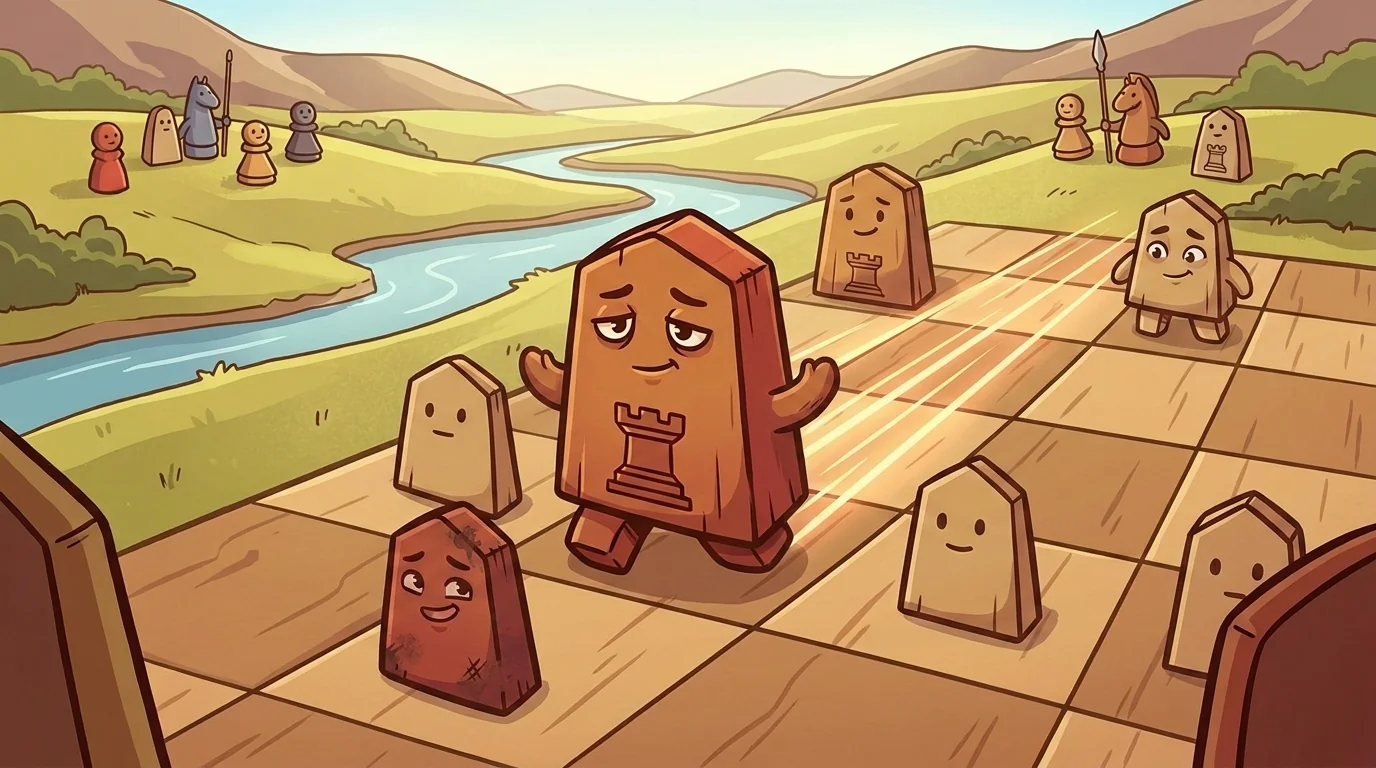
Hisha's student was a show-off named Dai-ki who owned a rook and adored it — and flung it out into the open every single game, alone, early, to dazzle. It was captured, alone, early, every single game.
"You love your rook," said Hisha. "So stop feeding it to the enemy. A rook out alone is a snack. Watch." She had a foot-soldier trade itself off — a small sacrifice — to open a file straight into the enemy's heart. Then, only then, she brought the rook thundering down the newly-open lane, unstoppable, the whole board bending before it. "See the difference? Same rook. But the first way, I went out alone and died. The second way, a friend cleared the road, and I came down it like a river breaking a dam. The strong piece doesn't win by leaving everyone behind. It wins when everyone sets it up."
Dai-ki watched his beloved rook do more in one supported sweep than it had ever done in a dozen lonely charges. He stopped flinging it out to show off. He started spending his little pieces to open lanes — and then letting the rook finish what they'd opened.
"It's stronger when it's not alone," he said, sounding almost betrayed by how obvious it was.
"Everything is," said Hisha. "The strong ones just take the longest to believe it."
That night Hisha swept slow, easy lines up and down the empty hall — rank, then file, then rank again — not hunting anything, just moving, the way a strong piece moves when nobody's watching and nothing's expected.
She thought about the exhausting years of being the one everyone stood behind, and the lonely charge that had ended with the whole enemy army eating the "strongest piece in the valley," and the old rook who'd told her that strongest never meant alone. She was still the strongest unpromoted piece on the board. But she no longer felt she had to carry the whole game on her own back — and the relief of that was greater than any capture she'd ever made.
There was a warmth she'd never expected in being part of something instead of ahead of it — in coming down a lane a friend had cleared, with the army at her back, and feeling not like a lone hero but like the last strong beat of a plan everyone had built together. She was strongest, still. But she had learned that the finest thing a strong piece can feel is not I did this alone — it is we did this, and I got to be the one who finished it.
The DropTale ensemble
Rook Hisha is part of DropTale's distributed-narrative cast. Each character embodies a different curricular primitive; together they teach the full subject.
-
Boomerang Fu
The pawn (Fu): steps one square forward; captured, it comes back as a drop
-

Lance Kyo
The lance: charges straight forward any distance, never retreats
-

Leaping Kei
The knight (Keima): the only jumper — two fixed forward hops over any piece
-

Silverstep Gin
The silver general: steps forward plus all four diagonals (the attacker's five)
-

Goldguard Kin
The gold general: the six-direction shield step (cannot promote)
-

Bishop Kaku
The bishop: the long diagonal slide, locked to one colour
-

Crownfall Gyoku
The king: one step any direction; protecting it is the game — checkmate is its fall
-

Promote Nari
The promotion zone: a piece flips to its stronger promoted side in the last three ranks
-

Dropcatch Dai
The DROP rule: a captured piece enters your hand and redeploys on an empty square
-
Reserve Rin
Piece-in-hand + drop limits: the komadai reserve, nifu and uchifuzume
-
Sensei Tsume
The tsume-shogi puzzle master (mentor): forced-mate problems with one solution