
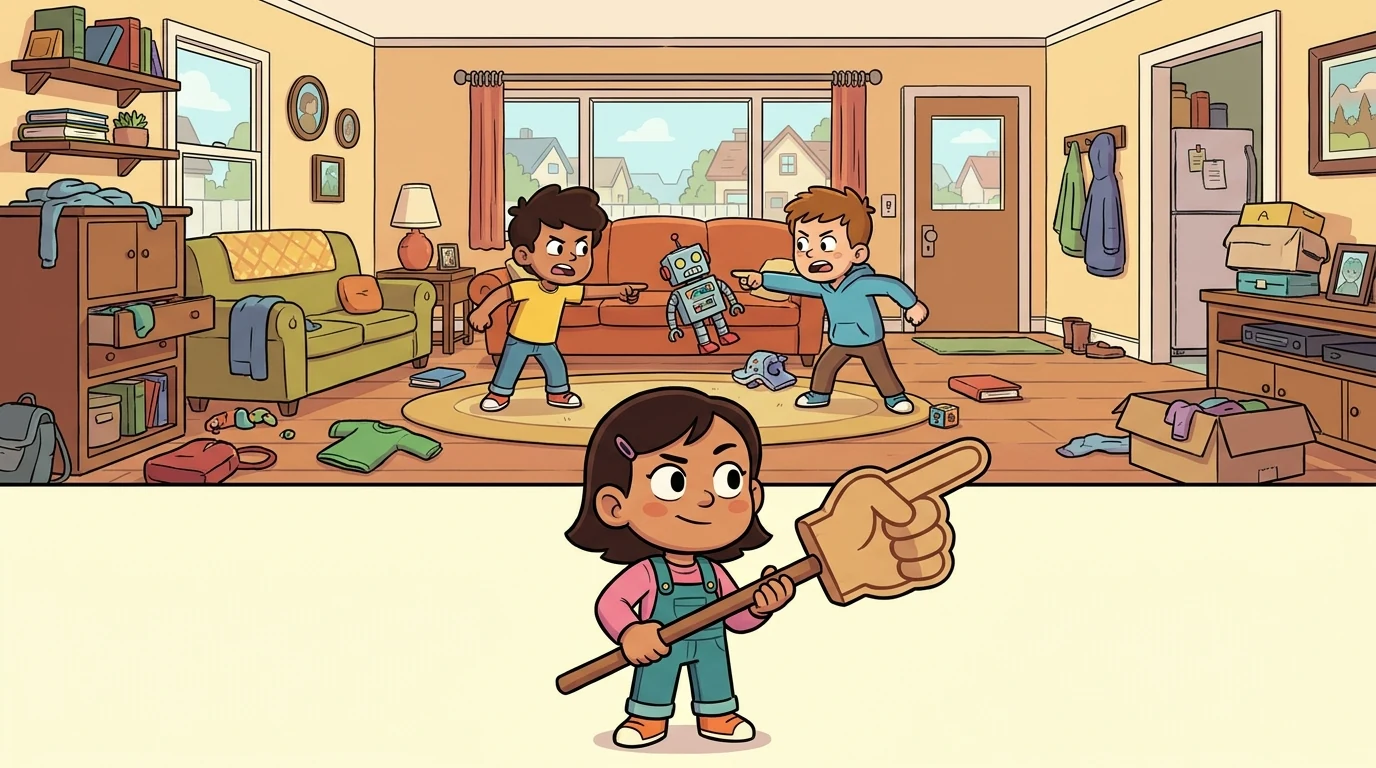
Ana
PRONOUN CLARITY (Advanced) — a pronoun is clear only when the reader, at the moment they reach it, can name its one antecedent WITHOUT backtracking. Advanced clarity handles the harder cases: distance (a pronoun so far from its noun the thread snaps), the 'this'/'that'/'which' that points at a whole clause instead of a noun (broad reference), and the technically-unambiguous pronoun that still makes the reader pause. The fix is not always 'name the noun' — sometimes it is to restructure so the right noun sits closest, or to give the floating 'this' a summary noun to land on.
Chapter — Ana and the “This” That Meant the Whole Paragraph
Ana’s wooden pointing-finger sorted out the easy errors years ago — the it that could mean the dog or the cat, the he caught between two names. The advanced apprentices arrive already able to catch those. What they come to her to learn is the harder truth: a pronoun can point at exactly one noun and still leave the reader lost.
“Grammar has a low bar,” she tells them. “It asks: is there one possible antecedent? But the reader has a higher bar. The reader asks: can I find it instantly, without reading backward? A pronoun can pass the grammar test and fail the reader test — and it’s the reader you’re writing for.”
She learned the gap between technically clear and actually clear from a sentence that was, by the rules, flawless.
A careful apprentice had written: The senator introduced the bill after the committee revised the draft that the governor had criticized in the speech, and she defended it for an hour. Ana pointed at she. Grammatically, only one female noun existed in the sentence — the senator — so she was unambiguous. Legal. Correct. And yet Ana’s own eyes had skidded to a stop, hunting backward through committee, draft, governor, speech to re-find the senator buried at the very front. “It’s not ambiguous,” Ana admitted. “There’s only one answer. But the answer is twelve words upstream, behind three other nouns, and I had to backtrack to get it. A pronoun the reader has to hunt for is a pronoun that failed — even if it’s technically innocent.”
Proofa, passing, added the line Ana still teaches: “Clear isn’t the absence of a second answer. Clear is the reader never having to look for the first one.”
So advanced Ana widened her test from how many antecedents? to how hard is the ONE? Three cases her wooden finger now hunts for:
Distance. The pronoun is so far from its noun the thread has gone slack. The fix often isn’t naming the noun again — it’s restructuring so the noun sits closer: After revising the draft, the senator defended her bill for an hour puts senator next to her.
Broad reference. A this, that, which, or it pointing not at a noun but at a whole preceding idea. The funding was cut, the teachers quit, and enrollment fell, which worried everyone. Which what? There’s no noun for which to grab — it’s pointing at the entire situation. The fix: give it a summary noun to land on — which decline worried everyone, or and this collapse worried everyone.
The technically-fine stumble. One legal antecedent, but a nearer noun of the same type tempts the eye first. Restructure so the intended noun is the nearest candidate.
“Beginners fix ambiguous,” Ana says. “Editors fix effortful. Both pronouns are wrong — one because it points two ways, one because it points one way slowly.”
BOLT-3000, having mastered obvious pronouns, now overuses the broad this — it loves ending a paragraph by gesturing vaguely backward. It handed Ana: “The engine overheated, the coolant leaked, and the warning light failed to trigger. This is what the investigation focused on.”
Ana pointed at This. “Point your finger back,” she said. “At which noun?” BOLT could not answer, because there wasn’t one — this was reaching for the whole three-part mess and hoping the reader would assemble it. “You’ve pointed at a paragraph,” Ana said. “The reader has to stop, scroll their eyes back up, and guess whether you mean the overheating, the leak, the light, or all three at once. That guess is work you should have done.” She showed the fix — pin the floating this to a summary noun that names what it means: “…the warning light failed to trigger. This chain of failures is what the investigation focused on” — or, if only the light mattered, “This last failure is what the investigation focused on.” “See how the noun chooses?” she said. “Chain of failures means all three. Last failure means one. The bare this meant whichever the reader felt like — which is to say, it meant nothing reliable.”
An advanced apprentice raised the objection Ana respects most. “But if I add a noun after every this, my writing gets heavy — this decision, this result, this situation over and over. Isn’t a bare this sometimes cleaner?” Ana nodded, because he’d found the real tension. “Sometimes,” she said. “When what this points at is short, recent, and singular — one noun, one line back — a bare this is fine and lighter. The summary noun is for when this is reaching across several ideas, or across distance. The rule isn’t always name it. It’s name it when the reader would otherwise have to assemble the meaning themselves.” She gave him the diagnostic: “Read up to your this, then cover everything above it and ask — could a stranger tell me in one word what ‘this’ means? If yes, leave it bare. If they’d have to say ‘well, all of that stuff’ — give it its noun.”
He tested a bare this in his own draft. Covered the paragraph above. Tried to name it in one word. Couldn’t — it meant all of that stuff. He gave it a noun. “It wasn’t wrong,” he said slowly. “It just made the reader do the summarizing.” “That’s the advanced error exactly,” said Ana. “Not incorrect. Uncarried. You left a job on the reader’s desk that was yours.”
That night Ana reread a letter she’d written to her grown brothers — the ones who’d taught her, long ago, what a house of vague its and thems costs. Near the end she’d written and this is what I’ve been trying to say. She pointed her wooden finger back. This — meaning what? The whole letter. She smiled, and gave it its noun: and this — that I finally understand what you meant — is what I’ve been trying to say.
“A pronoun points,” she said, retiring the finger to its hook. “The beginner’s job is to make sure it points at one noun. The editor’s job is to make sure the reader lands on that noun without reaching — no backtracking, no assembling, no guessing what a lonely this is waving at. Point clearly. And when this is waving at a whole paragraph, hand it a noun to hold.”
The EditQuest ensemble
Ana is part of EditQuest's distributed-narrative cast. Each character embodies a different curricular primitive; together they teach the full subject.
-
Cappy
Capitalization — makes proper nouns and every sentence's first word stand tall; its defining act is catching a lowercase name or opener
-
Pip
End punctuation — gives each sentence its right ending (. ? !); catches a sentence that stops with the wrong mark or none
-
Splice
Comma splices & run-ons — separates two full sentences a comma wrongly glued together, or breaks a run-on that never stops
-
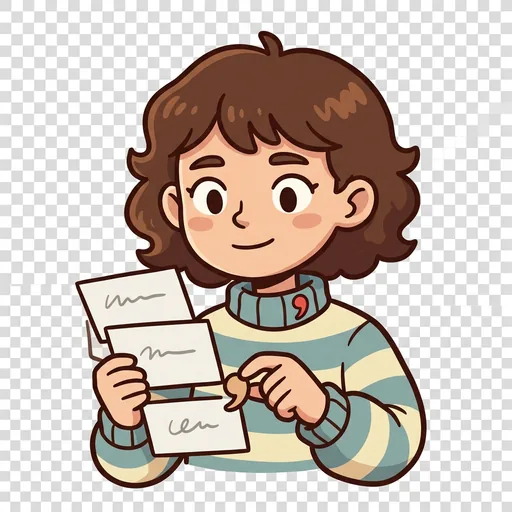
Listy
Commas in a series — sets the pauses between items in a list so the list reads cleanly
-
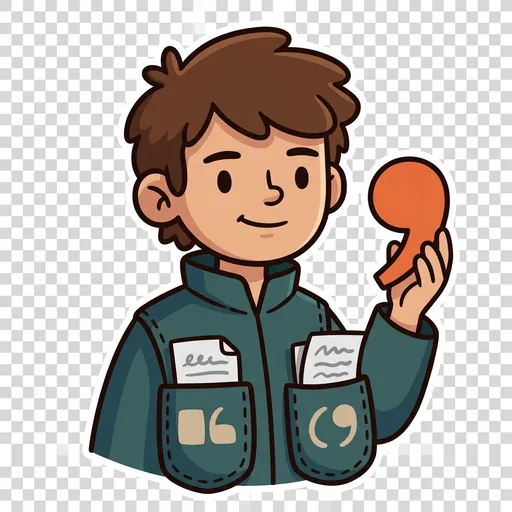
Apostro
Apostrophes — sorts possessives from contractions from plain plurals (its vs it's, dogs vs dog's)
-
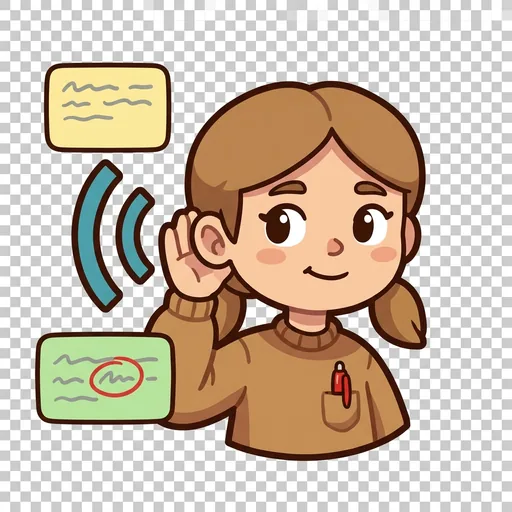
Echo
Homophones / spelling-in-context — hears the words that sound alike and picks the right one (their / there / they're)
-
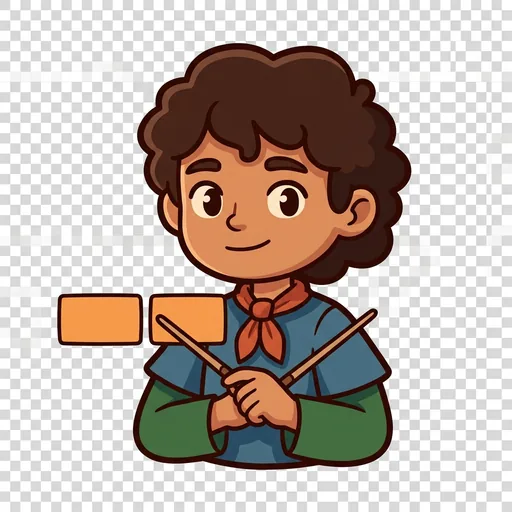
Concord
Subject–verb agreement — matches a verb to its subject's number (one bird sings, two birds sing)
-
Tempo
Verb-tense consistency — keeps a passage in one time; catches a sentence that slips from past to present
-

Trim
Concision — cuts wordiness and redundancy so the sentence says it once, clearly