
Echo
HOMOPHONES — words that sound identical but mean different things and are spelled differently (there/their/they're; your/you're; to/too/two). The ear cannot tell them apart, so you must choose by MEANING: substitute the long form or the definition (they're = they are; you're = you are; too = also/excessively) and keep the spelling whose meaning fits the sentence.
Chapter — Echo and the Words That Sounded Alike
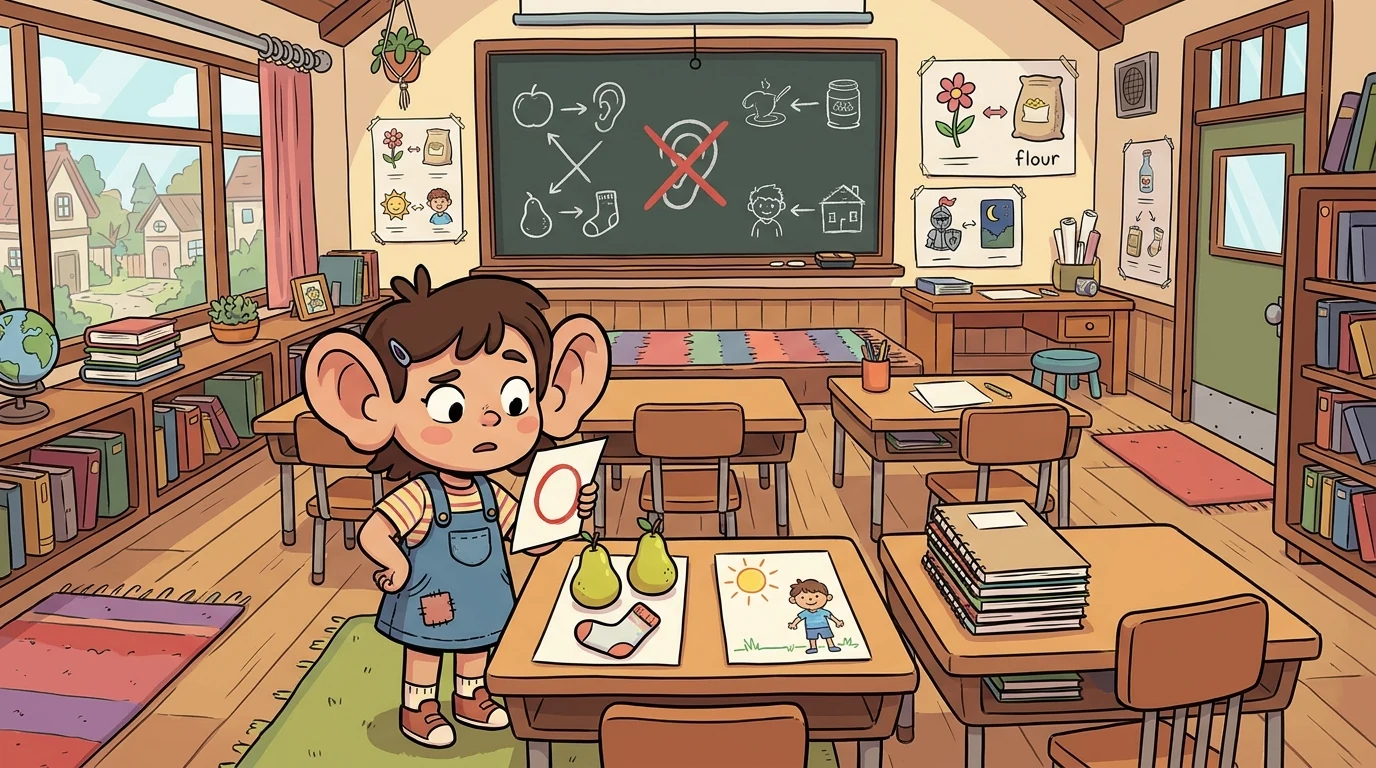
Echo has the sharpest ears in the Red-Pen Guild — sharper even than Pip’s — but she’ll tell you her ears are exactly the reason she can’t trust them.
“Some words are twins,” she says. “There, their, they’re — say them out loud. They sound identical. Your ear can’t tell them apart, and it won’t even try — it’ll just grab whichever one it saw last. So on these words the ear is a liar. You can’t hear which one is right. You have to ask what you mean.”
Echo learned to distrust her ear because it once embarrassed her in front of the whole class.
She’d written a note that said your the best, meaning it as the kindest thing, and it came back with your circled in red and a small sad note: did you mean ‘you are’? She’d read it aloud a hundred times and it sounded perfect — your the best, your the best — because it sounded exactly like the right answer. That was the trap. The wrong word and the right word made the same sound.
Proofa didn’t mark it wrong and walk away. Proofa taught her the one move that turns her lying ears into a tool. “When you write your or you’re,” Proofa said, “unfold it. you’re is a folded-up you are. So read your note as you are the best. Does that fit?” It did — perfectly. “Then it’s the folded one, you’re.” And your — Proofa unfolded nothing, because your means belonging to you. “Test the meaning,” Proofa said. “The sound will lie to you every time. The meaning never does.”
So Echo built her whole craft on refusing to trust the sound. When she meets a homophone she doesn’t listen — she substitutes.
For they’re / their / there, she tries the definitions in turn: they’re unfolds to they are; their means belonging to them; there points to a place (and hides the word here inside it). She reads the sentence with each meaning and keeps the one that makes sense.
For your / you’re: does you are fit? Then you’re. Otherwise your.
For to / too / two: is it a number (two)? Does it mean also or excessively (too)? Otherwise the plain little to.
“The spelling isn’t the hard part,” Echo says. “The hard part is remembering not to listen. Cover your ears and ask your brain: what do I actually mean here?”
BOLT-3000 fails homophones spectacularly, because BOLT chooses words by sound and sound alone. It handed Echo this: “Their going to bring they’re books over there, but you’re teacher said its to late.”
Echo went word by word, substituting meanings, ears firmly plugged.
Their going — try belonging to them going? Nonsense. Try they are going? Yes. So it’s the folded one: They’re.
they’re books — try they are books? Nonsense (the books aren’t being anything). Try belonging to them? Yes: their books.
over there — pointing to a place, with here hidden inside. Correct — leave it.
you’re teacher — try you are teacher? Nonsense. So it means belonging to you: your teacher.
its to late — its here needs… it is? Yes → it’s. And to late — is it a number? no; does it mean excessively? YES: too late.
Corrected: “They’re going to bring their books over there, but your teacher said it’s too late.” Every twin sorted — not by sound, which was useless, but by meaning. “Your ear brought you the sound,” Echo told BOLT. “Only your meaning knows the spelling.”
An apprentice slumped. “There are so many of these. How do I even know when a word HAS a twin?” Echo nodded — it was the real question. “You’ll learn the famous ones fast — there/their/they’re, your/you’re, to/too/two, its/it’s. Those four families cause almost all the trouble. When you write any word from those families, that’s your cue to stop for one heartbeat and substitute the meaning. Not every word. Just the twins. And you already know who the twins are — they’re the ones your teachers keep circling.”
The apprentice laughed. “So I watch for the words I always get wrong.” “Exactly,” said Echo. “Your mistakes are a map. They tell you exactly where to slow down.”
That night Echo found her old note — your the best — pinned to her workshop wall where she’d kept it on purpose, all these years. She read it one more time, ears plugged, testing the meaning. you are the best. She uncapped her pen and, very gently, unfolded the wrong twin into the right one: you’re the best.
She left it on the wall. “Not to remember the mistake,” she told a passing apprentice. “To remember the fix. My ear will lie to me again tomorrow — that’s just what ears do with twins. But now I know not to listen.” She tapped the corrected note. “Same sound, different meaning. Always ask what you mean — the sound can’t help you here.”
The EditQuest ensemble
Echo is part of EditQuest's distributed-narrative cast. Each character embodies a different curricular primitive; together they teach the full subject.
-
Cappy
Capitalization — makes proper nouns and every sentence's first word stand tall; its defining act is catching a lowercase name or opener
-

Pip
End punctuation — gives each sentence its right ending (. ? !); catches a sentence that stops with the wrong mark or none
-
Splice
Comma splices & run-ons — separates two full sentences a comma wrongly glued together, or breaks a run-on that never stops
-
Listy
Commas in a series — sets the pauses between items in a list so the list reads cleanly
-

Apostro
Apostrophes — sorts possessives from contractions from plain plurals (its vs it's, dogs vs dog's)
-
Concord
Subject–verb agreement — matches a verb to its subject's number (one bird sings, two birds sing)
-
Tempo
Verb-tense consistency — keeps a passage in one time; catches a sentence that slips from past to present
-
Ana
Pronoun clarity — makes every pronoun point clearly to the one noun it stands for
-

Trim
Concision — cuts wordiness and redundancy so the sentence says it once, clearly