
Concord
SUBJECT-VERB AGREEMENT — a verb must match the NUMBER of its subject: a singular subject takes a singular verb (one bird sings), a plural subject takes a plural verb (two birds sing). The trap is a word standing between the subject and verb; you must match the verb to the true subject (the one DOING the action), not to the nearest noun.
Chapter — Concord and the Verb That Followed the Wrong Word
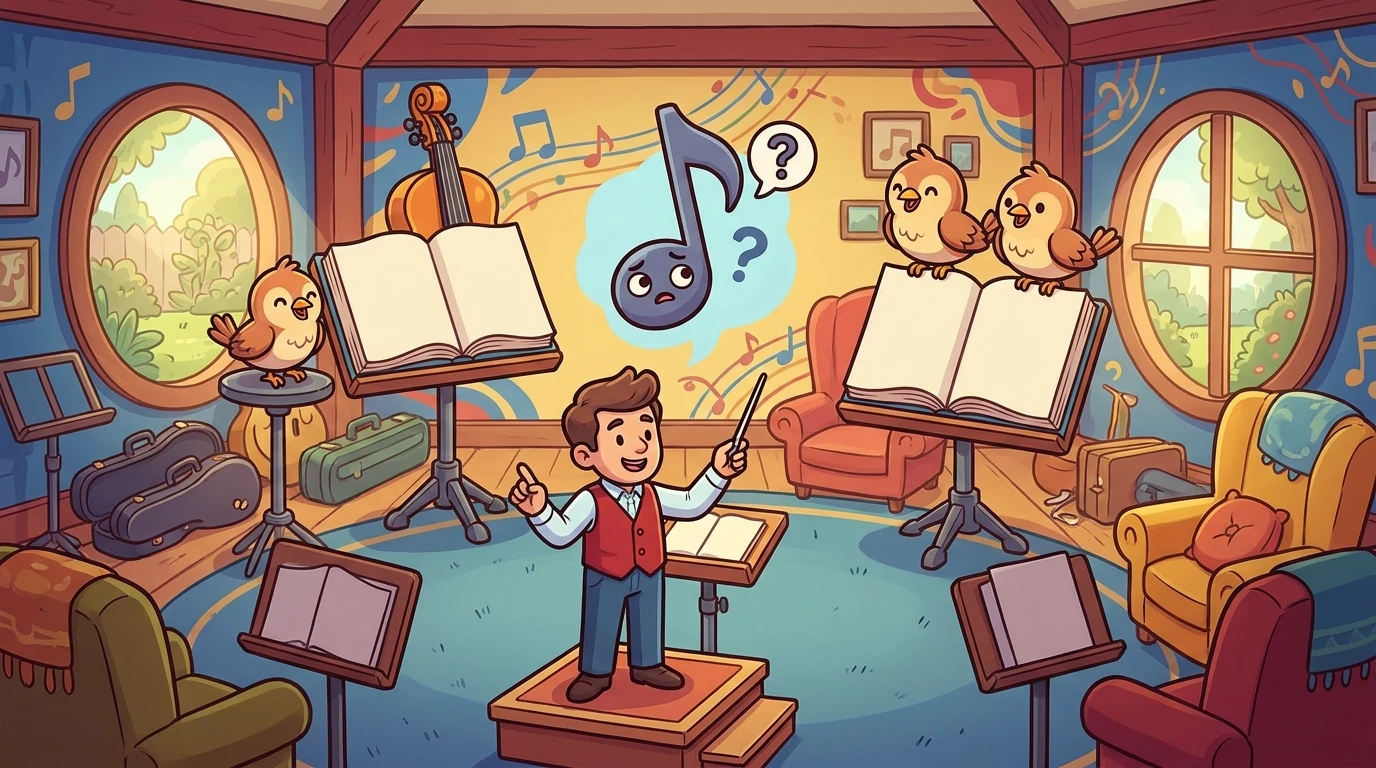
Concord conducts a very small orchestra: a subject and its verb, two instruments that must play in the same key. When they match, the sentence sounds right — you can hear the harmony. When they don’t, something scrapes.
“A verb has to agree with its subject,” Concord says, tapping a little baton. “One thing, singular verb: the bird sings. Many things, plural verb: the birds sing. Simple — until someone drops a distracting word between them, and the verb gets confused and follows the wrong noise. My whole job is finding the real subject and making the verb match that.”
Concord cares about agreement because he once matched himself to the wrong thing entirely.
He was the quiet one in a loud friend group, and he spent a couple of years shaping himself to agree with whoever was standing closest and talking loudest — laughing at jokes he didn’t find funny, wanting things he didn’t want, because the nearest voice was easy to follow. He’d lost track of who he actually was. His life had a subject-verb agreement error: he kept matching his actions to the nearest noise instead of to his true self.
Proofa said something to him once that he only later realized was about grammar. “The loudest word in the room isn’t always your subject,” Proofa said. “Find the one the sentence is actually about. Match yourself to that.” Concord went home and thought about it for a week, and then he stopped agreeing with the nearest voice — and started agreeing with his own.
So he built the test he uses on every wobbly verb: find the true subject — the one doing the action — cross out everything between it and the verb, and then match.
Take the box of crayons ___ on the table. The nearest noun is crayons — plural, loud, distracting. But crayons isn’t the subject; the sentence is about the box. One box. He crosses out of crayons to hear it clean: the box ___ on the table. One box is on the table. The plural crayons was a decoy standing between the subject and its verb.
“Words love to stand between the subject and the verb,” Concord says. “of crayons, along with her friends, in the drawers — all decoys. Cross out the in-between stuff. Find the one doing the action. Count it. Match the verb to it.”
BOLT-3000 always matches the verb to the nearest word, which is exactly the trap. It handed Concord this: “The team of scientists were excited, and the results of the study was surprising.”
Concord found the true subjects and crossed out the decoys.
The team of scientists were excited — the nearest noun is scientists (plural), but the subject is team (one team). Cross out of scientists: the team ___ excited. One team was. BOLT matched to the decoy. Fix: The team of scientists was excited.
the results of the study was surprising — here the nearest noun is study (singular), but the subject is results (plural — more than one result). Cross out of the study: the results ___ surprising. Many results were. Fix: the results of the study were surprising.
Corrected: “The team of scientists was excited, and the results of the study were surprising.” “Both times,” Concord said, “your verb followed the word standing closest. But closest isn’t the subject. Cross out the middle, find who’s really acting, and match to them.”
An apprentice found this genuinely hard. “How do I know which noun is the real subject when there are three of them?” Concord smiled — this was the good question. “Ask who or what is doing the verb. Who is excited? Not the scientists individually — the team, as one. What was surprising? The results. The subject is the one the action truly belongs to. The others are just visiting.”
He gave her a trick. “Read just the subject and the verb, nothing else. Team was. Results were. If that tiny two-word sentence sounds right, you’ve found the pair. If it scrapes, you matched to a decoy.”
That evening Concord tuned his little orchestra one last time and thought about the quiet years when he’d matched himself to the nearest loud voice. He wrote a sentence about it, then checked his own agreement: The opinions of the crowd ___ loud, but my own choice ___ mine. Opinions — plural — were loud. Choice — one — was mine. Subject and verb, matched to the truth and not the noise.
“The verb follows the subject,” he said, tapping his baton once. “Not the nearest word. Not the loudest one. Find who’s really doing the action — cross out everyone standing in the way — and let the verb agree with them.”
The EditQuest ensemble
Concord is part of EditQuest's distributed-narrative cast. Each character embodies a different curricular primitive; together they teach the full subject.
-
Cappy
Capitalization — makes proper nouns and every sentence's first word stand tall; its defining act is catching a lowercase name or opener
-

Pip
End punctuation — gives each sentence its right ending (. ? !); catches a sentence that stops with the wrong mark or none
-

Splice
Comma splices & run-ons — separates two full sentences a comma wrongly glued together, or breaks a run-on that never stops
-

Listy
Commas in a series — sets the pauses between items in a list so the list reads cleanly
-

Apostro
Apostrophes — sorts possessives from contractions from plain plurals (its vs it's, dogs vs dog's)
-

Echo
Homophones / spelling-in-context — hears the words that sound alike and picks the right one (their / there / they're)
-

Tempo
Verb-tense consistency — keeps a passage in one time; catches a sentence that slips from past to present
-

Ana
Pronoun clarity — makes every pronoun point clearly to the one noun it stands for
-

Trim
Concision — cuts wordiness and redundancy so the sentence says it once, clearly