
Listy
COMMAS IN A SERIES — when three or more items appear in a row, a comma goes AFTER each item except the last, separating them so no two blur together (eggs, milk, bread, and cheese). The comma is a small pause that keeps each item its own thing; without it, items collide and the reader mis-groups them.
Chapter — Listy and the Items That Ran Together
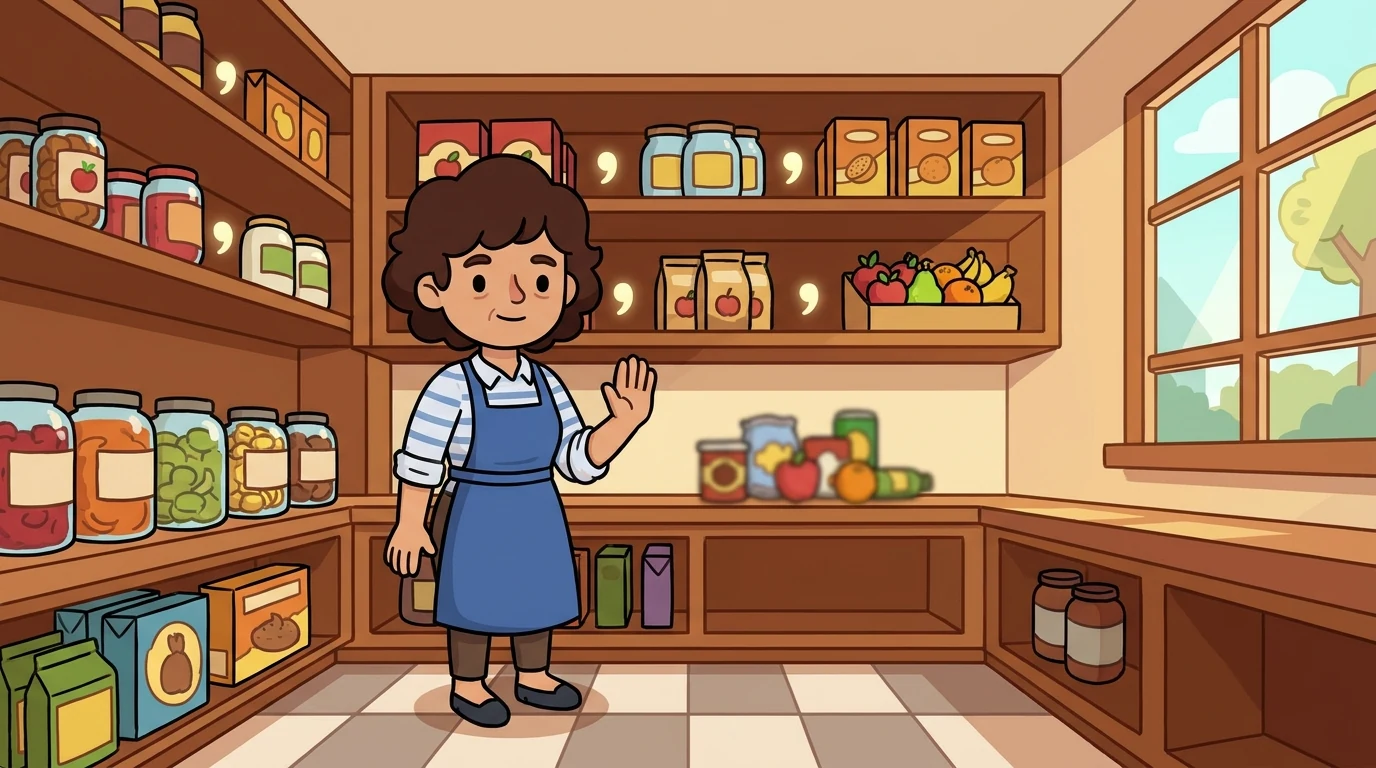
Listy runs the copy-desk pantry, and she is famous for one rule that sounds silly until it saves you: everything in a row needs a little space, or the things start eating each other.
“Watch what happens without the pauses,” she says, and she reads a shopping list out loud with no commas at all: “eggs milk bread cheese.” It comes out as one strange mush-word, eggsmilkbreadcheese, and the apprentices always laugh. “A comma,” Listy says, “is just a tiny breath between items. Three or more things in a row? Put a breath between each one, and the reader can tell where one thing ends and the next begins.”
Listy cares about this because she once lost a whole item in a crowd, and it wasn’t a grocery item — it was her.
She grew up the middle of five, and at big loud family dinners her news, her small daily news, would get swept into the rush of everyone talking at once. School was fine soccer was fine my tooth is loose we need more milk — all of it in one breathless run, and by the end nobody had heard the loose tooth. She’d wanted just one small pause, one comma’s worth of space, so that her item could be its own item and not get blurred into the pile.
Proofa noticed. At the next dinner Proofa said, quietly, “Listy has something — go ahead,” and held up a hand so the table paused. One comma’s worth of silence. And in that little space, Listy said, “my tooth is loose,” and everyone heard it, and it was its own thing. “That pause,” Proofa told her later, “is what a comma does for a list. It gives each item room to be heard.”
So Listy learned the small, exact rule and made it hers. Line up the items. Put a comma after each one except the last. And before that last item, the little word and (or or) with its comma, so the reader knows the list is landing.
eggs, milk, bread, and cheese.
Four items. Three commas doing the separating, plus the one before and. “Count the things,” Listy says, “and you’ll need one comma fewer than the number of things to keep them apart — and then the and tells the reader we’re at the finish.” She likes the last comma before and — the one some people skip — because she has seen too many items collide without it. “Keep it,” she says. “It costs nothing, and it never lets two items hold hands by accident.”
BOLT-3000 writes lists the way it does everything: fast, and jammed together. It handed Listy this line one morning: “I packed a notebook two pencils an eraser and a snack.”
Listy read it aloud and heard the mush. notebook two pencils — wait, was that a notebook that somehow had two pencils, or three separate things? Without pauses, the items were sliding into each other. So she walked the row and set a breath after each item that wasn’t the last: “I packed a notebook, two pencils, an eraser, and a snack.”
“Now count,” she told BOLT. “A notebook. Two pencils. An eraser. A snack. Four items, and every one is standing in its own space. Before you added the commas, your reader couldn’t tell if ‘notebook two pencils’ was one weird thing or two. The pauses don’t slow the reader down — they speed the reader up, because now nobody has to stop and untangle the pile.”
An apprentice pushed back, the way apprentices do. “But it’s obvious what I meant. Why do I need commas if anyone can figure it out?” Listy smiled, because figure it out was the whole problem.
“You’re asking the reader to do work you could do for them,” she said. “Every time two items run together, the reader has to stop, back up, and re-sort. Do it a few times and they’re tired. A comma is you saying, here, I already sorted these for you — each of these is its own thing.” She wrote his run-on list, then the fixed one, side by side. “Read both. Which one lets your eye just glide?” He read them. The commaed one glided. “That’s the gift,” said Listy. “Not correctness. Ease.”
That evening Listy set the dinner table for her big loud family, and she laid the plates out with a little space between each one — not crowded, not touching. Her youngest sibling asked why she always did that. “So every plate is its own plate,” Listy said, “and nobody’s food slides onto anybody else’s.”
Then she grinned, because it was exactly her rule. “Same with words in a row. Give each one a little pause, and every item gets to be its own item.” She set the last fork down. “Count the things. One breath between each — right up until the and that lands the list.”
The EditQuest ensemble
Listy is part of EditQuest's distributed-narrative cast. Each character embodies a different curricular primitive; together they teach the full subject.
-
Cappy
Capitalization — makes proper nouns and every sentence's first word stand tall; its defining act is catching a lowercase name or opener
-

Pip
End punctuation — gives each sentence its right ending (. ? !); catches a sentence that stops with the wrong mark or none
-

Splice
Comma splices & run-ons — separates two full sentences a comma wrongly glued together, or breaks a run-on that never stops
-

Apostro
Apostrophes — sorts possessives from contractions from plain plurals (its vs it's, dogs vs dog's)
-

Echo
Homophones / spelling-in-context — hears the words that sound alike and picks the right one (their / there / they're)
-

Concord
Subject–verb agreement — matches a verb to its subject's number (one bird sings, two birds sing)
-
Tempo
Verb-tense consistency — keeps a passage in one time; catches a sentence that slips from past to present
-

Ana
Pronoun clarity — makes every pronoun point clearly to the one noun it stands for
-

Trim
Concision — cuts wordiness and redundancy so the sentence says it once, clearly