
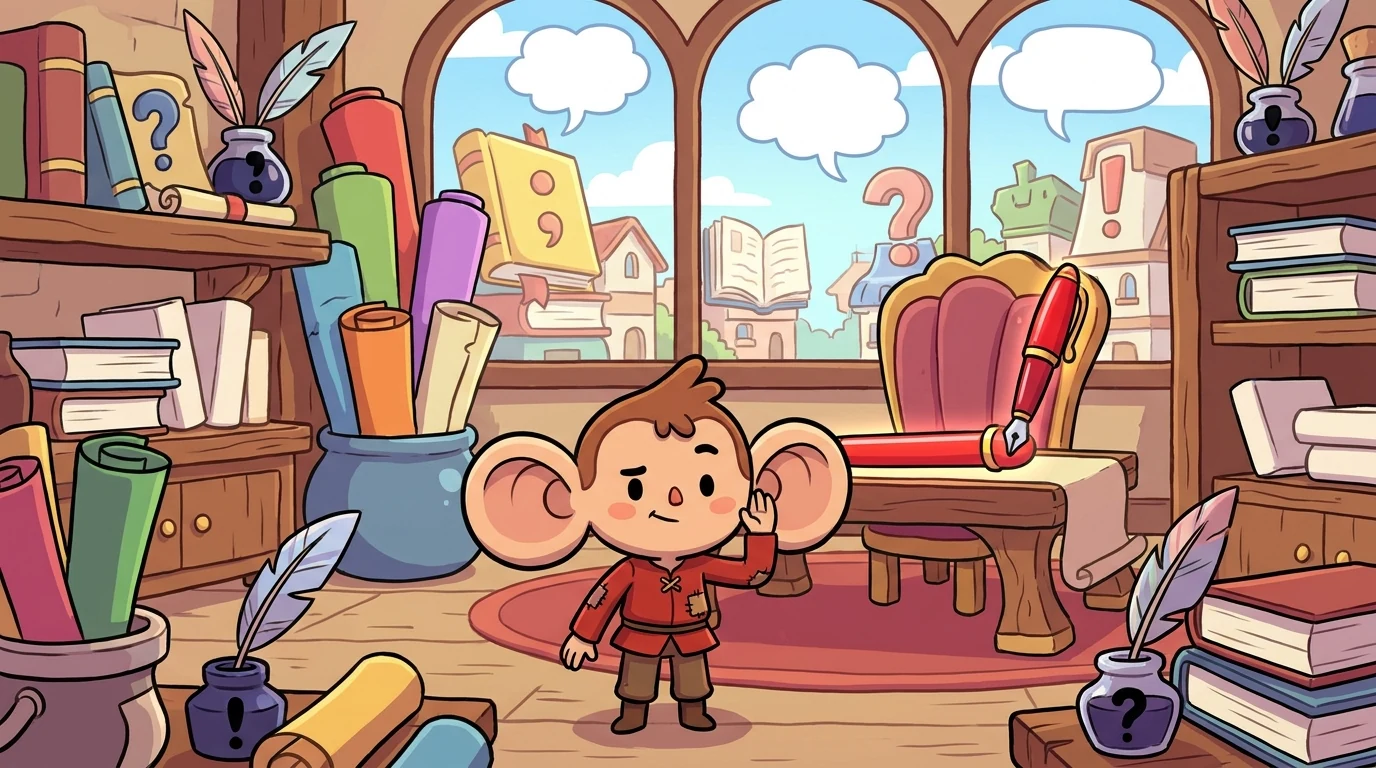
Pip
END PUNCTUATION — every complete sentence closes with exactly one end mark, and the mark matches the sentence's JOB: a statement takes a period, a question takes a question mark, a strong exclamation takes an exclamation point. To check, read the sentence aloud and hear where your voice falls, rises, or jumps — the sound tells you the mark.
Chapter — Pip and the Sentence That Never Landed
Pip has enormous ears, which the other editors tease him about, but the ears are the whole secret. Pip does not look at a sentence to find its ending. Pip listens to it.
“A sentence is going somewhere,” he says, cupping a hand behind one ear. “And how it lands tells you which mark it needs. A statement comes down flat and stops — that’s a period. A question tips up at the end, like it’s reaching for an answer — that’s the question mark. And a shout jumps right off the edge — that’s the exclamation point. You don’t decide the mark. You hear it.”
Pip’s ears got their training the hard way. When he was small he wrote in one long breathless line, no endings at all, because stopping felt like giving up. His pages were single sentences a hundred words long that ran and ran and never let the reader breathe.
A teacher once read one of Pip’s pages aloud to the class, exactly as written — no stops, because there were none — until she turned purple and had to gasp, and the class laughed, and small Pip wanted to disappear.
But Proofa, the editor-in-chief, found him afterward and did not laugh. “Your reader is holding their breath the whole time you write,” Proofa said. “An end mark isn’t the writing stopping. It’s you letting the reader breathe. Give them a place to land.” Pip never forgot it: a period is a gift of air.
So Pip taught himself to listen. He’d read a line aloud and pay attention to what his own voice did at the end.
If his voice came down and settled — the sun is a star — that flat landing was a period.
If his voice tilted up, hopeful, waiting — is the sun a star? — that rising reach was a question mark.
If his voice jumped, startled or thrilled — the sun is enormous! — that leap off the edge was an exclamation point.
“The mark is already in the sentence,” Pip realized. “It’s hiding in the sound. I just have to say it out loud and catch where my voice goes.”
Which is exactly the trick he uses on BOLT-3000’s pages, and BOLT is a menace to end punctuation — it either forgets the mark entirely or slaps an exclamation point on everything, so its calmest facts read like it’s screaming. One day BOLT handed Pip this: “The library closes at six. Did you return the book. That’s amazing.”
Pip read it aloud, listening.
The library closes at six. His voice came down flat and stopped. Period — correct, BOLT got that one.
Did you return the book. His voice tipped up — that was a question, plain as day, reaching for a yes or no — but BOLT had landed it with a period, flat, as if it weren’t asking anything at all. Pip lifted the period into a question mark: Did you return the book?
That’s amazing. Here his voice barely moved — it was a mild, ordinary remark — but BOLT had… actually BOLT had used a period, and Pip almost left it, then heard how flat it truly was and decided the calm period was right after all. Not every sentence is a shout. “Half of editing,” Pip murmured, “is not adding the exclamation point.”
Corrected: “The library closes at six. Did you return the book? That’s amazing.” Three sentences, three landings, each one letting the reader breathe.
An apprentice with a shy voice told Pip she couldn’t do his trick because she hated reading aloud. Pip smiled. “You don’t have to be loud,” he said. “You can whisper it. You can even just mouth it, or hear it in your head. The point isn’t the volume — it’s noticing where the sentence wants to land. Watch.” He mouthed her sentence silently, and at the end his eyebrows went up. “Feel that? My face just asked a question. Your sentence is a question. It needs the mark that lifts.”
She mouthed it herself, felt her own eyebrows rise, and laughed. “It IS a question.” She fixed the period to a question mark. “I didn’t know my face knew grammar.”
“Your face has always known grammar,” said Pip. “So has everyone’s. That’s why reading aloud works — you already know how sentences sound. End punctuation is just writing the sound down.”
That night Pip went back to that hundred-word breathless page from his childhood, the one that made the teacher gasp, and he read it aloud one more time — but slowly, listening for every place his voice wanted to fall or rise or jump. Each time it landed, he set a mark, and each mark was a small door held open for air.
By the end the page had turned into eleven sentences, and a person could read it and breathe eleven times.
“There,” said Pip, capping his pen. “Now nobody turns purple.” He tapped his big ear once. “Every sentence is going somewhere. You just have to hear where it lands — and give the reader a place to breathe when it does.”
The EditQuest ensemble
Pip is part of EditQuest's distributed-narrative cast. Each character embodies a different curricular primitive; together they teach the full subject.
-
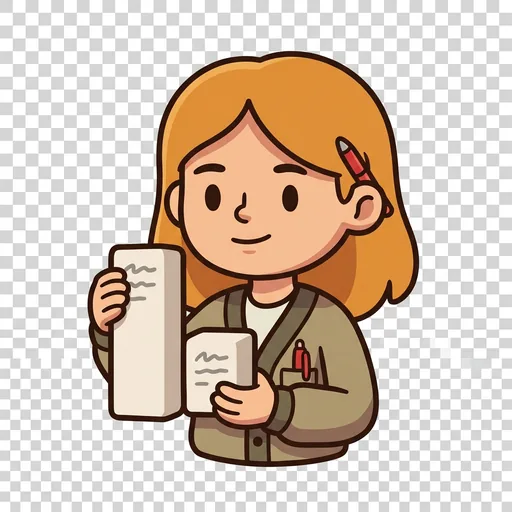
Cappy
Capitalization — makes proper nouns and every sentence's first word stand tall; its defining act is catching a lowercase name or opener
-
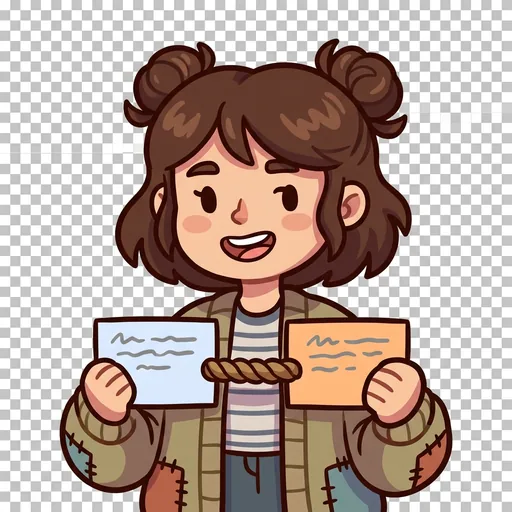
Splice
Comma splices & run-ons — separates two full sentences a comma wrongly glued together, or breaks a run-on that never stops
-
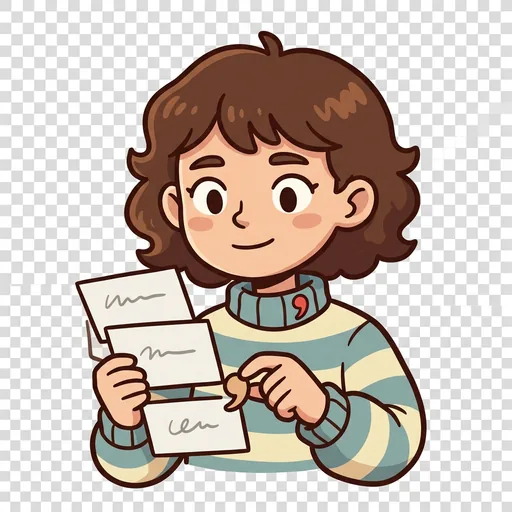
Listy
Commas in a series — sets the pauses between items in a list so the list reads cleanly
-
Apostro
Apostrophes — sorts possessives from contractions from plain plurals (its vs it's, dogs vs dog's)
-
Echo
Homophones / spelling-in-context — hears the words that sound alike and picks the right one (their / there / they're)
-
Concord
Subject–verb agreement — matches a verb to its subject's number (one bird sings, two birds sing)
-
Tempo
Verb-tense consistency — keeps a passage in one time; catches a sentence that slips from past to present
-
Ana
Pronoun clarity — makes every pronoun point clearly to the one noun it stands for
-

Trim
Concision — cuts wordiness and redundancy so the sentence says it once, clearly