
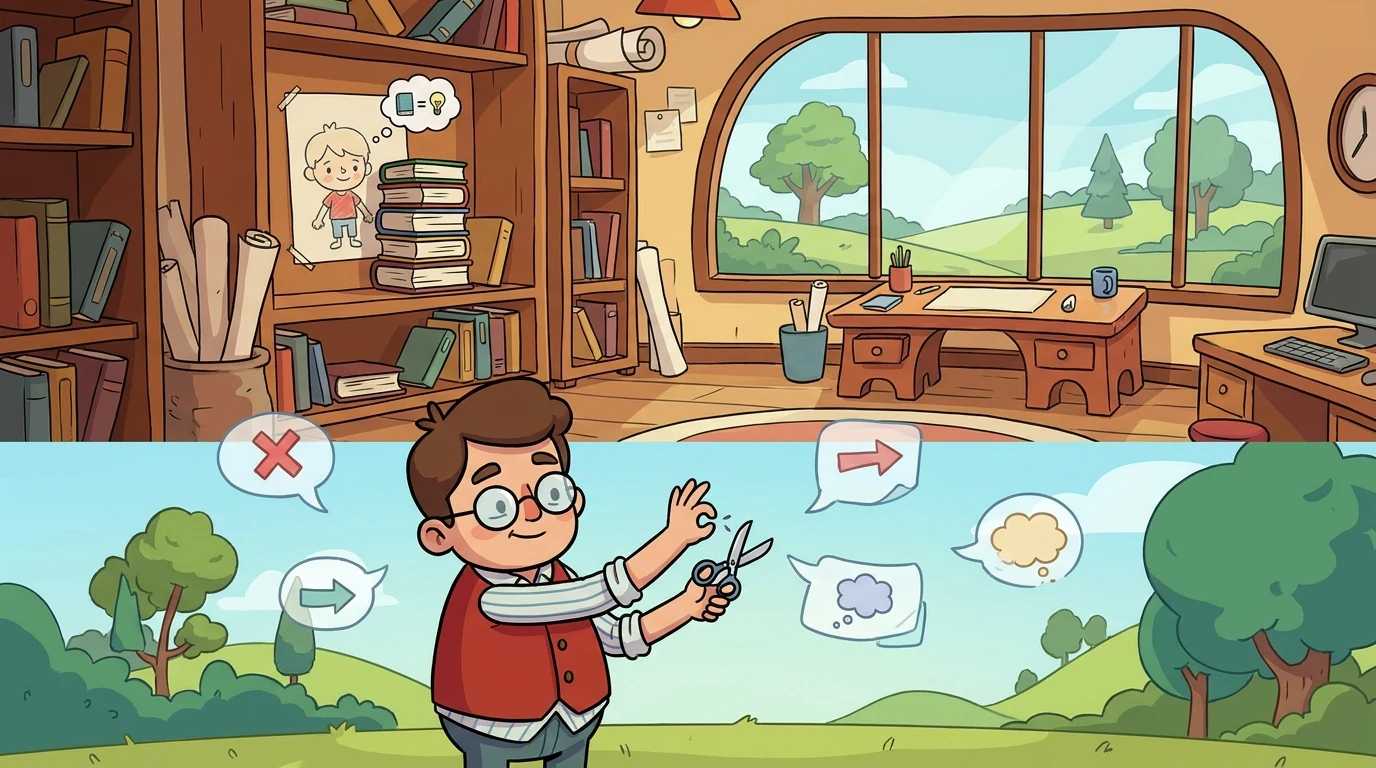
Trim
CONCISION — cut words that do no work: redundancy (each and every, free gift, past history), filler (very, really, actually, in order to), and padding (the fact that, at this point in time). The test: remove the word; if the sentence still means the same thing and reads clearly, the word was dead weight. Cut to reveal the meaning, never to lose it.
Chapter — Trim and the Words That Were Only Taking Up Space
Trim keeps a pair of small silver scissors and a rule that frightens new apprentices: if a word can disappear without changing what the sentence means, the word was never really there.
“Every word should be doing something,” Trim says, snipping the air gently. “Carrying meaning, or making it clearer. But sentences fill up with words that just… sit there. Very. Really. Actually. The fact that. In order to. They look busy. They’re not. Take them out and the sentence means exactly the same thing — only now you can see it. My job isn’t to make writing shorter. It’s to make the meaning visible by clearing away everything standing in front of it.”
Trim didn’t always believe less could be more. As a kid he thought long meant smart.
He’d write due to the fact that in my personal opinion I actually really think when he meant I think, because the long version felt more impressive, more grown-up. But his teacher kept writing wordy in the margin, and Trim took it as an insult — he’d worked hard on all those words. Why cut the words he’d worked on?
Proofa reframed it for him in a single sentence. “You’re not being asked to say less,” Proofa said. “You’re being asked to stop making your reader dig. Every empty word is a shovelful of dirt they have to move to reach your point. Clear the dirt. The point was always the treasure — the words were just burying it.” That landed. Trim stopped defending the dirt and started clearing it.
So Trim built the one test he trusts completely: cross out the word, then read the sentence. Did the meaning change? Did it get unclear? If no — the word was dead weight; leave it out. If yes — the word was working; keep it.
She ran very quickly. Cross out very. She ran quickly. Same meaning, still clear. Very was decoration. Gone. (And if he wants the speed back, he trades two words for one strong one: She sprinted.)
In order to win, they practiced. Cross out in order. To win, they practiced. Identical meaning. Gone.
Each and every student. Each and every mean the same thing here — keep one. Every student.
“The test never lies,” Trim says. “Remove the word. If the sentence survives unchanged, the word was a passenger, not a driver. But — and this matters — if removing it breaks something, it was working. I cut passengers, never drivers.”
BOLT-3000 writes the way young Trim did: long, to sound smart. It handed him this proud sentence: “Due to the fact that it was actually raining very heavily, we made the decision to postpone the game at this point in time.”
Trim got out his scissors and tested each suspect.
Due to the fact that → just Because. (Five words doing one word’s job.) actually → cross it out; meaning unchanged. Gone. very heavily → heavily already means a lot; very is a passenger. Or better, one strong word: pouring. made the decision to → decided to. (Four words → two.) at this point in time → now, or just cut it — the past tense already tells us when.
Corrected: “Because it was pouring, we decided to postpone the game.” From twenty-three words to nine, and — Trim made BOLT check — not one piece of meaning lost. “Everything you were saying is still here,” Trim said. “The rain, the decision, the postponed game. I only cut the words that were burying it. Now the reader sees your point in one glance instead of digging for it.”
An apprentice got nervous. “But what if I cut something important by accident? What if less becomes too little?” Trim set down his scissors — this was the fear that keeps concision honest. “That’s exactly why the test is remove and check, not remove and hope,” he said. “You never cut blind. You cut a word, then you read what’s left and ask: is it still true? Still clear? If cutting made it wrong or confusing, you put the word back — it was a driver. Concision isn’t cutting ruthlessly. It’s cutting the passengers and keeping every driver.” He handed her the scissors. “Cut scared, if you have to. Read after every snip. The meaning will tell you when to stop.”
She tried it on her own wordy paragraph, snipping and re-reading, putting two words back when the meaning wobbled. When she finished, it was half the length and twice as clear, and she looked amazed. “It says more now,” she said. “With fewer words.” “It doesn’t say more,” said Trim, smiling. “It always said this much. You just cleared the dirt off it.”
That night Trim found his old buried-treasure sentence — due to the fact that in my personal opinion I actually really think — pinned above his desk. He read it, got out his scissors, and cut, checking after each snip. When only the drivers were left, two words remained: I think.
“There it is,” he said. “That’s what I meant the whole time. The other words weren’t wrong. They were just standing in front of it.” He capped his scissors with a soft click. “Cross out the word. If the meaning survives, the word was never working — cut it, and let the meaning show.”
The EditQuest ensemble
Trim is part of EditQuest's distributed-narrative cast. Each character embodies a different curricular primitive; together they teach the full subject.
-
Cappy
Capitalization — makes proper nouns and every sentence's first word stand tall; its defining act is catching a lowercase name or opener
-

Pip
End punctuation — gives each sentence its right ending (. ? !); catches a sentence that stops with the wrong mark or none
-

Splice
Comma splices & run-ons — separates two full sentences a comma wrongly glued together, or breaks a run-on that never stops
-
Listy
Commas in a series — sets the pauses between items in a list so the list reads cleanly
-
Apostro
Apostrophes — sorts possessives from contractions from plain plurals (its vs it's, dogs vs dog's)
-

Echo
Homophones / spelling-in-context — hears the words that sound alike and picks the right one (their / there / they're)
-
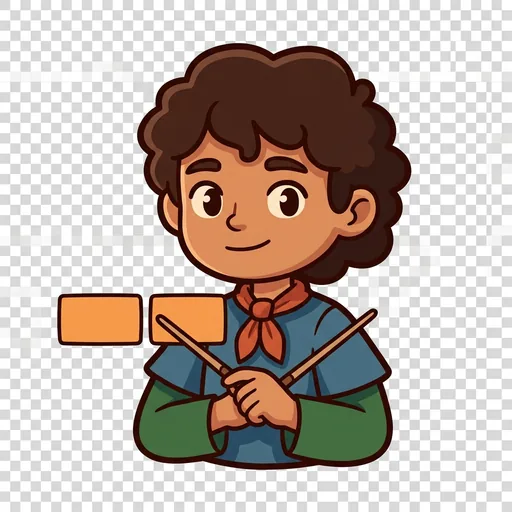
Concord
Subject–verb agreement — matches a verb to its subject's number (one bird sings, two birds sing)
-

Tempo
Verb-tense consistency — keeps a passage in one time; catches a sentence that slips from past to present
-

Ana
Pronoun clarity — makes every pronoun point clearly to the one noun it stands for