
Tempo
VERB-TENSE CONSISTENCY — within a single passage the verbs stay in ONE time frame (all past, or all present) unless the meaning genuinely shifts in time. An unintended jump — a verb slipping from past to present or back for no reason — jars the reader; the fix is to pick the passage's main tense and pull the stray verb into it.
Chapter — Tempo and the Story That Kept Changing Clocks
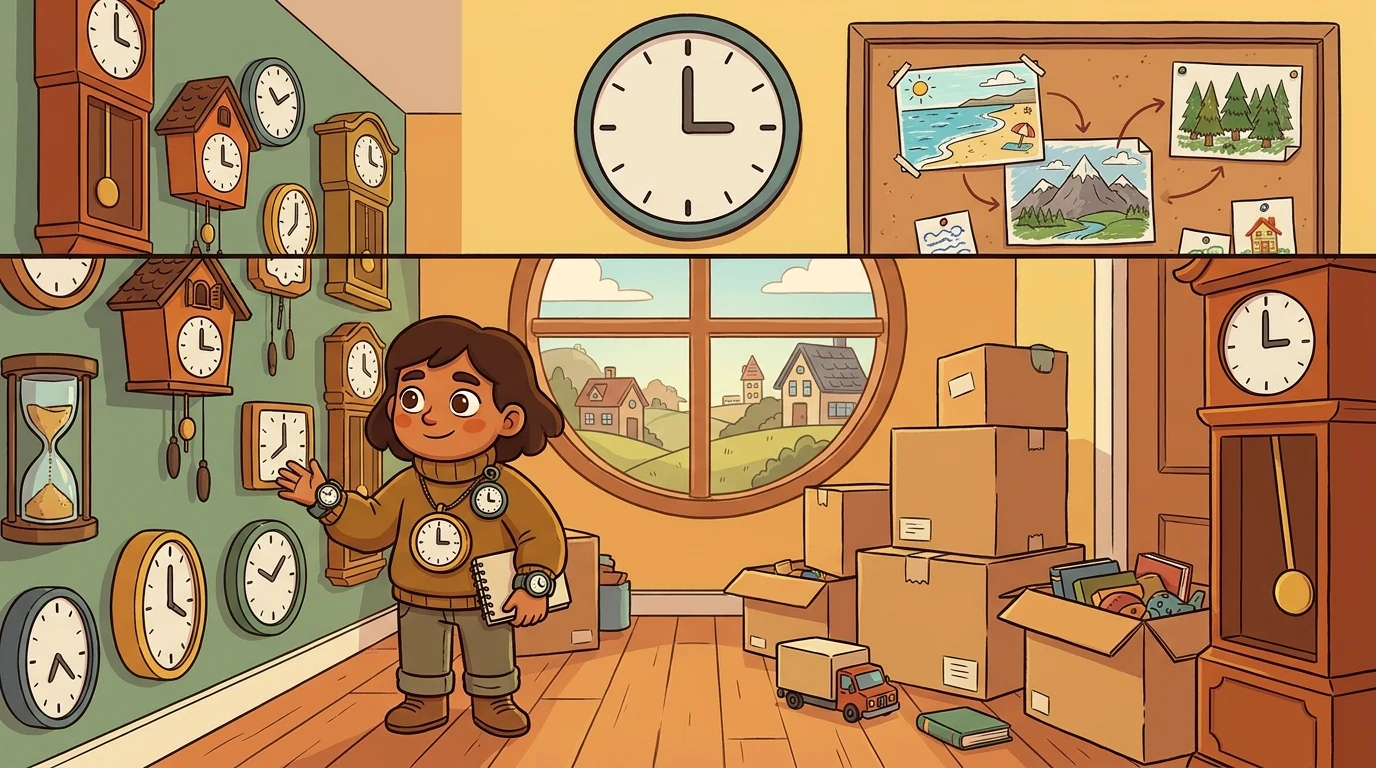
Tempo wears a lot of clocks — one on each wrist, one on a chain, one clipped to her collar — and every single one is set to the same time on purpose. “A story runs on a clock,” she says. “Was, walked, said — that’s the past clock. Is, walks, says — that’s the present clock. You pick one and you stay on it. The reader settles into the time you chose. And then if a verb suddenly jumps to the other clock, for no reason, the reader trips.”
Tempo learned this the year her own story kept changing clocks, and it had nothing to do with grammar at first.
Her family moved a lot, and every few months she’d have to tell a new class who she was, and she noticed she kept switching: I lived by the ocean, I love the mountains, I was the fast one, I’m the quiet one. Past, present, past, present. She was narrating herself on two clocks at once, and new friends couldn’t tell which version was true now. She confused people, and she confused herself.
Proofa read one of her class-intro paragraphs and said, gently, “You keep changing clocks. Pick the time you’re actually in. If you’re telling me who you are now, stay on the present. If you’re telling me a story from before, stay on the past. Let the reader know which clock they’re on.” It was the first time anyone had told Tempo she was allowed to pick one.
So Tempo made her rule: read the passage, hear its main clock, then hunt for the verb that jumped. Almost every tense error is one lonely verb on the wrong clock while all its neighbors agree.
She reads a paragraph and listens for the dominant tense. If nearly every verb is past — walked, saw, opened — then a sudden runs or is stands out like a wristwatch ticking a different second. She pulls it back: runs → ran, is → was. If the passage is present, she does the reverse. “You don’t judge each verb alone,” Tempo says. “You find the clock the passage is keeping, and you match the stray one to it.”
The one exception she guards carefully: sometimes time really does change — I walked to school today; tomorrow I will ride the bus. That’s not an error; that’s meaning. “A real time-change is fine,” she says. “An accidental clock-slip is the bug. Ask: did the time actually move in the story, or did my verb just wander?”
BOLT-3000 slips clocks constantly, because it writes each sentence in whatever tense pops up first. It handed Tempo this: “The knight walked into the cave. He sees a dragon and freezes. Then he lifted his shield.”
Tempo listened for the main clock. walked — past. lifted — past. The passage is a past story. But right in the middle: sees and freezes — present. Two verbs on the wrong clock, surrounded by past.
She pulled them back onto the past clock: sees → saw, freezes → froze. Corrected: “The knight walked into the cave. He saw a dragon and froze. Then he lifted his shield.” One clock, start to finish. “Did the time actually change in your story?” she asked BOLT. “No — it’s all one scene, one moment after another. So it’s all one clock. Your verbs just wandered onto the present for two words. Pull them home.”
An apprentice was worried. “But sometimes I WANT to change tense. How do I know if it’s a mistake or on purpose?” Tempo loved this question, because it’s the whole art. “Ask one thing,” she said. “Did time move in the story? If your character finishes remembering the past and returns to now — that’s a real change; the clock should move. But if you’re describing one continuous scene and a verb just slips to the other clock, that’s an accident.” She wrote two examples. “I remembered the beach; now I miss it — time moved, two clocks, correct. I walked in and there is a mess — same moment, two clocks, slip. Fix the second, keep the first.”
The apprentice studied them. “So it’s not ‘never change tense.’ It’s ‘change it only when time actually changes.’” “Exactly,” said Tempo. “Consistency isn’t a cage. It’s a promise to the reader that the clock only moves when the story does.”
That night Tempo rewrote her old class-introduction — the one that kept flipping clocks — and this time she chose the present, because she was telling people who she is. I’m the quiet one. I love the mountains. I read at lunch. I’m still finding my place, but I like it here. One clock. Present. Steady.
She read it back and it sounded, for the first time, like one person and not two. “Pick your clock,” she said, straightening the watch on her wrist. “Stay on it unless the story’s time really moves — and when a lonely verb jumps for no reason, pull it back home.”
The EditQuest ensemble
Tempo is part of EditQuest's distributed-narrative cast. Each character embodies a different curricular primitive; together they teach the full subject.
-
Cappy
Capitalization — makes proper nouns and every sentence's first word stand tall; its defining act is catching a lowercase name or opener
-

Pip
End punctuation — gives each sentence its right ending (. ? !); catches a sentence that stops with the wrong mark or none
-

Splice
Comma splices & run-ons — separates two full sentences a comma wrongly glued together, or breaks a run-on that never stops
-
Listy
Commas in a series — sets the pauses between items in a list so the list reads cleanly
-

Apostro
Apostrophes — sorts possessives from contractions from plain plurals (its vs it's, dogs vs dog's)
-

Echo
Homophones / spelling-in-context — hears the words that sound alike and picks the right one (their / there / they're)
-

Concord
Subject–verb agreement — matches a verb to its subject's number (one bird sings, two birds sing)
-

Ana
Pronoun clarity — makes every pronoun point clearly to the one noun it stands for
-

Trim
Concision — cuts wordiness and redundancy so the sentence says it once, clearly