
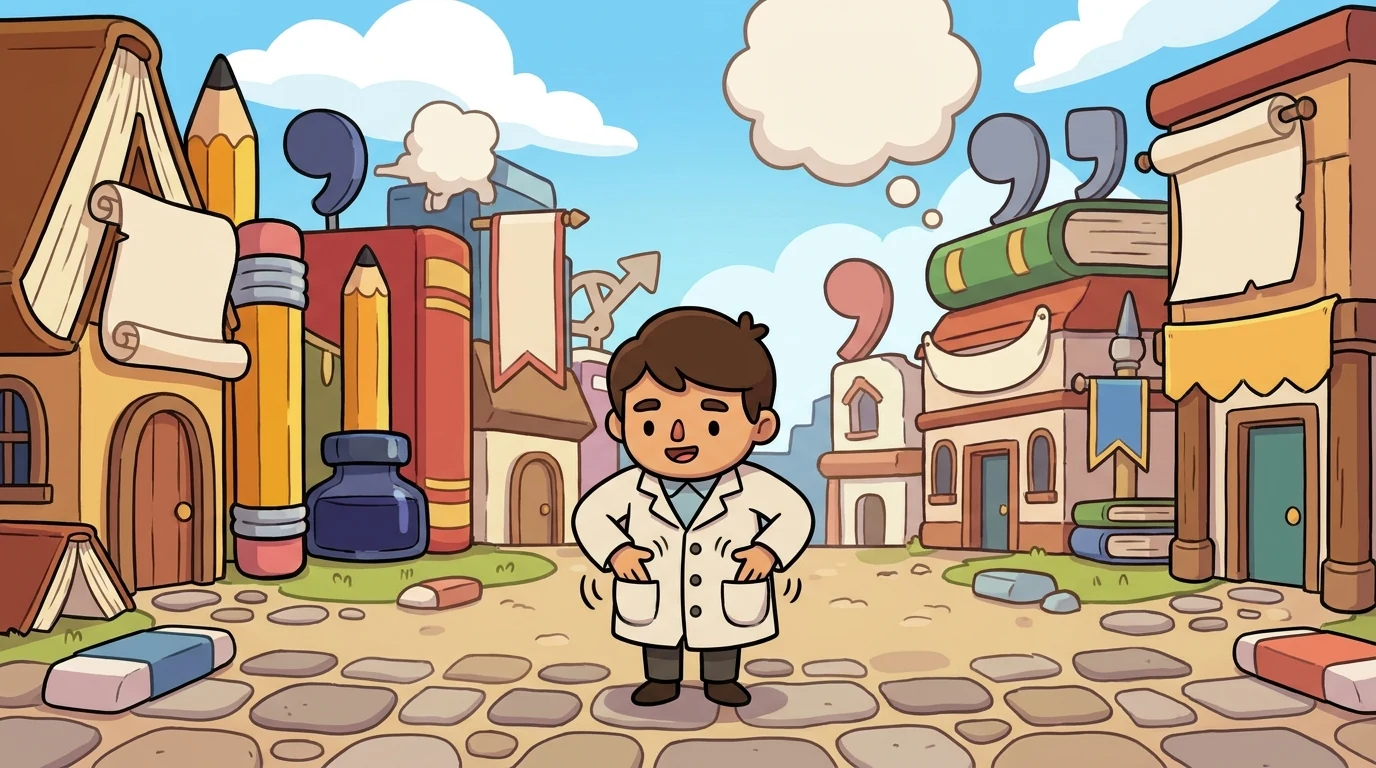
Apostro
APOSTROPHES (Advanced) — beyond it's/its and stray-plural apostrophes lie the cases that trip careful writers: possessives of plural nouns (the dogs' bowls vs the dog's bowl — the apostrophe sits after the s when the owner is plural), singular nouns already ending in s (the class's rule), possessives of names ending in s, and the difference between a possessive and a descriptive plural (a teachers meeting vs a teachers' meeting). The two questions still govern — missing letter, or owning? — but the advanced reader must also ask: is the owner ONE or MANY, and where does the apostrophe fall for each?
Chapter — Apostro and the Bowl That Belonged to Everyone and No One
Apostro’s two-pocket coat settled the beginner’s war years ago: missing letter, or owning; and if neither, leave the plural alone. But the advanced apprentices bring him the sentence the two questions almost solve — the one where the apostrophe clearly marks ownership, so the pocket is right, but the mark still lands in the wrong place.
“The two questions tell you whether an apostrophe belongs,” he says, patting the pockets. “They don’t always tell you where. Because ownership has a second question hiding inside it — one owner, or many? — and that answer moves the mark.”
He learned this from a bowl.
An apprentice had written a sign for the guild kennel: the dogs’ bowl. Apostro read it and paused, because it was correct only if it was true. “How many dogs?” he asked. “Six.” “One bowl, or six?” “Six bowls.” “Then your mark is placed right — dogs’, apostrophe after the s, means the bowls belong to the dogs, plural. Six owners.” He drew the other version beside it. “But if it were the dog’s bowl — apostrophe before the s — you’d be telling the reader there’s one dog, with one bowl. Same word, same pocket, mark moved two letters — and now the world it describes has five fewer dogs in it.”
The apprentice stared. “So the apostrophe’s place is a fact about how many owners there are.” “Exactly,” said Apostro. “Missing-letter-or-owning gets you into the right pocket. One-or-many tells you where in the pocket to stand.”
So advanced Apostro added the placement rule beneath his two questions, and it is shorter than apprentices fear: find the owner-word as it exists BEFORE the apostrophe, then add the mark. If the owner already ends in s because it’s plural — dogs, teachers, girls — the apostrophe goes after that s: dogs’, teachers’, girls’. If the owner is singular — dog, teacher, girl — you add apostrophe-s: dog’s, teacher’s, girl’s, even when it makes a second s.
The tricky singular: a name or noun already ending in s — the class, James. The owner is one (one class, one James), so it still takes apostrophe-s: the class’s rule, James’s coat. “One owner always gets apostrophe-s,” Apostro says, “even if the word already ended in s and now you’ve got two of them. Class’s looks strange and is right. The strangeness is just your eye not being used to the truth.”
And the trap that fools everyone: the descriptive plural that only looks possessive. A teachers meeting — is it a meeting the teachers own, or a meeting of the type ‘teachers’? Often it’s descriptive — a meeting for teachers — and takes no apostrophe at all. “Before you place the mark,” he says, “ask whether it’s ownership or just description. A sports car isn’t a car the sports own.”
BOLT-3000 handed him a flyer riddled with the advanced error — right pocket, wrong place: “The girl’s soccer team won the parents’ award at the players banquet, and the coachs whistle went missing.”
Apostro walked it, asking one or many at each.
The girl’s soccer team — how many girls? A whole team. Many owners → the mark belongs after the s: the girls’ soccer team. BOLT had it as one girl’s team.
the parents’ award — many parents, mark after the s. Correct — BOLT got one right.
the players banquet — ownership, or description? A banquet for players, descriptive. No apostrophe needed: the players banquet. (Or players’ if you truly mean the players own it — but read as description here.)
the coachs whistle — one coach owns one whistle. Singular owner → apostrophe-s. And coachs isn’t even a word; the plural of coach is coaches. Here it’s singular possessive: the coach’s whistle.
“Every one of your marks was in the ownership pocket,” Apostro told BOLT. “You knew whether. You just didn’t ask how many owners — so you kept putting one dog where there were six.”
An advanced apprentice found the honest hard edge. “But sometimes I genuinely don’t know if the writer means one owner or many. The student’s projects — one student with many projects, or many students each with a project?” Apostro nodded slowly, because this was the deep truth. “Then the apostrophe isn’t a spelling question anymore,” he said. “It’s a fact question. The mark can’t tell you how many students there are — only the writer knows the world. Your job as the editor is to ask, not guess. If you place student’s, you’ve claimed there’s one. If students’, you’ve claimed there are many. You can’t dodge it — even leaving it out makes a claim. So find out the fact, then let the mark tell the truth about it.” He tapped the flyer. “An apostrophe is small, but it counts things. Get the count wrong and you’ve quietly rewritten the world.”
The apprentice went and asked the writer — how many students? — got the answer, and placed the mark that matched reality. “It felt weird to ask about a comma-sized thing,” she said. “It’s not comma-sized,” said Apostro. “It’s the difference between one and many. That’s never small.”
That night Apostro passed the kennel sign again — the dogs’ bowls — and counted: six dogs, six bowls, mark after the s. True. He nodded and moved on.
“Two questions get you the pocket,” he said, patting his coat. “Missing a letter, or owning a thing. But when it’s owning, ask the third, quiet question — one owner or many? — because that’s where the mark actually stands. Get it wrong and the sentence is still grammatical and still a lie: one dog where there were six, or six where there was one. The apostrophe doesn’t just mark ownership. It counts the owners. Count them right.”
The EditQuest ensemble
Apostro is part of EditQuest's distributed-narrative cast. Each character embodies a different curricular primitive; together they teach the full subject.
-
Cappy
Capitalization — makes proper nouns and every sentence's first word stand tall; its defining act is catching a lowercase name or opener
-

Pip
End punctuation — gives each sentence its right ending (. ? !); catches a sentence that stops with the wrong mark or none
-

Splice
Comma splices & run-ons — separates two full sentences a comma wrongly glued together, or breaks a run-on that never stops
-
Listy
Commas in a series — sets the pauses between items in a list so the list reads cleanly
-

Echo
Homophones / spelling-in-context — hears the words that sound alike and picks the right one (their / there / they're)
-
Concord
Subject–verb agreement — matches a verb to its subject's number (one bird sings, two birds sing)
-
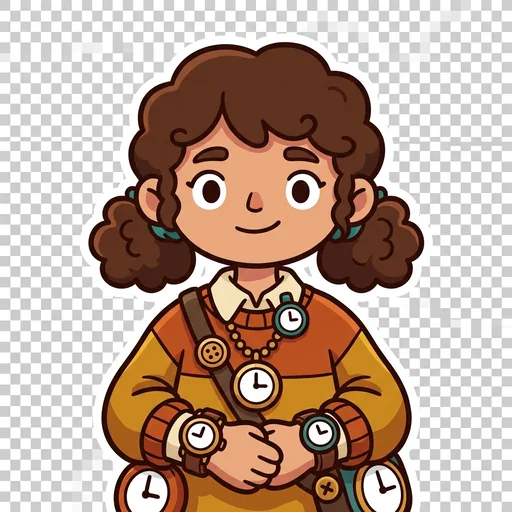
Tempo
Verb-tense consistency — keeps a passage in one time; catches a sentence that slips from past to present
-
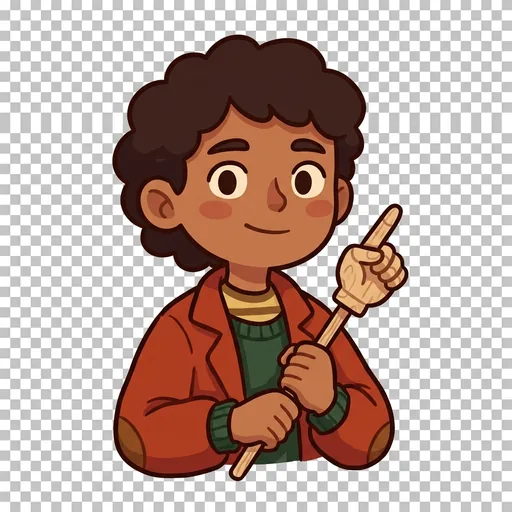
Ana
Pronoun clarity — makes every pronoun point clearly to the one noun it stands for
-

Trim
Concision — cuts wordiness and redundancy so the sentence says it once, clearly