
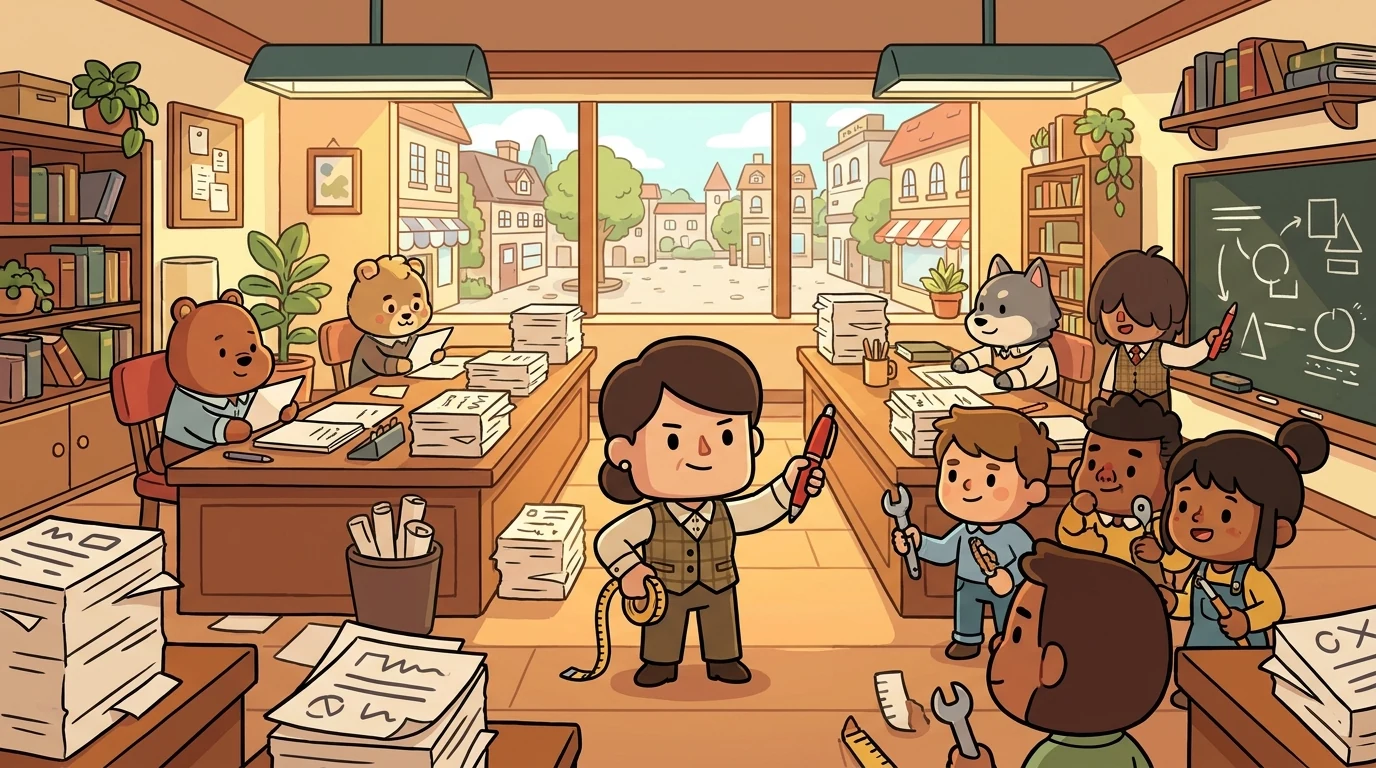
Cappy
CAPITALIZATION (Advanced) — the start-or-name rule holds, but the advanced cases turn on a subtler question: is this word being used as a SPECIFIC NAME right now, or as a general category? The same word flips: 'Mom' (used as her name) vs 'my mom' (a category); 'the North' (a specific region) vs 'drive north' (a direction); 'President Lee' vs 'a president'; 'French' (from a proper noun) vs 'french fries' (drifted into common use). Title case in headings adds a placement rule. The error is usually not ignorance of names but capitalizing a word for feeling IMPORTANT rather than for being a name.
Chapter — Cappy and the Word That Was a Name on Tuesday
Cappy’s tape measure sorted the beginners’ capitals long ago — the sentence-start that stood, the proud Pizza that sat back down. What the advanced apprentices bring her is stranger: a single word that is a name in one line and an ordinary word in the next, and demands a capital in exactly one of them.
“Beginners think capitalization is about which words are names,” she says. “It isn’t. It’s about which words are being used as names right now. The same letters can be a somebody on Tuesday and a nobody on Wednesday. You don’t capitalize the word. You capitalize the job the word is doing in this sentence.”
The word that taught her was Mom.
An apprentice had written two lines: I asked Mom for help and I asked my Mom for help, and capitalized Mom in both. Cappy tested each with her question — not is this a name? but is it being USED as a name here? “I asked Mom — you’re using Mom the way you’d use Sarah. It’s standing in for her actual name. It’s a name right now. It stands.” Then the second: “I asked my mom — here mom is a category, like my teacher or my friend. The my gives it away; you don’t say my Sarah. It sits down.” Same three letters, two jobs, one capital.
Proofa, nearby, gave it the rule Cappy now opens the advanced class with: “A capital isn’t a property a word owns. It’s a property a word borrows for the sentence it’s in — and gives back the moment its job changes.”
So advanced Cappy widened her tape measure to the words that flip:
Directions vs regions. Drive north for an hour — a direction, a category, lowercase. She grew up in the North — a specific named region, capital. Ask: a way to point, or a place with a name?
Titles. President Lee spoke — the title is fused to the name, part of it, capital. A president spoke, or Lee, the president, spoke — now it’s a category or a description, lowercase.
Proper adjectives that drifted. French cooking keeps its capital because it’s straight from France. But french fries and roman numerals drifted so far into everyday use they lowercased over time. “Language wears words smooth,” Cappy says. “Some proper adjectives keep the capital; some have worn down to common. When in doubt, ask whether people still hear the place in it.”
Headings. In a title you stand up the important words regardless — but that’s a placement rule for headings, not a name rule. “Don’t let heading-style leak into your sentences,” she warns. “A Heading Can Look Like This, but a sentence cannot.”
BOLT-3000 capitalizes for importance — its oldest, deepest habit — and handed Cappy: “We drove North to visit Grandma, then my Uncle took us to see the President speak about French History.”
Cappy walked it, asking used as a name here? at each capital and lowercase.
drove North — a direction, not the named region. Category. Sit: north.
visit Grandma — used as her name, like visit Rosa. Stands. Correct.
my Uncle — the my marks a category, like my teacher. Sit: uncle.
the President speak — no name attached; it’s a president, a category here. Sit: president.
French History — French is from France, keeps its capital. But History — the subject, a category, not a titled course-name. Sit: history.
Corrected: “We drove north to visit Grandma, then my uncle took us to see the president speak about French history.” “Every capital you added,” Cappy told BOLT, “you added because the word felt big — North, Uncle, President, History all feel important. But important isn’t the test. Being used as a name is. Grandma passed because you used her as a name. The rest just felt grand.”
An advanced apprentice found the genuinely uncertain edge. “But ‘the North’ — how do I know if it’s the named region or just a direction? Sometimes it’s really both.” Cappy set down her tape measure, because this was the honest hard case. “You read for whether it names a specific place people would recognize as a place,” she said. “The North won the war — a specific region, a side, a place with an identity. Capital. The wind came from the north — just the compass direction the wind blew from. Lowercase. When it’s truly ambiguous, the rest of the sentence usually tells you which the writer means — and if it doesn’t, that’s a clarity problem bigger than the capital.” She gave the diagnostic: “Try replacing it with a plain compass direction. The wind came from the north still works as pure direction — lowercase. The [direction] won the war is nonsense — so it’s the named region, capital. Let the meaning, not the grandeur, stand the word up.”
The apprentice tested a West she’d capitalized. Replaced it with the direction: we headed [direction]. Worked fine as pure direction. She sat it down. “It just felt like a Place,” she said. “Feelings capitalize everything,” said Cappy. “Names earn it.”
That night Cappy reread her childhood shouting-page one more time — and found, near the bottom, a line she’d written after she’d learned the beginner’s rule but before she’d learned this one: I love the Ocean and the Summer and my Mom. She tested each by its job. ocean — a category, no name. Down. summer — a season, category. Down. Mom — used as her name. It stood, alone, at the end.
“The start-or-name rule never changed,” she said, capping her pen with its small square click. “What changed is how carefully I ask. The same word can be a name today and a nobody tomorrow — Mom stands, my mom sits, and only the sentence it’s in can tell you which. Don’t capitalize what’s important. Capitalize what’s being named — right here, right now.”
The EditQuest ensemble
Cappy is part of EditQuest's distributed-narrative cast. Each character embodies a different curricular primitive; together they teach the full subject.
-

Pip
End punctuation — gives each sentence its right ending (. ? !); catches a sentence that stops with the wrong mark or none
-

Splice
Comma splices & run-ons — separates two full sentences a comma wrongly glued together, or breaks a run-on that never stops
-
Listy
Commas in a series — sets the pauses between items in a list so the list reads cleanly
-

Apostro
Apostrophes — sorts possessives from contractions from plain plurals (its vs it's, dogs vs dog's)
-

Echo
Homophones / spelling-in-context — hears the words that sound alike and picks the right one (their / there / they're)
-
Concord
Subject–verb agreement — matches a verb to its subject's number (one bird sings, two birds sing)
-
Tempo
Verb-tense consistency — keeps a passage in one time; catches a sentence that slips from past to present
-
Ana
Pronoun clarity — makes every pronoun point clearly to the one noun it stands for
-

Trim
Concision — cuts wordiness and redundancy so the sentence says it once, clearly