
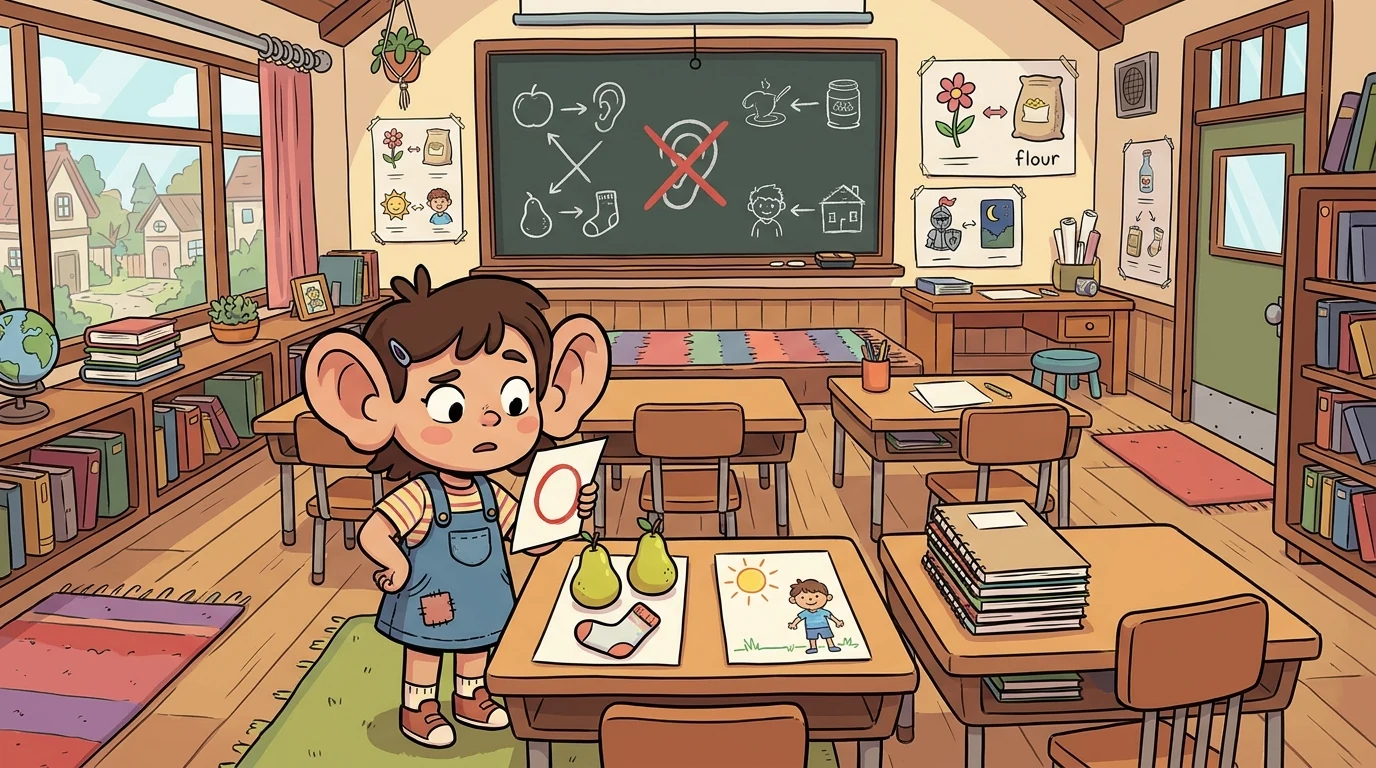
Echo
HOMOPHONES (Advanced) — past the famous four families lie the harder sound-alikes: affect/effect, then/than, lose/loose, whose/who's, accept/except, led/lead, past/passed, and the mishearing 'could of' for 'could've.' These aren't always perfect homophones — some are near-sounds the ear still blurs. The advanced move keeps the same engine (choose by MEANING, not sound) but adds targeted substitutions: 'affect' is usually the verb (to influence), 'effect' the noun (a result); 'than' compares, 'then' is time; 'could of' is never right — it's a misheard 'could have.'
Chapter — Echo and the Word That Was Never a Word
Echo’s plugged-ears trick — substitute the meaning, don’t trust the sound — retired the famous homophones long ago: they’re/their/there, your/you’re, to/too/two. The advanced apprentices arrive with those beaten. What they bring her is subtler and, she thinks, more dangerous: sound-alikes that aren’t quite twins, and one phantom that isn’t a real phrase at all.
“The famous four are twins,” she says. “Identical sound, different meaning — bad enough. But now you meet the near-twins — affect and effect, than and then, lose and loose — where the ear blurs a small difference into none. And worst of all, you meet a word your ear invented — a sound so convincing you wrote it down as a word, and it never existed.”
The phantom that taught her was could of.
An apprentice had written I could of tried harder, and swore he’d heard it that way his whole life. Echo didn’t correct the spelling — she attacked the meaning. “What does could of mean?” she asked. “Of what? Of is a joining word — a cup of tea, the top of the hill. What is could joining to with of?” The apprentice opened his mouth and found nothing. “It means… ‘could have’?” “Say could have fast,” Echo said. Could’ve. “There it is. Could’ve — the folded-up could have — sounds exactly like could of. Your ear heard the fold and unfolded it into the wrong word. Could of was never a phrase. It’s a mishearing that dressed up as spelling.”
Proofa’s old line came back to her, upgraded: “The ear doesn’t just confuse real words. It manufactures fake ones. Test the meaning and the fakes have nothing to say.”
So advanced Echo widened her substitution kit to the near-twins and the phantoms:
affect / effect — usually a verb/noun split. Affect = to influence (a verb): the rain affected the game. Effect = a result (a noun): the rain had an effect. Test: can you put the or an in front? Then it’s the noun, effect. Is it an action being done? Then the verb, affect.
than / then — than compares (taller than me); then is time or sequence (first this, then that). Test: is it weighing two things against each other? Than. Is it next? Then.
lose / loose — not even a true homophone, but the ear blurs it. Lose (one o) = to misplace or not win; loose (two o’s) = not tight. Test the meaning; the spelling follows.
could’ve / should’ve / would’ve — always the folded have, never of. “Of is a phantom here,” Echo says. “The moment you’re tempted to write of after could, should, would — unfold it to have and the phantom vanishes.”
BOLT-3000, choosing by sound as always, handed Echo: “The new rule effected everyone, and it was worse then before — I should of studied the affects, but their to loose with the details and I could of lost the whole point.”
Echo went through it with the meaning, ears plugged.
effected everyone — an action being done to everyone (influenced). Verb → affected.
worse then before — comparing worse-vs-before. Comparison → than.
should of studied — phantom. Unfold: should have. → should’ve (or should have).
the affects — has the in front → noun → effects.
their to loose — their (owning)? No — try they are: they’re. to loose — means excessively, so too; and loose here should be… too careless, meaning not-tight-with-details, so loose is actually right in meaning here — careless. Kept, but to → too. → they’re too loose.
could of lost — phantom → could have lost.
Corrected: “The new rule affected everyone, and it was worse than before — I should have studied the effects, but they’re too loose with the details and I could have lost the whole point.” “Your ear,” Echo told BOLT, “gave you effected, then, should of, affects, their, to, could of — seven confident sounds, and only meaning could tell you six were wrong and one phantom was never a word.”
An advanced apprentice slumped. “There are so many of these now. I can’t test every word — I’d never finish a sentence.” Echo nodded, because he’d found the real limit. “You don’t test every word,” she said. “You test the repeat offenders — the near-twins and phantoms that are known to fool the ear. Affect/effect, than/then, lose/loose, could’ve. Those, plus the famous four, are a short list — maybe a dozen families that cause almost every homophone error in the language. You’re not scanning every word for a twin. You’re watching for the dozen faces you already know are trouble, and slowing down only for them.” She tapped his draft. “And your own mistakes narrow it further. The words you get wrong are your personal short-list. Learn your dozen. Test only those. Trust the rest.”
He circled the three near-twins he always missed. “So I don’t have to be paranoid about every word.” “Paranoia isn’t editing,” said Echo. “Targeted suspicion is. Know which words lie to you, and check only the liars.”
That night Echo added a new card to her wall, beneath her old you’re the best note. This one read, in an apprentice’s hand, I could of been a great editor. She left it up — not the mistake, the lesson — and beside it pinned the fix: I could’ve been a great editor. Then, smiling, she crossed out could’ve been and wrote am.
“The ear lies with twins, blurs the near-twins, and invents words that were never real,” she said. “Meaning catches all three. Plug your ears, know your dozen liars, and ask what you actually mean — because could of sounds perfect and was never once a phrase.”
The EditQuest ensemble
Echo is part of EditQuest's distributed-narrative cast. Each character embodies a different curricular primitive; together they teach the full subject.
-
Cappy
Capitalization — makes proper nouns and every sentence's first word stand tall; its defining act is catching a lowercase name or opener
-

Pip
End punctuation — gives each sentence its right ending (. ? !); catches a sentence that stops with the wrong mark or none
-

Splice
Comma splices & run-ons — separates two full sentences a comma wrongly glued together, or breaks a run-on that never stops
-
Listy
Commas in a series — sets the pauses between items in a list so the list reads cleanly
-

Apostro
Apostrophes — sorts possessives from contractions from plain plurals (its vs it's, dogs vs dog's)
-
Concord
Subject–verb agreement — matches a verb to its subject's number (one bird sings, two birds sing)
-
Tempo
Verb-tense consistency — keeps a passage in one time; catches a sentence that slips from past to present
-

Ana
Pronoun clarity — makes every pronoun point clearly to the one noun it stands for
-

Trim
Concision — cuts wordiness and redundancy so the sentence says it once, clearly