
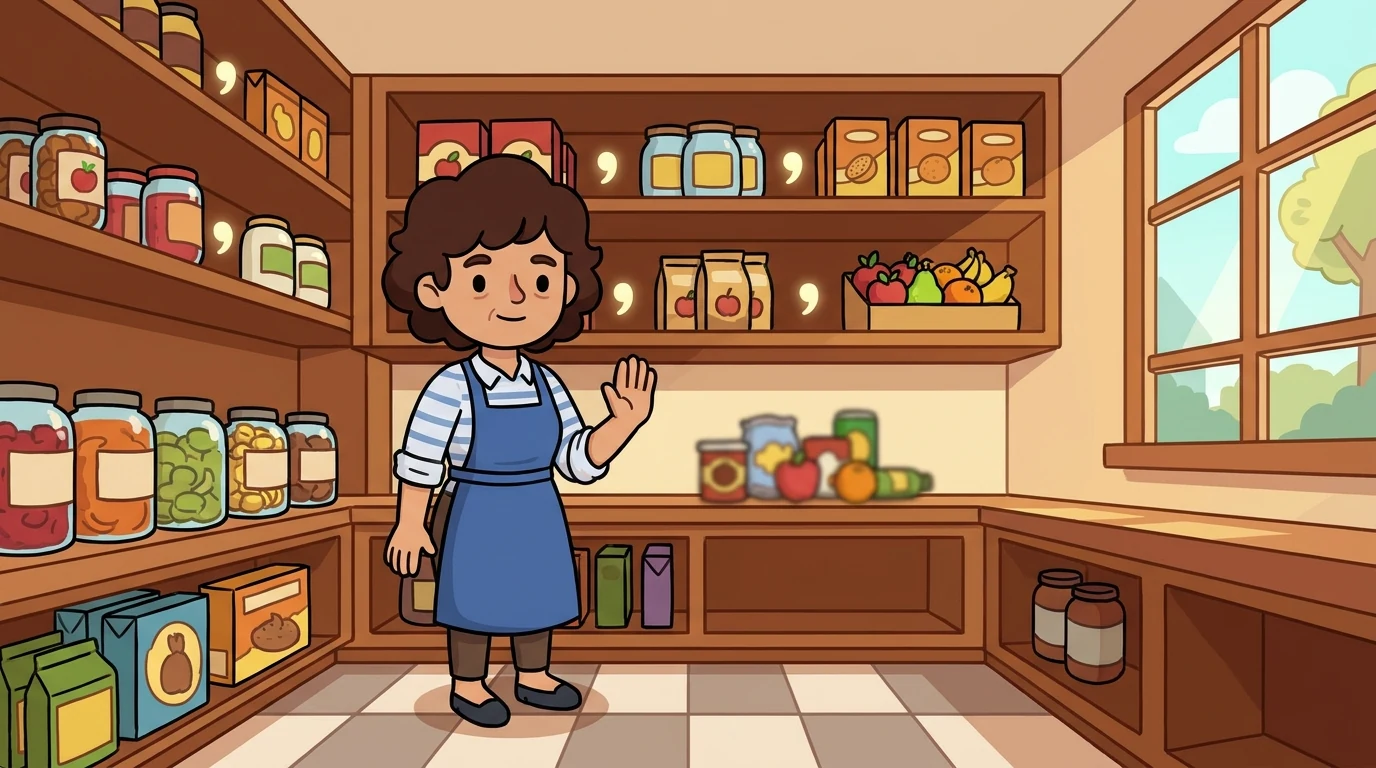
Listy
COMMAS IN A SERIES (Advanced) — the basic rule (a comma between three-or-more items) grows two advanced edges. First, the serial (Oxford) comma before 'and' isn't just stylistic — it PREVENTS REAL AMBIGUITY when the last two items could blur into one ('my parents, a teacher and a nurse' — two people or four?). Second, when the list items THEMSELVES contain commas (complex items), the separators must be upgraded to SEMICOLONS so the reader can tell the big items apart from the commas inside them. Also: coordinate adjectives (each independently modifying the noun) take a comma; cumulative ones don't.
Chapter — Listy and the List That Turned Two People Into Four
Listy’s rule — a little breath between each item so nothing runs together — feeds the whole guild. The advanced apprentices know it cold. What they come to her for is the day the ordinary comma stops being enough: when leaving one out changes who exists, and when the items themselves are so tangled with their own commas that the reader can’t tell the big pauses from the small ones.
“You learned commas separate items,” she says. “Now learn what happens when the separating fails — when a missing comma glues two people into one, or when the items are so busy they need a bigger separator than a comma can be.”
The sentence that taught her was about her own parents.
An apprentice wrote a dedication: To my parents, a teacher and a nurse. Listy read it and stopped. “How many people is this thanking?” she asked. The apprentice said, “Two — my parents, who are a teacher and a nurse.” “Read it again as a list of three,” Listy said. To my parents, a teacher, and a nurse — now it thanks four: the parents, PLUS a teacher, PLUS a nurse. “Without the comma before and, your two parents are the teacher and nurse — a description. With it, they’re three separate groups — a list. One small mark decides whether four people or two walk into the sentence.”
Proofa had told her the principle years back: “The serial comma isn’t decoration or a style you can take or leave. When the last item could be read as a description of the one before it, the comma is the only thing that says no, these are separate. Leave it out and you can accidentally marry your parents to two strangers.”
So advanced Listy teaches the serial comma as a disambiguator, not a habit, and adds the two harder cases:
The ambiguous last pair. When the final two items could blur — I invited my dog, a clown and a magician (a talented dog? or three guests?) — the serial comma resolves it: my dog, a clown, and a magician = three. She keeps it always, precisely so the ambiguous cases are already safe.
Complex items — upgrade to semicolons. When the items themselves contain commas, a comma separator drowns. We visited Paris, France, Rome, Italy, and Tokyo, Japan reads as a mush of six. Upgrade the item separators to semicolons: We visited Paris, France; Rome, Italy; and Tokyo, Japan. “Now the semicolons are the big pauses between the three places,” she says, “and the commas inside stay small, doing city-and-country. Two sizes of pause, two jobs. When the items get busy, the separator has to get stronger.”
Coordinate adjectives. A comma also goes between adjectives that each independently describe the noun — a cold, cutting wind (cold AND cutting). Test: could you swap them, or put and between? Then they’re coordinate, comma. But a bright red balloon — you can’t say red bright or bright and red naturally; bright modifies red balloon as a unit. Cumulative, no comma.
BOLT-3000 drops serial commas and never upgrades to semicolons, so it handed Listy: “I thanked my coaches, a runner and a swimmer, and packed my gear, my lunch and a towel for the meets in Denver, Colorado, Austin, Texas and Reno, Nevada.”
Listy untangled it.
my coaches, a runner and a swimmer — are the coaches the runner and swimmer, or four people? Ambiguous, and the earlier comma makes it worse. She read the intent: two coaches who are a runner and a swimmer — a description, so keep it descriptive: my coaches, a runner and a swimmer, (set off with commas as an appositive) — fine as a description of the coaches.
my gear, my lunch and a towel — a plain three-item list missing its serial comma: my gear, my lunch, and a towel.
Denver, Colorado, Austin, Texas and Reno, Nevada — three cities each with a state, commas everywhere, mush. Upgrade: Denver, Colorado; Austin, Texas; and Reno, Nevada.
Corrected: “I thanked my coaches, a runner and a swimmer, and packed my gear, my lunch, and a towel for the meets in Denver, Colorado; Austin, Texas; and Reno, Nevada.” “Your first list needed the serial comma so nothing blurred,” Listy told BOLT. “Your second list of places needed semicolons, because the items already had commas inside them and were fighting for air. Same idea — keep each item its own item — but the busier the items, the stronger the separator.”
An advanced apprentice pushed back. “My teacher says the Oxford comma is optional — a style choice. So how can it be wrong to skip it?” Listy smiled, because this is the honest debate. “In many lists it is optional — eggs, milk and bread is clear either way, no comma could confuse it. That’s where it’s a style choice, and reasonable people skip it.” She wrote the parents dedication beside it. “But this list isn’t clear either way. Here the comma is the only thing standing between two parents and four people. When a list can’t be misread, the serial comma is style. When it can — when the last item could be swallowed as a description — it’s not style anymore, it’s meaning. So I keep it always: that way the dangerous lists are already protected, and the harmless ones lose nothing.” She tapped the page. “‘Optional’ is true right up until it isn’t. I’d rather not have to notice which list I’m in.”
The apprentice looked at a comma-less list in his own draft — I love my sisters, Mia and Jo — and went pale. “Are Mia and Jo my sisters, or three separate people?” “Now you see it,” said Listy. “Add the comma if they’re three. Leave it if Mia and Jo are the sisters. Either way — decide, and let the comma tell the truth.”
That evening Listy set her family’s long table again, spacing the plates. Then she noticed the seating card an apprentice had made: To Listy, the cook and the host. One person doing three jobs, or three people? She was the cook and the host — a description of her. She left the commas as an appositive, smiling, because for once the ambiguity resolved in her favor: it meant she was all three.
“A comma between items keeps them apart,” she said, straightening the last card. “But the advanced truth is stronger: leave one out and two things can fuse into one, or one can split into three. And when the items themselves get busy with their own commas — reach for the semicolon, the bigger breath. Count the things. Keep each its own. And never let a missing mark quietly rewrite who’s at the table.”
The EditQuest ensemble
Listy is part of EditQuest's distributed-narrative cast. Each character embodies a different curricular primitive; together they teach the full subject.
-

Cappy
Capitalization — makes proper nouns and every sentence's first word stand tall; its defining act is catching a lowercase name or opener
-

Pip
End punctuation — gives each sentence its right ending (. ? !); catches a sentence that stops with the wrong mark or none
-

Splice
Comma splices & run-ons — separates two full sentences a comma wrongly glued together, or breaks a run-on that never stops
-

Apostro
Apostrophes — sorts possessives from contractions from plain plurals (its vs it's, dogs vs dog's)
-

Echo
Homophones / spelling-in-context — hears the words that sound alike and picks the right one (their / there / they're)
-

Concord
Subject–verb agreement — matches a verb to its subject's number (one bird sings, two birds sing)
-

Tempo
Verb-tense consistency — keeps a passage in one time; catches a sentence that slips from past to present
-

Ana
Pronoun clarity — makes every pronoun point clearly to the one noun it stands for
-

Trim
Concision — cuts wordiness and redundancy so the sentence says it once, clearly