
Splice
COMMA SPLICES & RUN-ONS (Advanced) — the stand-alone test still finds the error, but the advanced trap is the CONJUNCTIVE ADVERB: however, therefore, moreover, thus, consequently, then, instead. These FEEL like joining words but grammatically are NOT — 'It rained, however we played' is still a splice, because 'however' can't bridge two sentences the way 'but' can. The fix is a semicolon before it (or a period): 'It rained; however, we played.' Advanced writers also learn the deliberate stylistic exception (short parallel clauses: 'I came, I saw, I conquered') and the semicolon-vs-colon choice (semicolon joins equals; colon introduces).
Chapter — Splice and the Word That Sounded Like a Bridge But Wasn’t
Splice’s cover-each-side test — if both halves stand alone, a comma can’t hold them — settled the plain splices long ago. The advanced apprentices catch those. What they bring her is the sentence that feels fixed, that has a big impressive connecting word right in the middle, and is still a splice — because the word they trusted to bridge two sentences was never built to carry them.
“You learned the fixes: period, semicolon, or a joining word — and, but, so, because,” she says. “Now meet the impostor. However, therefore, moreover, instead — they mean connection, they sound like but and so, and they cannot bridge two sentences by themselves. Put one after a comma between two full sentences and you’ve built the same weak bridge, just with a fancier plank on it.”
The impostor that caught her was however.
She’d written The plan was risky, however we tried it, proud of the grown-up however, and Proofa covered each side. The plan was risky — stands alone. we tried it — stands alone. “Two whole sentences,” Proofa said. “What’s holding them?” “However —” Splice began, then stopped. “A comma. However is just… sitting there.” “Exactly. However is a conjunctive adverb. It comments on the relationship between two sentences, but it doesn’t grammatically join them the way but does. The plan was risky, but we tried it — but is a real joiner, that’s fine. Swap in however and the joiner’s gone; you’re back to two sentences and a comma. A splice wearing a suit.”
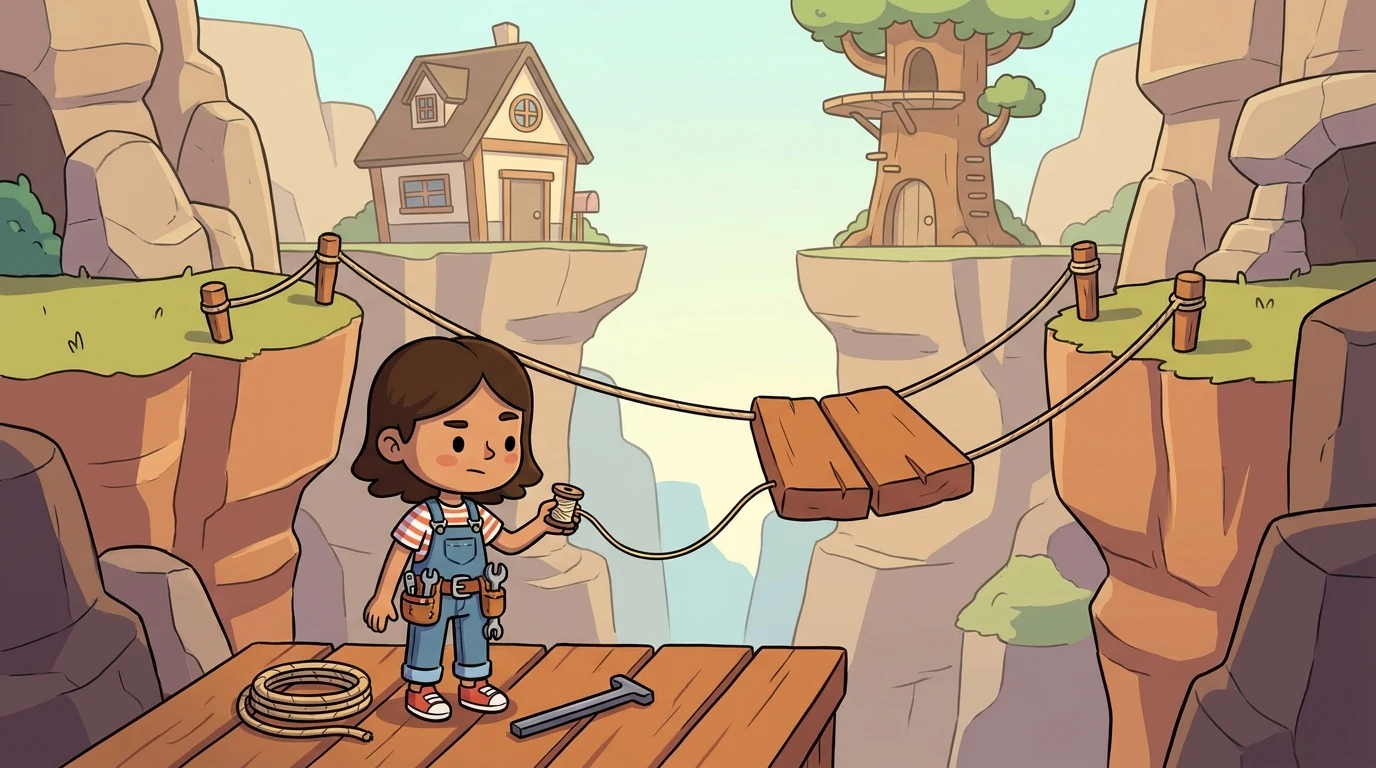
Splice felt the trap close. “So but can bridge, and however can’t — even though they mean almost the same thing?” “The meaning is nearly the same,” Proofa said. “The grammar is completely different. But is a bridge. However is a signpost you plant on a bridge — you still need the bridge underneath.”
So advanced Splice teaches the impostor list and its fix:
Conjunctive adverbs — however, therefore, moreover, thus, consequently, instead, then, nevertheless, furthermore. When one sits between two complete sentences, it needs a semicolon (or a period) before it, and usually a comma after: The plan was risky; however, we tried it. Or The plan was risky. However, we tried it. “The semicolon is the real bridge,” she says. “However just stands on it, pointing.”
The semicolon vs the colon. A semicolon joins two equal, related complete sentences: The rain stopped; the game resumed. A colon introduces — it promises the reader that what follows explains or lists: We needed one thing: rope. “Semicolon = two equals holding hands. Colon = a door opening onto what’s next.”
And the one deliberate exception — the stylistic splice. Very short, parallel, punchy clauses may take commas on purpose: I came, I saw, I conquered. “That’s a splice,” she admits. “A famous one. It works because the clauses are tiny, parallel, and the rhythm is the point. But you only get to break the rule on purpose, knowing it’s a rule — three short drumbeats, not a paragraph. Break it because you’re an editor choosing an effect, never because you didn’t notice.”
BOLT-3000 loves conjunctive adverbs because they sound sophisticated, and it handed Splice: “The engine stalled, therefore we stopped, we checked the manual, however it was missing, the trip was over.”
Splice covered sides all the way down.
The engine stalled, therefore we stopped — both stand alone; therefore can’t bridge. Semicolon: The engine stalled; therefore, we stopped. (Or period.)
we stopped, we checked the manual — both stand alone, only a comma. Plain splice. Period or joiner: We stopped and checked the manual, or two sentences.
we checked the manual, however it was missing — impostor again; however needs a semicolon: we checked the manual; however, it was missing.
it was missing, the trip was over — both stand alone. so fits the meaning: it was missing, so the trip was over.
Corrected (one clean version): “The engine stalled; therefore, we stopped and checked the manual. It was missing, however, so the trip was over.” — or split further. “Two of your four bridges,” Splice told BOLT, “used a signpost where a bridge was needed. Therefore and however told the reader how the ideas relate — but a comma still can’t hold two sentences, no matter how smart the word standing on it sounds.”
An advanced apprentice, having just learned the impostors, over-corrected: “So I should never use a comma between clauses at all?” Splice laughed, because the pendulum always swings too far first. “No — commas between clauses are fine when one side can’t stand alone. Because it rained, we stayed in — because it rained is a fragment, leaning on the second half; the comma’s doing an ordinary job. The splice rule only fires when both sides could stand alone.” She wrote three. “I stayed in because it rained — no comma needed, one sentence. Because it rained, I stayed in — comma, but no splice, because half of it can’t stand alone. It rained, I stayed in — splice, both stand alone, needs a real bridge. Same idea, three structures. Test whether the sides can stand, every time. Don’t ban the comma — aim it.”
The apprentice tested his over-corrections and put three commas back. “I panicked,” he said. “Learning the trap made me distrust all commas.” “The cure for a trap isn’t fear,” said Splice. “It’s the test. Cover each side. Let it try to stand. The comma’s guilt or innocence is always in the answer.”
That night Splice reread her breathless childhood page one final time — now bridged with periods, semicolons, and honest joiners — and near the end she found a line she’d once “fixed” with a proud however: I was late, however I ran. She covered each side: both stood. She lifted the comma to a semicolon, set however on top of it where it could finally do its pointing: I was late; however, I ran.
Then she smiled and rewrote it the punchier way, breaking the rule on purpose, three drumbeats: I woke. I was late. I ran. “However is a signpost, not a bridge,” she said, coiling her rope. “Semicolons and periods and real joiners carry the weight; however just tells the reader which way to look once they’ve crossed. Cover each side. If both stand, the fancy word won’t save the comma — build a real bridge, then plant your signpost on it.”
The EditQuest ensemble
Splice is part of EditQuest's distributed-narrative cast. Each character embodies a different curricular primitive; together they teach the full subject.
-

Cappy
Capitalization — makes proper nouns and every sentence's first word stand tall; its defining act is catching a lowercase name or opener
-

Pip
End punctuation — gives each sentence its right ending (. ? !); catches a sentence that stops with the wrong mark or none
-

Listy
Commas in a series — sets the pauses between items in a list so the list reads cleanly
-

Apostro
Apostrophes — sorts possessives from contractions from plain plurals (its vs it's, dogs vs dog's)
-

Echo
Homophones / spelling-in-context — hears the words that sound alike and picks the right one (their / there / they're)
-

Concord
Subject–verb agreement — matches a verb to its subject's number (one bird sings, two birds sing)
-

Tempo
Verb-tense consistency — keeps a passage in one time; catches a sentence that slips from past to present
-

Ana
Pronoun clarity — makes every pronoun point clearly to the one noun it stands for
-

Trim
Concision — cuts wordiness and redundancy so the sentence says it once, clearly