
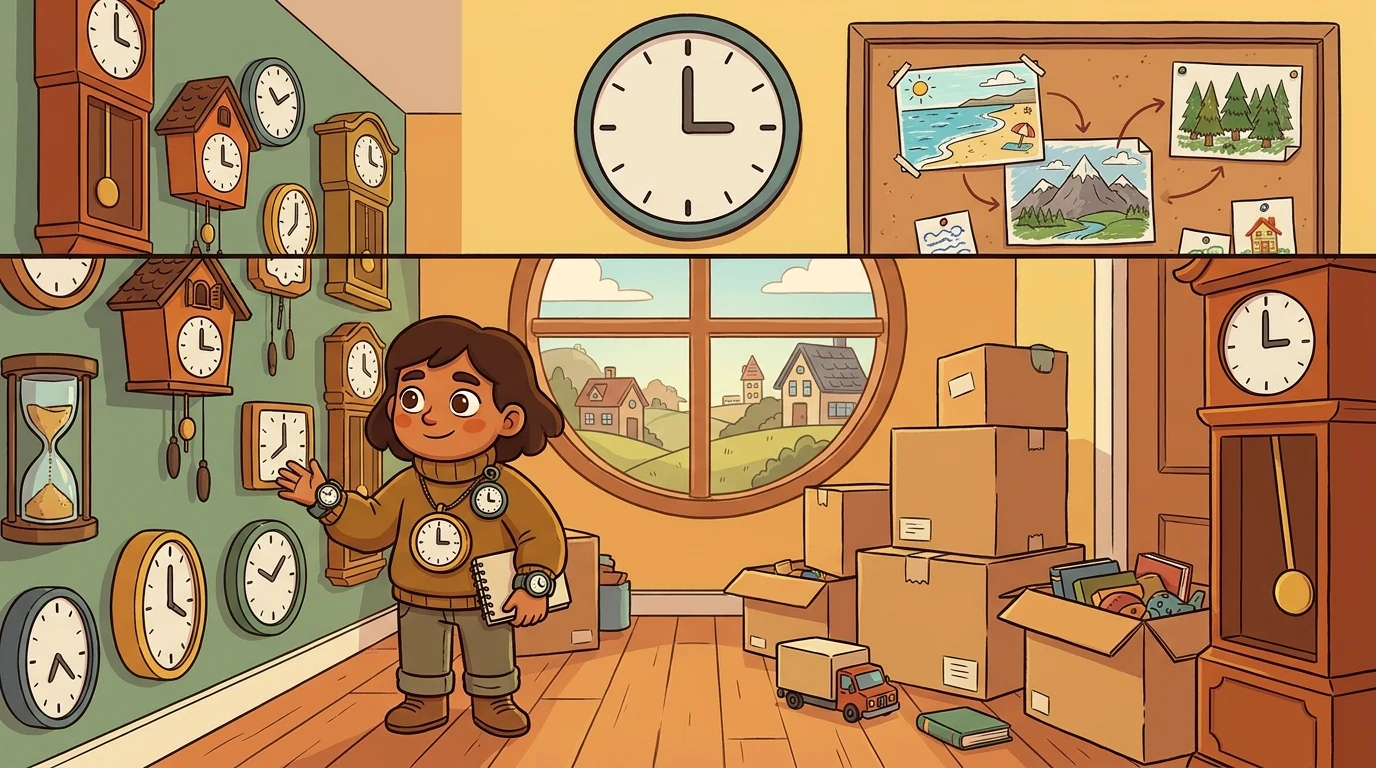
Tempo
VERB-TENSE CONSISTENCY (Advanced) — 'pick one clock and stay' still holds, but advanced writing has legitimate reasons the clock MOVES that beginners misread as errors: the PERFECT tenses deliberately mark one action as earlier than another within the same passage ('had finished' before 'left'), so a past-perfect inside a past narrative is CORRECT sequencing, not a slip; the LITERARY PRESENT is the convention for discussing a text ('In the story, the hero learns…') even when narrating past events; and reported speech backshifts on purpose. The advanced move: distinguish a MEANINGFUL time-relationship (keep it) from an ACCIDENTAL wander (fix it) — the perfect tenses are the clock working, not breaking.
Chapter — Tempo and the Clock That Was Supposed to Move
Tempo’s clocks — pick one time and stay, pull back the lonely wanderer — steadied the beginners’ passages. The advanced apprentices arrive with the wandering verb already tamed. What confuses them now is the opposite fear: they’ve become so good at hunting tense-changes that they “fix” the ones that were supposed to be there — the changes that carry meaning. Because in real writing, the clock sometimes moves on purpose, and pulling it back breaks the truth.
“You learned to hunt the verb that jumped for no reason,” she says, checking her wrist. “Now learn the harder thing: some verbs jump for a very good reason, and if you drag them back you erase what they were telling the reader. The advanced skill isn’t keep one clock. It’s tell a meaningful move from an accidental slip.”
The verb that taught her was a had.
She’d been editing a past-tense story and found By the time the guests arrived, she had cleaned the whole house. Her clock-hunting instinct fired — arrived is past, had cleaned is… a different tense! — and she nearly “corrected” it to she cleaned. Proofa stopped her hand. “Read what you almost did,” she said. By the time the guests arrived, she cleaned the whole house — now it sounds like she cleaned while or after they arrived. “But the story means she finished before they came. That had cleaned — past perfect — is the clock working. It marks one past action as earlier than another past action. Pull it back to plain past and you lose the order. You wouldn’t be fixing a slip. You’d be deleting a fact about when.”
Tempo felt the whole rule deepen. “So a tense-change inside a past passage can be correct.” “When it marks earlier-than, yes,” Proofa said. “The perfect tenses exist precisely so one clock can show two depths of past. That’s not two clocks fighting. That’s one clock with an earlier hand.”
So advanced Tempo split “clock-change” into two kinds, and the whole art is telling them apart:
Meaningful moves — keep them. The perfect tenses show sequence within one time frame: had done (before another past thing), has done (up to now). She had finished before he arrived is correct past narration — the had is doing the ordering. Real time-shifts in the story — I walked to school today; tomorrow I will ride — are meaning, not error. And the literary present: when you discuss a text, convention keeps it present even for past events — In the novel, the hero learns to forgive — and you stay consistently present about the text.
Accidental slips — fix them. A verb that hops to the other clock mid-scene for no reason, with no earlier-than to mark and no real time-move — I walked in and there is a mess — same moment, no sequence, pure wander. Pull it home.
“The test,” she says, “is one question: does this change carry information — order, or a real time-move, or the literary-present convention — or did the verb just wander? Information: keep it. Wander: fix it.”
BOLT-3000 both slips accidentally AND over-simplifies (flattening real sequence into plain past), so it handed Tempo two problems in one: “By the time we found the map, the ship sailed, and now the crew is stranded — in the story the sailors gave up.”
Tempo asked information or wander at each.
By the time we found the map, the ship sailed — the meaning is the ship left before they found the map. That’s earlier-than — needs the perfect: the ship had sailed. BOLT flattened a real sequence; she added the clock-depth back.
and now the crew is stranded — now + present, inside a past story. Is now a real time-move to the present, or a slip? Read in context, it’s a slip — the whole thing is past narration. Pull home: the crew was stranded.
in the story the sailors gave up — discussing the text. Literary present convention: in the story, the sailors give up.
Corrected: “By the time we found the map, the ship had sailed, and the crew was stranded. In the story, the sailors give up.” “Three verbs, three different answers,” Tempo told BOLT. “One needed a deeper past-tense because it happened earlier — the clock working. One was a pure slip — the clock wandering. One followed the literary-present convention for talking about a text. ‘Keep one clock’ was never the whole rule. The rule is know why the clock moves.”
An advanced apprentice was overwhelmed. “How do I ever know if a had is right or if I’m just adding tenses?” Tempo smiled — this is the real skill. “Ask what the had is claiming,” she said. “Had claims this happened before that other past thing. So check: did it? She had eaten before she left — did the eating come before the leaving? Yes — had is telling the truth, keep it. But She had walked to the store yesterday with nothing it’s ‘before’ — no second past action for it to precede — that had is claiming an order that isn’t there; plain walked is enough. The perfect tense isn’t decoration you sprinkle for sounding formal. It’s a claim about order. Use it only when there’s a real order to mark.” She wrote both. “Right had: there are two past moments and you’re saying which came first. Wrong had: there’s only one moment and the had is just showing off.”
The apprentice tested a lone had in his draft — hunted for the second past action it was supposed to precede — found none. Plain past. “It was pretending there was an order,” he said. “Then it was a wander in a fancy coat,” said Tempo. “Same fix. Pull it home.”
That night Tempo reread her present-tense self-introduction — I’m the quiet one, I love the mountains — steady on one clock. Then she wrote a new line about her past, and let the clock move on purpose: Before I learned this, I had flipped between clocks without knowing why; now I move them only when time truly moves. Past perfect for the before, present for the now. Two hands on one honest clock.
“Pick your clock and stay — that’s the floor,” she said, straightening the watch on her wrist. “But the advanced truth is that the clock is allowed to move: backward with a had to show what came first, forward for a real time-change, into the present to talk about a story. The skill isn’t never changing. It’s knowing, every single time, whether the change means something — or whether the verb just wandered off on its own.”
The EditQuest ensemble
Tempo is part of EditQuest's distributed-narrative cast. Each character embodies a different curricular primitive; together they teach the full subject.
-
Cappy
Capitalization — makes proper nouns and every sentence's first word stand tall; its defining act is catching a lowercase name or opener
-

Pip
End punctuation — gives each sentence its right ending (. ? !); catches a sentence that stops with the wrong mark or none
-

Splice
Comma splices & run-ons — separates two full sentences a comma wrongly glued together, or breaks a run-on that never stops
-

Listy
Commas in a series — sets the pauses between items in a list so the list reads cleanly
-

Apostro
Apostrophes — sorts possessives from contractions from plain plurals (its vs it's, dogs vs dog's)
-

Echo
Homophones / spelling-in-context — hears the words that sound alike and picks the right one (their / there / they're)
-

Concord
Subject–verb agreement — matches a verb to its subject's number (one bird sings, two birds sing)
-

Ana
Pronoun clarity — makes every pronoun point clearly to the one noun it stands for
-

Trim
Concision — cuts wordiness and redundancy so the sentence says it once, clearly