Merle the Gleaner
The HANGING PIECE — a piece with no defender at all can simply be taken, no trick required
Loading audio…
Press play to listen along. The line being read lights up as you go.
Show full transcript
Loading transcript…
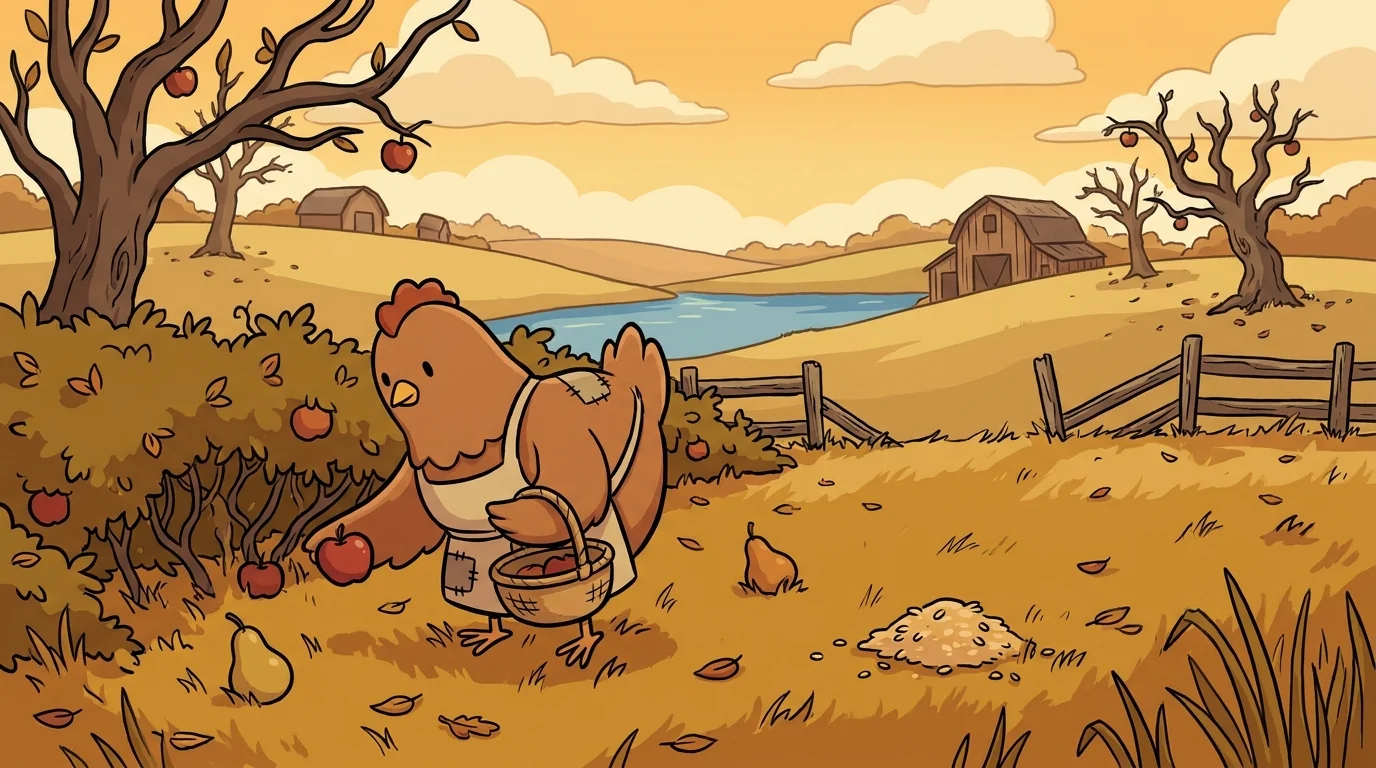
At the low end of the Slow Lake, past the last of the barns, there was an orchard that everyone had agreed to stop worrying about. It was too small to bother the pickers and too far to bother the market. So when the harvest carts rolled through in autumn, they took the easy rows and left the rest, and the rest was where you found Merle.
Merle was a hen — a plain brown hen with a plainer walk — and she did the least glamorous job in the whole valley. She gleaned. After the pickers had gone home with their tall baskets, Merle went out into the trampled grass and gathered what they had left behind: the apple that had rolled under the hedge, the pear that had dropped a day too early, the handful of grain that had slipped through a hole in a sack. Nobody had guarded these things. Nobody was coming back for them. So Merle took them, one by one, and she was never once told off, because you cannot steal a thing that no one is keeping.
She had noticed, over many autumns of this, that the orchard was full of forgotten things — and that the forgotten things had a particular look to them. A guarded apple, high in the tree, had a farmer's ladder leaning under it and a dog dozing at the trunk. But a fallen apple in the wet grass had nothing at all around it. No ladder. No dog. No one. Merle could tell the two apart at a glance, the way you can tell a sleeping house from an empty one, and she had never put the difference into words. She simply walked the rows at dusk and picked up whatever had been left alone.
It would take a duckling, in the end, to give it a name.
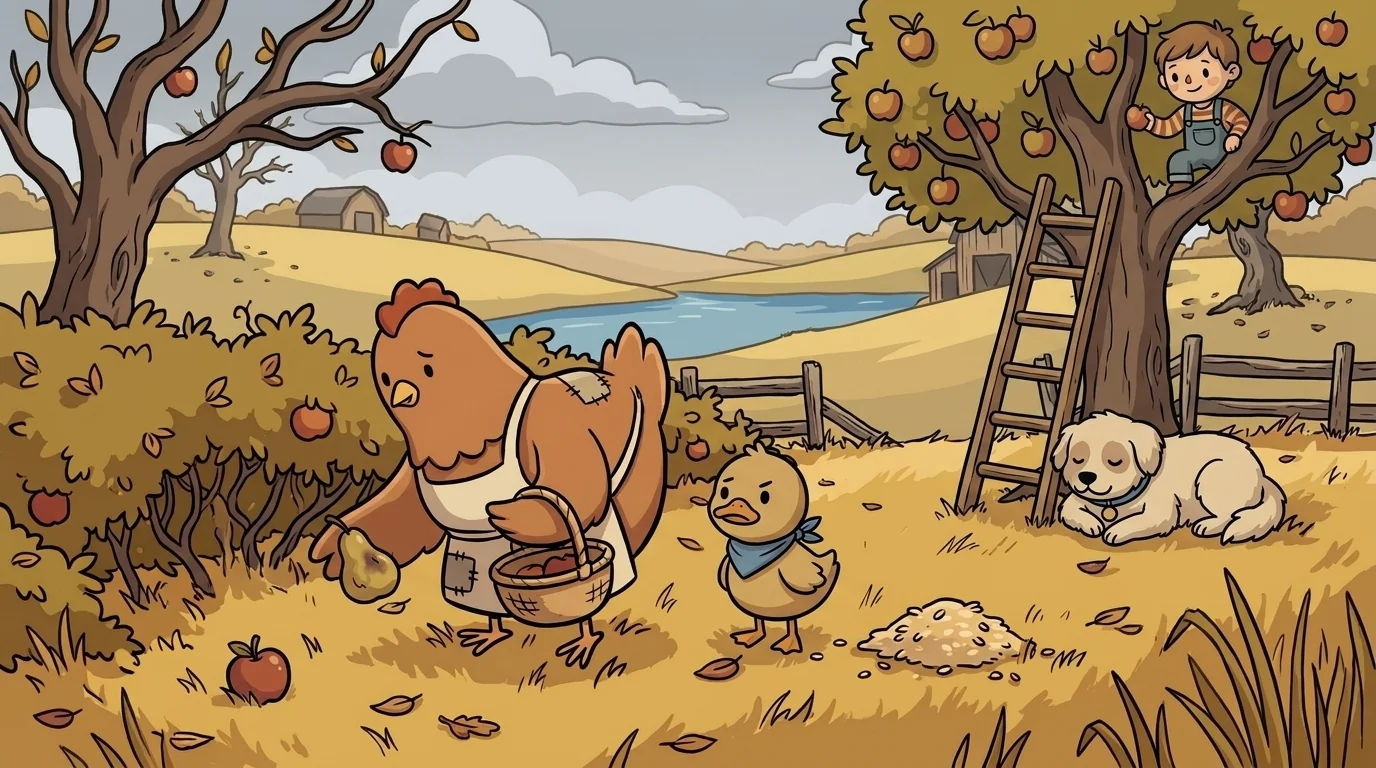
One grey morning a duckling named Pip followed Merle into the orchard because he had nothing better to do. He watched her walk straight past a whole tree loaded with apples — ignored it entirely — and then stop at a single bruised pear lying by itself near the fence.
"Why that one?" Pip asked. "There's a hundred better ones up there."
"Those are looked after," said Merle, tucking the pear under her wing. "The farmer wants those. There's a fence, and a dog, and a boy who counts them."
"And this one?"
"Nobody's watching this one," said Merle. "Nobody's coming for it. So it comes home with me."
Pip frowned at the pear. He was young, and to him a pear was a pear. "But it's just… sitting there."
"That," said Merle, "is exactly the point. A thing that nobody is guarding isn't a prize. It's just there for the taking. You don't need a plan for it. You don't need to be clever. You only need to see it — and most everyone is too busy staring up at the guarded apples to look down at the one in the grass."
Pip looked down at the one in the grass. Then he looked up at the guarded tree, and back down again, and something clicked into place behind his small eyes.
"It's hanging," he said. "That pear's just hanging there with nobody holding it."
Merle stopped walking. She turned the word over. She had gathered a thousand fallen things and never once called them that.
"Hanging," she said. "Yes. That's the word. It hangs there, with nothing underneath it, waiting for whoever bothers to look."
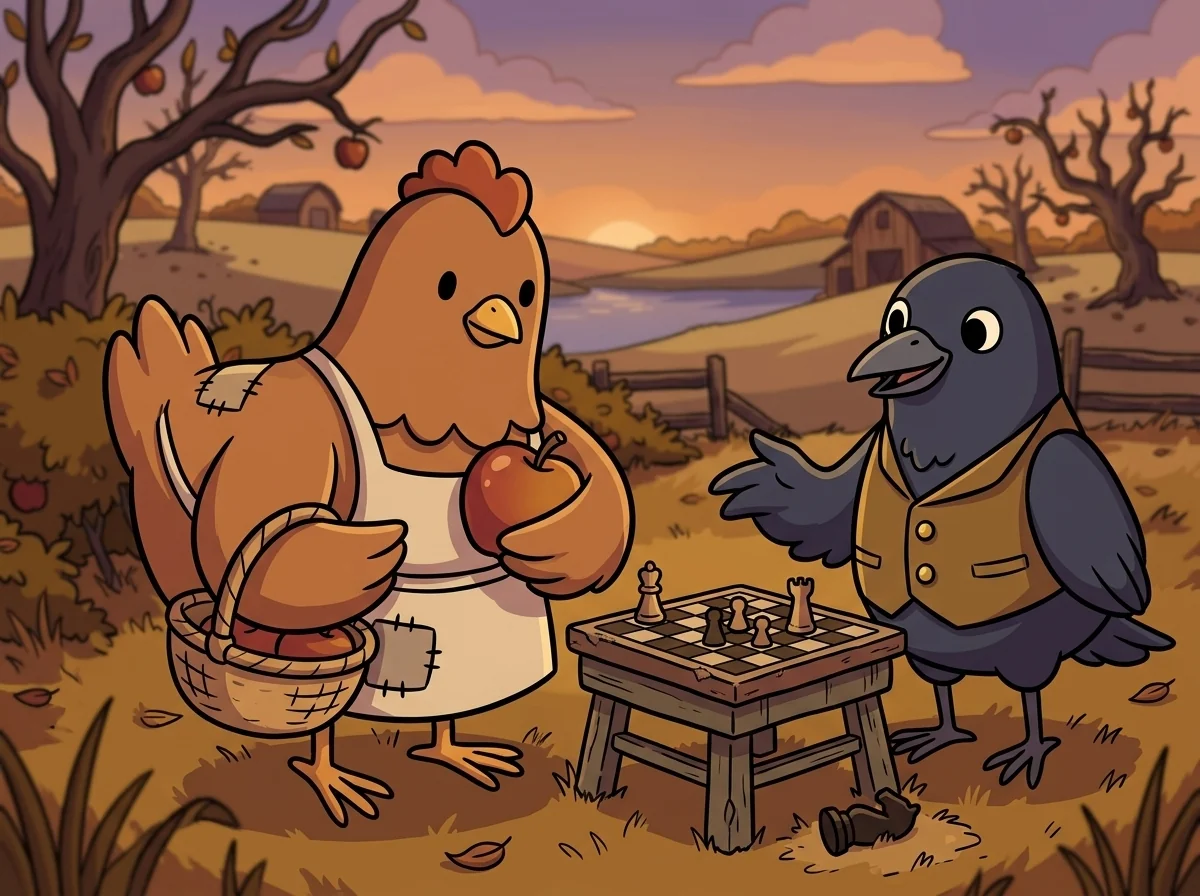
Three autumns later, a chunky cheerful rook in a brass-buttoned waistcoat walked into the orchard at dusk, which was not a thing that happened.
He introduced himself as Captain Castle. He said he ran an academy where children learned a game played on sixty-four squares, and he said the children were very good at spotting the clever tricks — the traps, the ambushes, the sacrifices — but that they kept losing games in the plainest way of all.
"They stare so hard at the clever moves," said Captain Castle, "that they walk straight past a piece the other player simply forgot to guard. They leave free things sitting in the grass. And I have been looking, for some time now, for someone who is very good at seeing what has been left alone."
Merle finished tucking a windfall apple under her wing. She was not a bird who was easily flustered, and she was not flustered now.
"I have spent my whole life," she said, "picking up what everyone else walked past. I suppose I could teach a child to do the same."
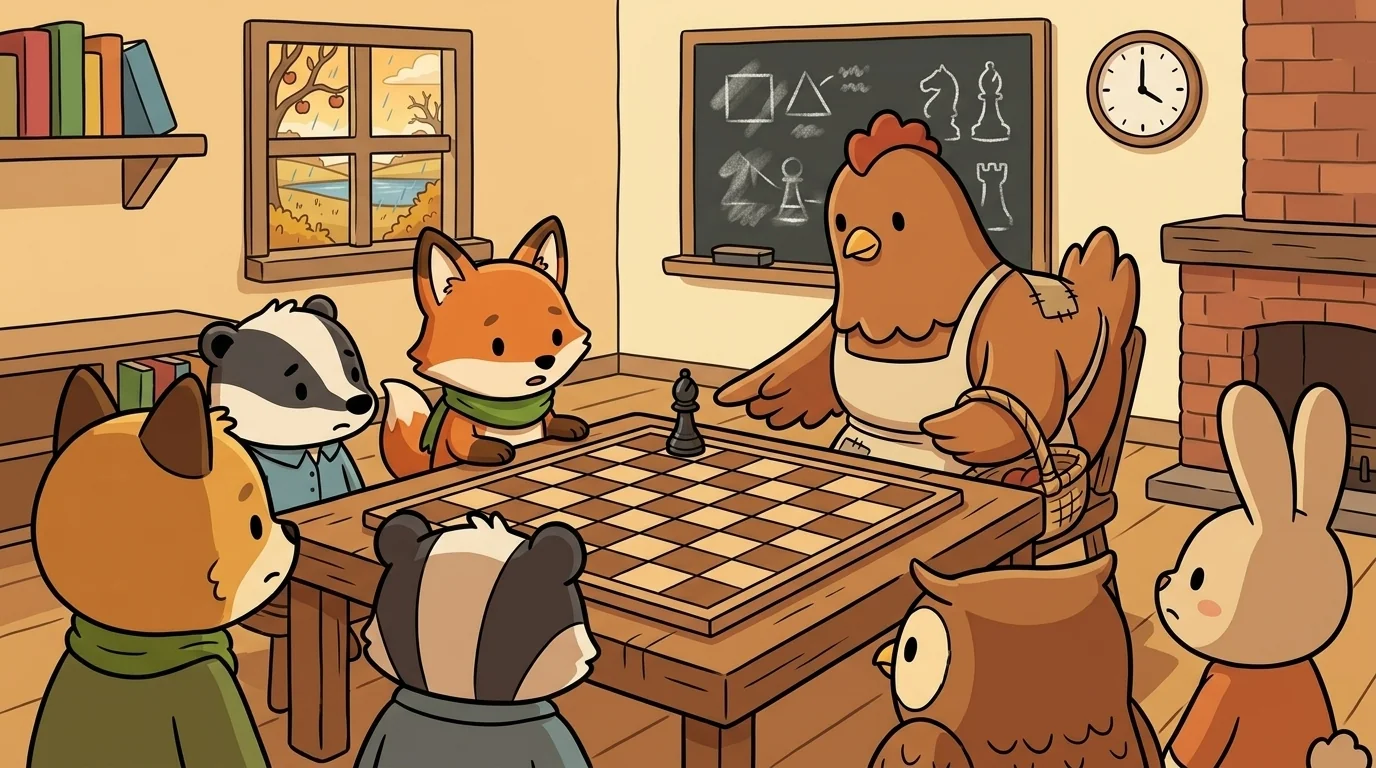
The chessboard, Merle found, was only an orchard with straighter rows.
She met her first class on a wet Tuesday. Captain Castle set a position on the board and stepped back, and the children immediately began hunting for something brilliant — a fork, a pin, a grand two-move net. They leaned and squinted and argued.
Merle let them hunt for a while. Then she walked to the board, slow as ever, and pointed one wing at a lone black bishop sitting out on the edge of things.
"Consider this bishop," she said. "Whose job is it to protect it?"
The children looked. They traced the lines. They checked the pawns, the knights, the squares nearby.
"…Nobody's," said a small fox in a green scarf, sounding almost disappointed. "There's nothing guarding it. It's just out there on its own."
"Then take it," said Merle.
"But — isn't that too easy? Shouldn't there be a trick? A catch?"
"There is no catch," said Merle, gently. "That is the whole lesson. A piece that no one is guarding is not a puzzle. It is a fallen apple in the grass. You do not need to be clever to pick it up. You need only to look down while everyone else is looking up." She reached out and, very simply, took the bishop off the board. "One move. No sacrifice. No cleverness. It was hanging there the whole time, waiting for someone to notice."
The fox in the green scarf wrote look down while everyone else looks up in her notebook, and underlined it twice. Captain Castle, watching from the corner, smiled into his brass buttons.
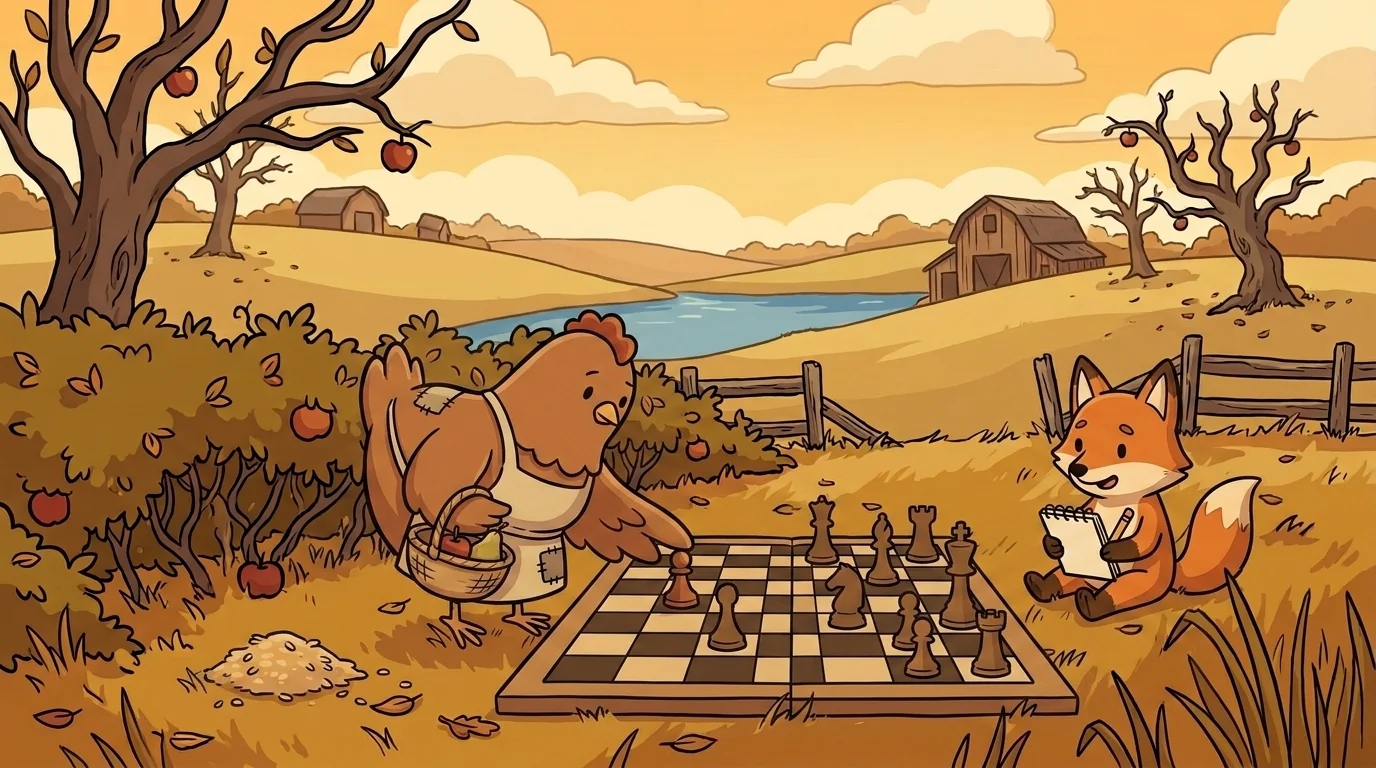
She still walks the rows slowly. She still tucks things under her wing.
But when the lessons are over and the children have gone home, Merle stays behind a little while, and she walks the folded board the way she walks the orchard at dusk — checking, always checking, for the thing that has been left alone.
Sometimes the fox with the notebook stays too, sitting cross-legged on the floor, and she asks, "Why this one, Merle? Why the plainest move of all?"
And Merle will settle her feathers, and consider, and say:
"The clever moves are wonderful, and you should learn every one of them. But do not let them make you proud. Before you go hunting for something brilliant, look down at the grass. Half the time, someone has already left the prize out where anyone could reach it — and the only skill you need is the plain, patient habit of noticing what everyone else forgot."
The fox writes it down. Merle glances at the little notebook, and feels — in a way she would never say aloud — the same quiet fullness she feels walking home at dusk with her wings heavy and warm. She closes the board. She goes home.
The GambitTales ensemble
Merle the Gleaner is part of GambitTales's distributed-narrative cast. Each character embodies a different curricular primitive; together they teach the full subject.
-

Sir Pinwell
Pin pattern — freezes pieces along a line
-

Twin Knights of Fork Hill
Fork pattern — attack two targets at once
-

Lady Skewer
Skewer pattern — force a valuable piece out of the way
-

Veil & Vow
Discovered attack — step aside to reveal a hidden threat
-

Captain Crossfire
Double attack — one move threatens two targets
-

The Glass Lantern
X-ray attack — light pierces through to the piece behind
-

King Pumble & King Sable
Two kings — librarian and gardener; one step at a time
-

Queen Vesper
Queen — ranger-messenger; any direction, any distance
-

Captain Castle
Mentor + narrator — rook archetype; the mascot who introduces the cast + scaffolds the lesson
-

The Pawn Cohort
Ensemble piece — the four pawn-paired sets (Pawn Patrol + Sienna & Bran + Trotter & Trundle + Gable & Garrett) acting as one in the world layer
-

Sir Sidetrack
Deflection — chase the guard off its duty, then take what it protected
-

Warden Snare
Trapped Piece — a piece with no safe square falls where it stands
-

Mason the Interposer
Interference — cut the line between a defender and its charge
-

Siren Lyra
Attraction — lure a piece onto the square where your next move wins it
-

Vale the Wayclearer
Clearance — move your own piece off the line so the power behind lands
-

Kester the Finisher
Checkmate — a check the king cannot escape, block, or capture
-
Linnet the Netweaver
Checkmate in Two — the first move forces the reply, the second springs the mate