Kester the Finisher
CHECKMATE — a check the king cannot escape, block, or capture ends the game in one move
Loading audio…
Press play to listen along. The line being read lights up as you go.
Show full transcript
Loading transcript…
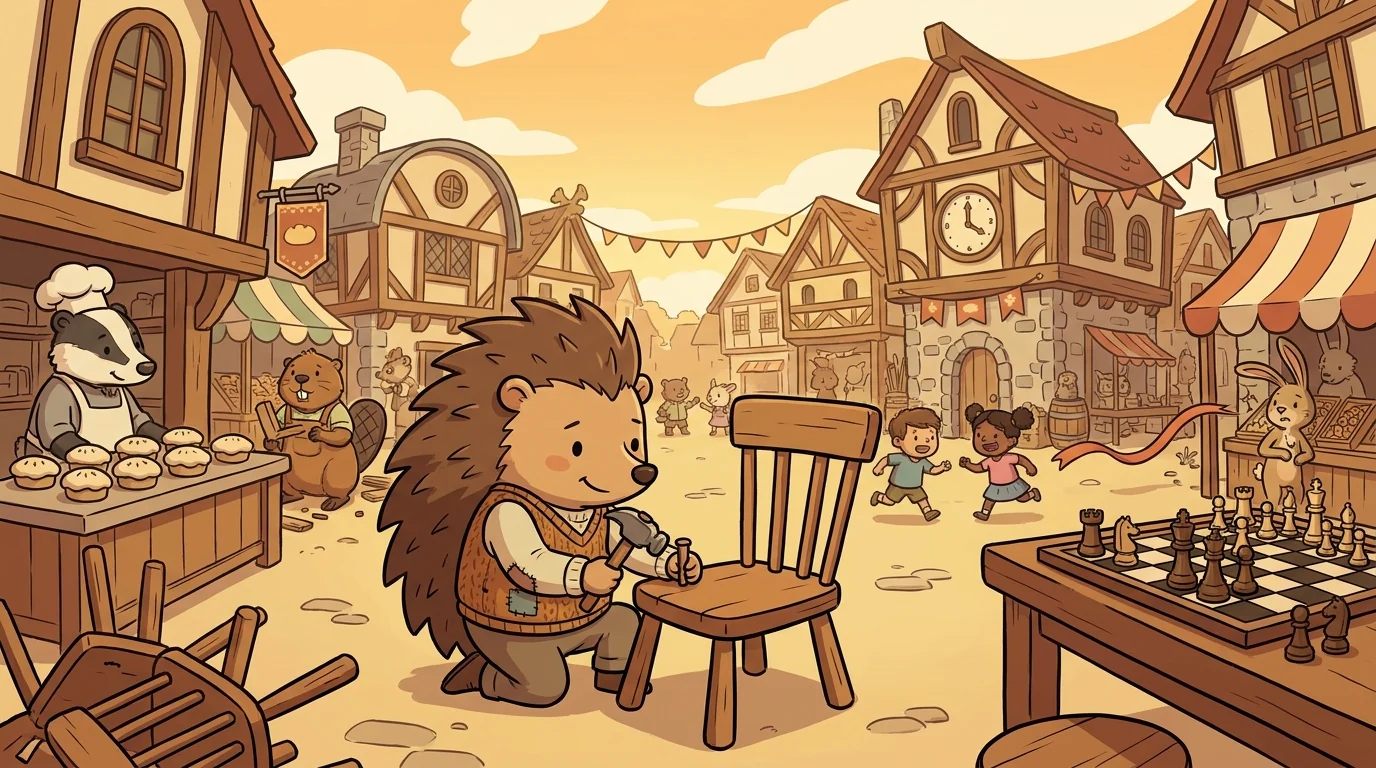
In the market town of Endby there was a young hedgehog named Kester who had a small and unusual reputation: he was the one who finished things.
Other folk in Endby were splendid at starting. The carpenter began a hundred beautiful chairs. The baker mixed a dozen grand cakes. The children began races, and games, and elaborate plans, all day long. But Endby was a town of half-done things — a chair with one leg missing, a cake left out of the oven a minute too soon, a race abandoned two strides from the ribbon because something more interesting came along.
Kester finished. When a chair needed its last leg pegged, they fetched Kester. When a game of tag had gone on so long that everyone had forgotten who was even It, Kester was the one who calmly made the tag that ended it. He was not the fastest or the cleverest child in Endby. But he had a rare and quiet gift: he could tell, at a glance, when a thing was one move from done — and he had the steadiness to actually make that one move, cleanly, without fumbling it, without getting distracted, without leaving it three-quarters finished like everyone else.
He had noticed, in all his finishing, something that most of Endby never learned: being almost done is not the same as being done. A race is not won two strides from the ribbon. A wall is not built until the last brick is set. And the final move — the one that truly ends a thing — is not a move to rush or to fumble. It is the move to be surest of. You check it, quietly, one last time. Then you make it, and it is over.
Kester had never given this a name. He simply finished what others left hanging.
It would take a small wren named Pib to name it.
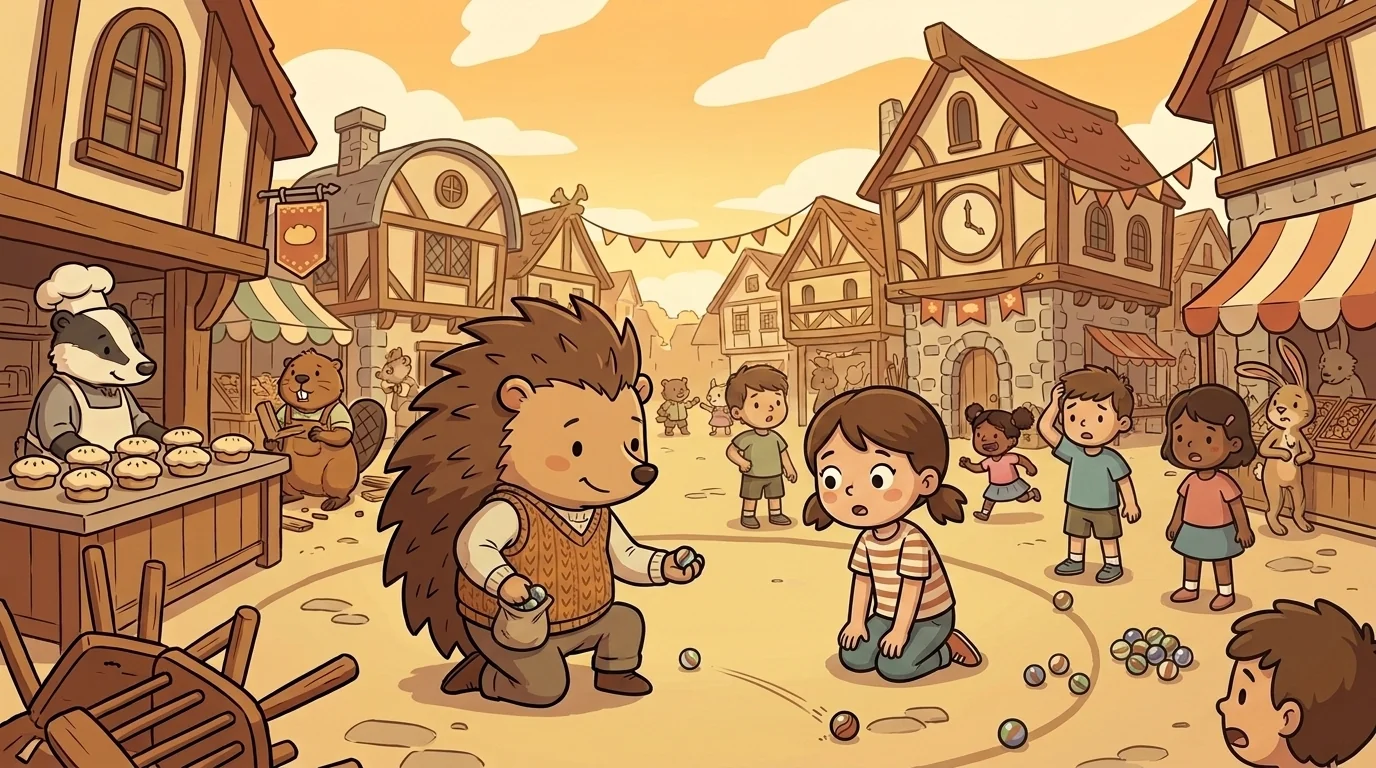
Pib was seven and quick and forever leaving games half-played, and one afternoon she watched Kester end a marbles match that had dragged on for an hour by simply, calmly, rolling the one marble that knocked out the last of his rival's — click — and standing up.
"That's it?" said Pib. "You just — ended it?"
"It was one move from over," said Kester, pocketing his marbles. "It had been, for a little while. Everyone else kept playing around the ending. I just made the move that finished it."
"How did you know it was the ending?"
"Because their last marble had nowhere to hide," said Kester. "It couldn't roll away. Nothing was in front of it to shield it. And I couldn't be knocked out first. Nowhere to go, no shield, no dodge — that's an ending. When all three are true at once, the next move is the last one."
Pib turned this over. She was a child who left everything half-done, and here was a boy who could see the exact shape of finished.
"You put them in checkmate," she said — she'd heard the word from a travelling player once. "No running, no blocking, no trading out of it. Just — done."
Kester nodded, slowly, the way he did everything final.
"Checkmate," he said. "No escape, no block, no capture. When all three doors are shut, one move ends it. That is exactly the thing I do."
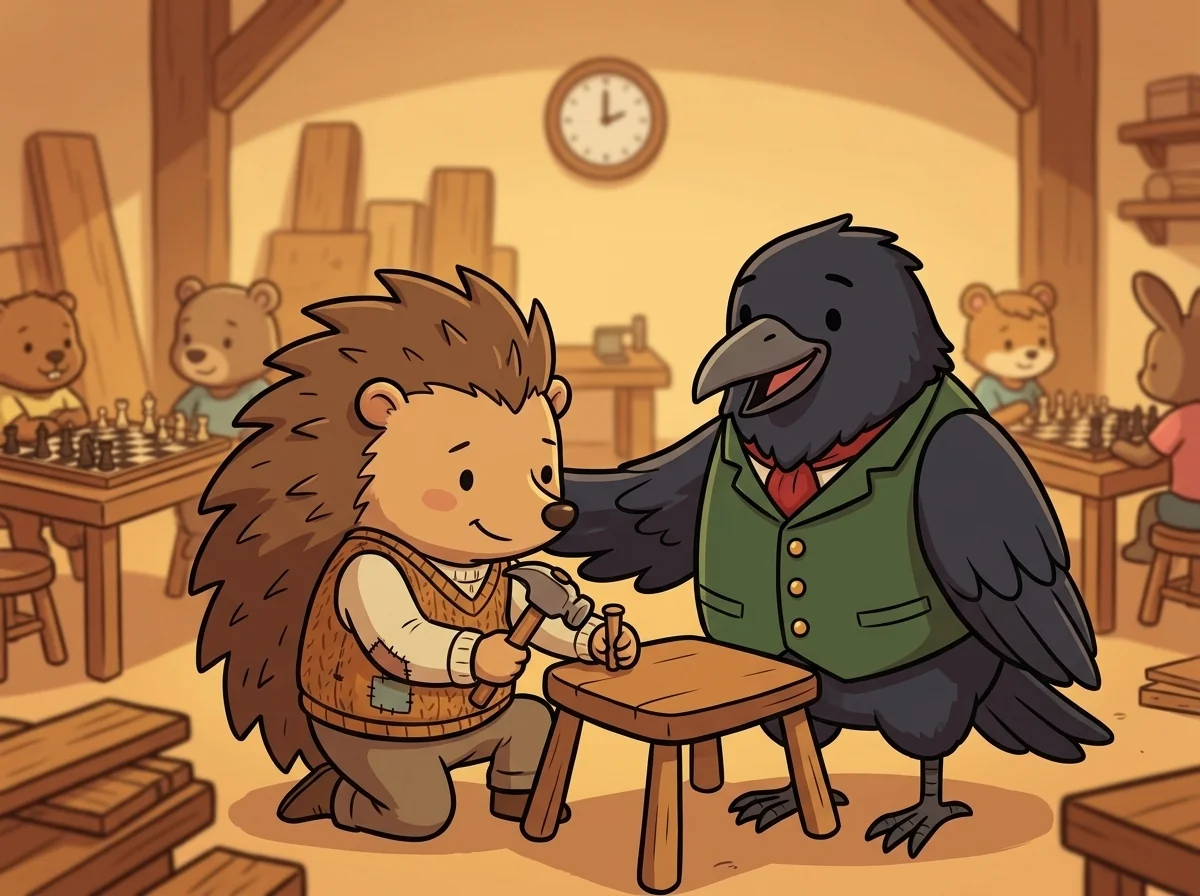
Some seasons after, a chunky cheerful rook in a brass-buttoned waistcoat watched Kester peg the last leg into a wobbling table and set it, for the first time in a week, perfectly steady.
Captain Castle introduced himself and said he ran an academy where children learned the game of sixty-four squares, and that his students played wonderful, roaring attacks — and then, at the very end, could not finish. "They get the enemy king cornered," he said, "one move from mate — and then they check it pointlessly, or grab a free pawn, or panic, and the moment slips away. They can start a storm. They cannot land the last drop of it. And I have long needed someone who knows how to make the final move."
Kester tested the table. It did not wobble.
"I have spent my life," he said, "finishing what other folk leave three-quarters done. I should be glad to teach a child to land the last move."
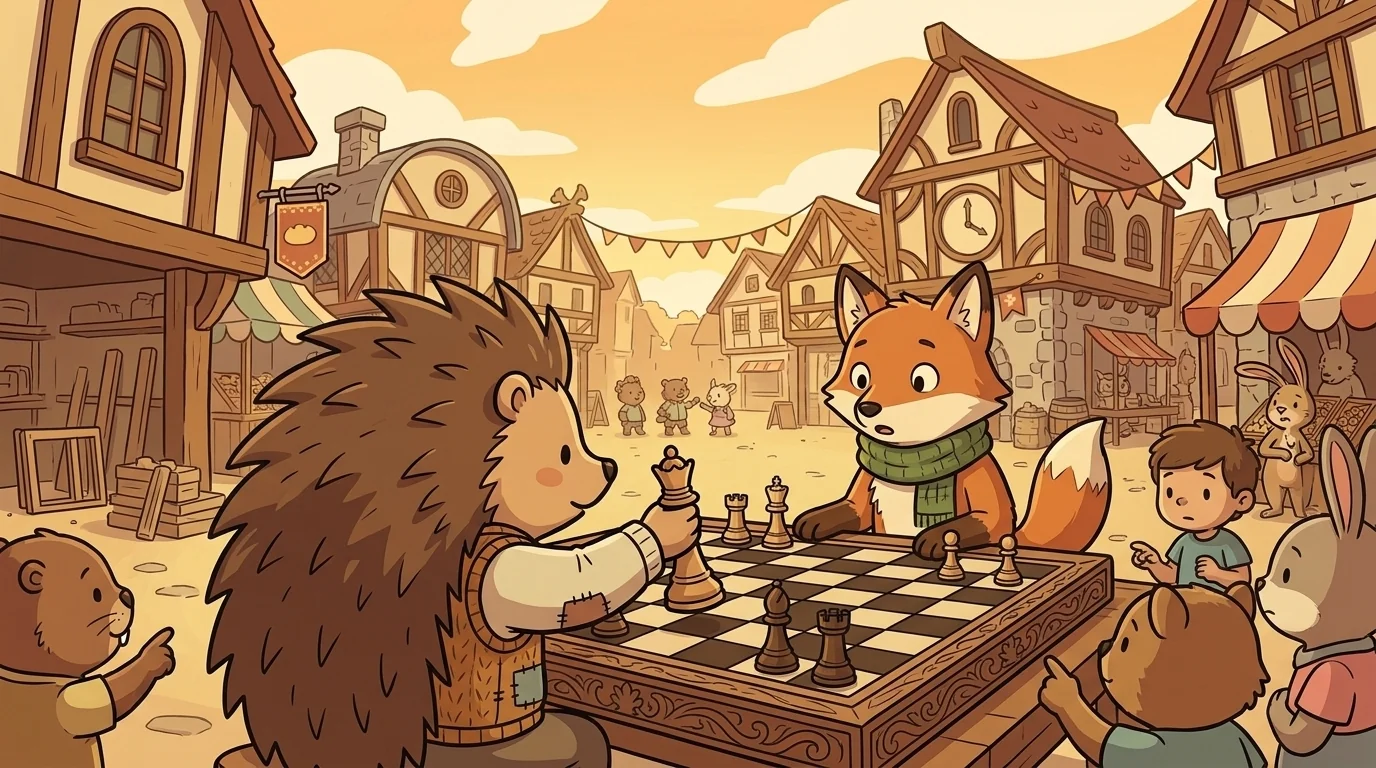
The chessboard, Kester found, was Endby's market square with all the half-done things swept away.
He met his first class on a keen morning. Captain Castle set a position where the black king was hemmed against the edge of the board, and the children saw at once that it was in trouble — but they dithered, checking here, grabbing there, unsure.
"It's nearly over, isn't it?" said a fox in a green scarf. "But which move?"
"Let us check the three doors," said Kester, calmly. "Door one — escape. Can the king run anywhere?" He touched each neighbouring square in turn. "Every square around it is either off the board or covered by us. No escape. Door two — block. If we check it, can anything of theirs step in the way?" He traced the line. "Nothing can reach in between. No block. Door three — capture. Can they take the piece that gives the check?" He looked. "It is defended. They cannot capture it." He met the fox's eyes. "No escape, no block, no capture. All three doors are shut." He lifted his queen and set it down, once, with a soft and final click, delivering the check. "So this is the last move. It is over."
The room was still. The fox in the green scarf wrote no escape, no block, no capture — then it is the last move in her notebook, and did not underline it, because some things do not need underlining. Captain Castle, in the doorway, was quiet for a moment, out of respect for the ending.
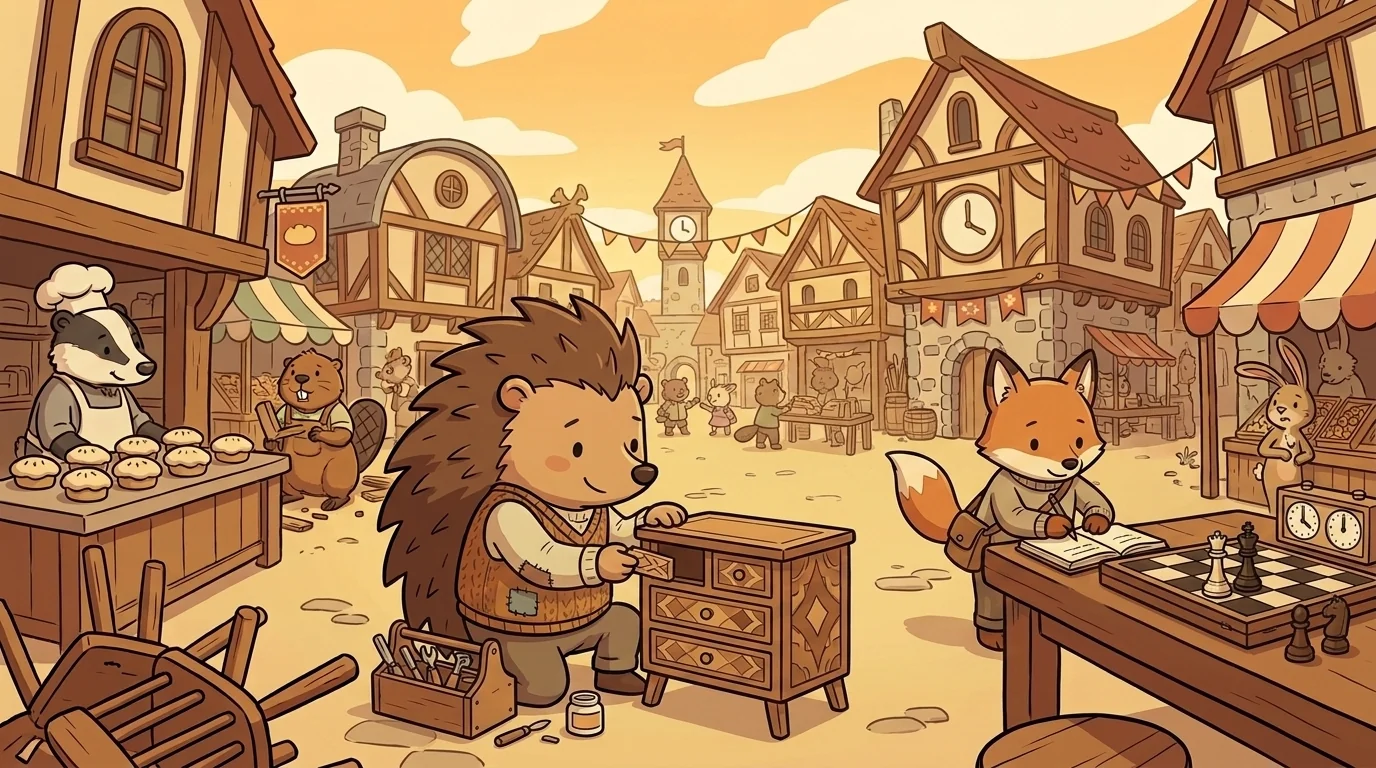
He still finishes things around the town — a chair, a cake, a game gone long.
But when the lessons end and the children have gone home, Kester studies the folded board the way he studies any nearly-done thing in Endby — asking, with his quiet steadiness, whether the three doors are truly all shut, and whether this is the move that ends it.
Sometimes the fox with the notebook stays behind, and asks, "How do you stay so calm at the very end, Kester? Doesn't your heart race?"
And Kester will settle himself, the way he settles a wobbling table, and say:
"The end is not the time to hurry — it is the time to be sure. Before the last move, check the three doors: can the king escape, can anything block, can they capture the checker? If all three are shut, the move is real, and you may play it slowly and gladly. Do not fumble the finish. A thing almost done is not done. Land the last move, cleanly, and let it be over."
The fox writes it down. Kester watches her, and feels — in a way he would never say out loud — the deep, level calm of someone who has, once again, actually finished the thing. He closes the board. He walks home through Endby, past a hundred half-done chairs, unbothered, because tomorrow he will finish some of those too.
The GambitTales ensemble
Kester the Finisher is part of GambitTales's distributed-narrative cast. Each character embodies a different curricular primitive; together they teach the full subject.
-

Sir Pinwell
Pin pattern — freezes pieces along a line
-

Twin Knights of Fork Hill
Fork pattern — attack two targets at once
-

Lady Skewer
Skewer pattern — force a valuable piece out of the way
-

Veil & Vow
Discovered attack — step aside to reveal a hidden threat
-

Captain Crossfire
Double attack — one move threatens two targets
-

The Glass Lantern
X-ray attack — light pierces through to the piece behind
-

King Pumble & King Sable
Two kings — librarian and gardener; one step at a time
-

Queen Vesper
Queen — ranger-messenger; any direction, any distance
-

Captain Castle
Mentor + narrator — rook archetype; the mascot who introduces the cast + scaffolds the lesson
-

The Pawn Cohort
Ensemble piece — the four pawn-paired sets (Pawn Patrol + Sienna & Bran + Trotter & Trundle + Gable & Garrett) acting as one in the world layer
-
Merle the Gleaner
Hanging Piece — a piece with no defender is a free piece
-

Sir Sidetrack
Deflection — chase the guard off its duty, then take what it protected
-

Warden Snare
Trapped Piece — a piece with no safe square falls where it stands
-

Mason the Interposer
Interference — cut the line between a defender and its charge
-

Siren Lyra
Attraction — lure a piece onto the square where your next move wins it
-

Vale the Wayclearer
Clearance — move your own piece off the line so the power behind lands
-
Linnet the Netweaver
Checkmate in Two — the first move forces the reply, the second springs the mate