
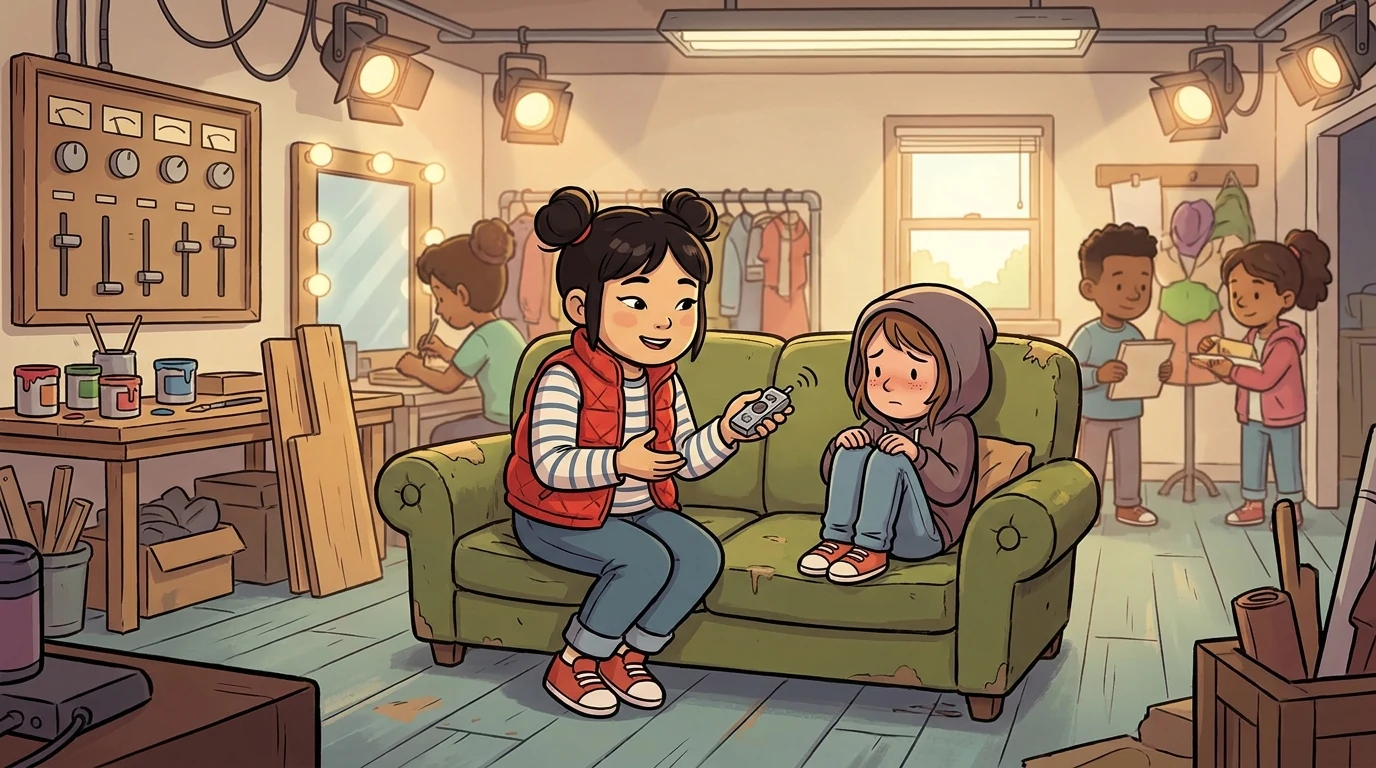
Tolly
HOW MANY, REALLY? - words like everyone, no one and all of them are hidden numbers; counting the real number usually shrinks the claim to its true size.
Listen along — Tolly
Loading audio…
Press play to listen along. The line being read lights up as you go.
Show full transcript
Loading transcript…
Tolly and the Little Silver Clicker
Tolly carries a small silver clicker in her vest pocket, the kind ushers use to count people coming into a theatre. Every time you press the button it clicks, and the number goes up by one.
At the Little Lamp Theatre, she uses it for its real job: counting the audience. But she also uses it for something else.
“Everyone is a number,” she says. “So is no one. So is all of them. You just have to count.”
One Saturday, a younger girl named Juno came into the green room after the matinee and sat down hard on the sofa with her hood pulled over her face.
“I’m never going on stage again,” she said into her hood. “Everyone was laughing at me.”
Tolly felt it land in her own stomach, that horrible drop. She remembered being nine and tripping on the school stage in front of the whole year, and the sound of the laughter seemed to go on forever. It’s one of the worst feelings there is, when you think a whole room is against you.
She sat down on the arm of the sofa. “That sounds awful,” she said, and meant it. Then, gently: “Can I count it with you?”
Juno peeked out from her hood. “Count what?”
Tolly took out the clicker. “Everyone. Let’s find out how many everyone is.”
Juno told the story. In her scene she had to carry a tray of cups across the stage, and a cup slid off and rolled into the wings. She heard laughing.
“Where was the laughing coming from?” asked Tolly.
Juno thought. “The front row. On the left.”
“How many people?”
Juno closed her eyes and pictured it. “Two. A boy and his dad, I think.”
Click. Click. Tolly held up the counter. “So far, two.”
“But the whole audience saw it,” Juno said.
“They saw it,” Tolly said. “Did they laugh?”
Juno thought harder. Then she said, slowly, “When I picked the cup up, some people clapped.”
“How many?”
“Lots. Like… the middle section.”
Tolly didn’t click for those. “So two people laughed, and a lot of people clapped when you kept going.” She turned the clicker round so Juno could see. “That’s not everyone.”
Juno pushed her hood back. Her face was still pink, but she wasn’t hiding any more. “Two is still two,” she said.
“Two is still two,” Tolly agreed. “It’s okay that it stung. But two people laughing is a much smaller problem than everyone hating you. You can survive two.”
The next week Juno carried the tray across the stage again, and this time she held the cups steady with her thumb. Nobody laughed. Tolly was in the back row, clicker in her pocket, and she clapped first.
Counting doesn’t always make things smaller. Sometimes you count and the number really is big, like when lots of people have been unkind for a long time. Then the counting is still useful, because it tells you this is serious, and it’s time to tell a grown-up who can help. A real number is something you can do something about. A feeling that says everyone is just a fog.
So Tolly keeps her clicker handy. When somebody says everyone, no one or all of them, she holds it up with a little smile.
“How many, really?”
The ShadeForge ensemble
Tolly is part of ShadeForge's distributed-narrative cast. Each character embodies a different curricular primitive; together they teach the full subject.
-
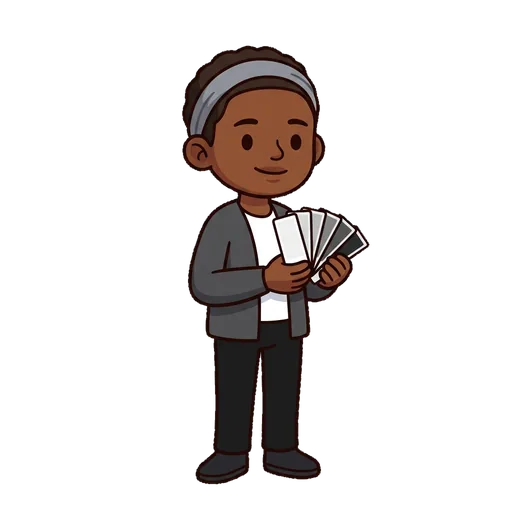
Gamut
(Mentor, a theatre kid with a fan of grey swatches) - never asks who is right; asks what each side really needs
-
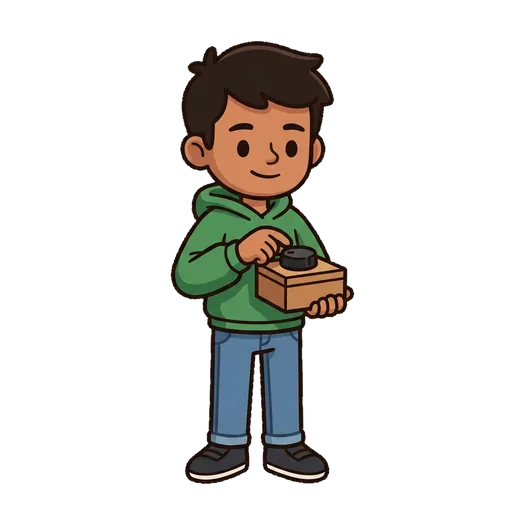
Rheo
Turns an all-or-nothing switch into a dial
-

Ellery
Asks how much, compared with what
-
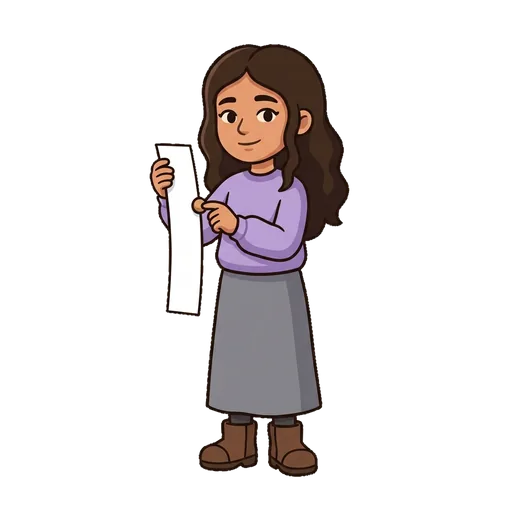
Odelia
Asks how sure we really are
-
Halvie
The Split move - each side gets part of what they want
-

Turnby
The Alternate move - take turns across time
-

Quid
The Trade move - swap something each side values
-
Tierney
The Stack move - do both, one on top of the other
-

Novo
The Third Option - invents what neither side proposed
-

Truett
Tells a question with a true answer from a trade-off of values