
Fluenna
FLUENCY — smooth, expressive reading at a comfortable pace. It comes from REPEATED READING: read a passage once (rough is fine), again (smoother), again (it flows). Accuracy comes first; smoothness is earned by going back through, the way a musician practices a piece.
Loading audio…
Press play to listen along. The line being read lights up as you go.
Show full transcript
Loading transcript…

A student named Amara read a paragraph correctly — every word right — but in a slow, word-by-word monotone, and at the end she couldn't say what it had been about.
Fluenna, warm and rhythmic, nodded like she'd seen it a hundred times. "You read every word correctly. That's the hard part, and you nailed it. But it came out one… word… at… a… time, and all your effort went into the words, so there was nothing left over for the meaning." She tapped the paragraph. "Read it again."
Amara did. It was smoother.
"Again."
The third time, it flowed — and Amara looked up, surprised. "It's about a boy who's scared of the dark." She'd understood it, because this time the reading was smooth enough to leave room to think.
"That's fluency," said Fluenna. "Smooth, expressive reading at a comfortable pace. And it comes from one thing: repeated reading. Not reading harder. Reading again."

Fluenna had once thought re-reading was a sign of failure.
When she was young, if she had to read a sentence twice, she felt stupid — as though a "real" reader would get it in one pass. So she never went back, and her reading stayed choppy and effortful, and she never understood much of what she read because every drop of attention was spent on decoding the words. She thought smoothness was something you either had or didn't.
An old teacher who also played the cello set her straight. "Do you think I play a piece perfectly the first time?" she asked. "I play it rough, then smoother, then it flows. Re-reading isn't failure. It's practice — the exact same thing a musician does. The first read is for accuracy. The second and third are for flow. You don't go back because you're bad. You go back because that's how flow is made." She handed her a short passage. "Read it three times. Watch what happens."
Fluenna read it three times, and by the third it sang — and for the first time she understood it, because her mind was finally free. The re-reading-is-failure shame dissolved into a musician's patience. She had never been a hopeless reader. She'd just been quitting after the rough first take.
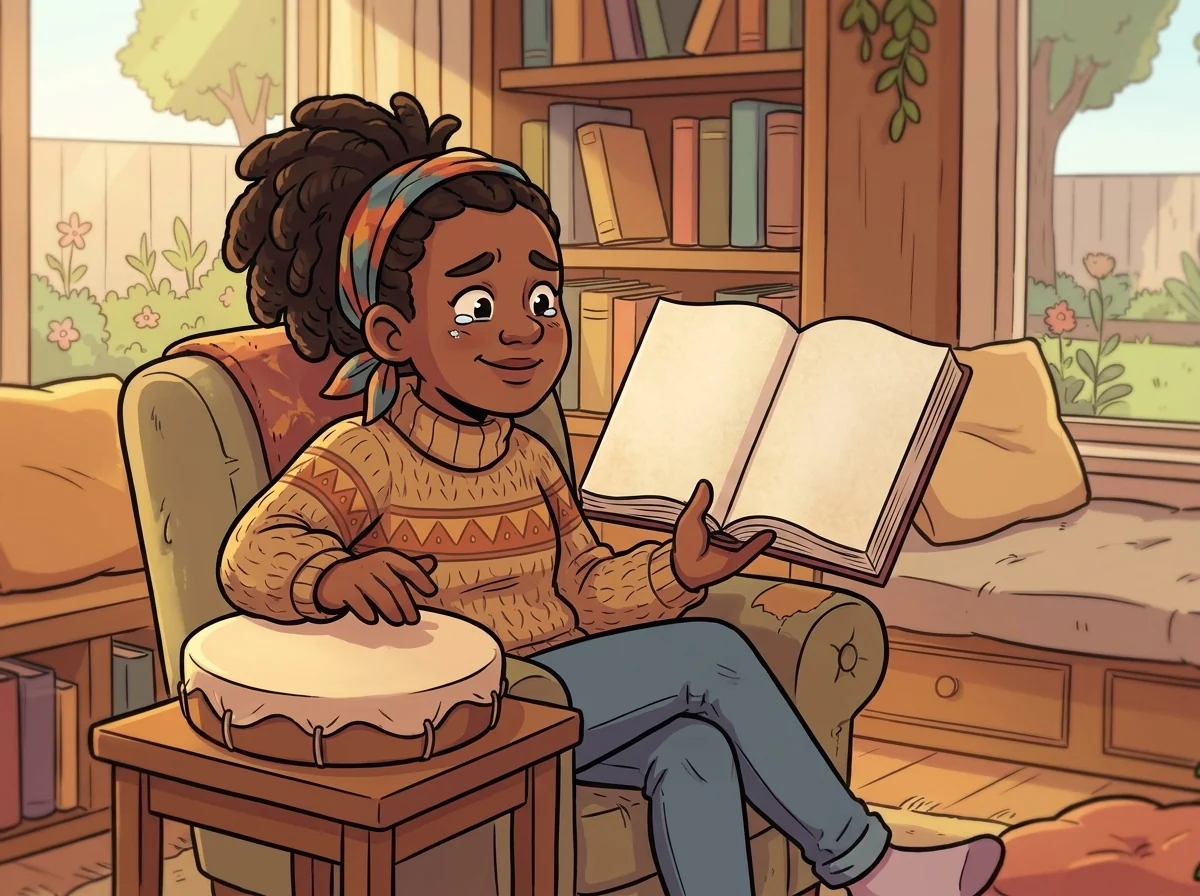
There is a reason fluency matters so much, and Fluenna gave it to Advanced readers straight.
"Your attention is a fixed amount," she said. "When reading is choppy, you spend all of it on decoding the words — and there's none left for understanding. When reading is fluent, decoding goes almost automatic, and all that freed-up attention pours into meaning. That's why fluency isn't just 'sounding nice.' It's the bridge between decoding and comprehension. A slow, correct, exhausting reader understands little, not because they can't think, but because thinking needs the attention that the words are eating." She tapped her chest, rhythmic. "Repeated reading makes the words cheap, so meaning becomes affordable."

"And here's how to practice it well," Fluenna went on. "Pick a passage that's a little hard but not brutal — one where you get most words right on the first pass. Read it aloud. Read it again, a bit faster and smoother. Read it a third time with expression — let your voice rise and fall, pause at the commas, punch the important words. Expression is the proof of understanding: you can't read a sentence with the right feeling unless you know what it means." She smiled. "And re-read passages you've already decoded — fluency practice isn't for brand-new hard words; that's Chip and Segwyn's job. Fluency is for polishing words you can already get right, until they flow."

Amara took a page she'd decoded the day before and read it three times.
First pass: smooth-ish. Second: smoother. Third: she read it with expression — pausing, rising, falling — and when she finished she could not only say what happened but how the boy felt. The reading had become cheap enough that the meaning came free.
"That's the whole thing," said Fluenna, warm. "Accuracy first — always. Then read it again, and again, until it flows and your voice carries the meaning. You're not going back because you failed. You're going back because that's how flow is built — one more pass, the way a musician earns a piece." She grinned. "Rough, smoother, flowing. That's the road, and everyone walks it."
The re-reading-is-failure shame settled into a practicer's calm. Amara wasn't a slow reader. She'd just been stopping after the rough first take, like a musician who plays a piece once and calls it done.
The DecodeForge ensemble
Fluenna is part of DecodeForge's distributed-narrative cast. Each character embodies a different curricular primitive; together they teach the full subject.
-

Segwyn
Segment & blend (mentor) — the master decoder who slides a word apart into its sounds and back together, and coaches the rest
-

Chip
Syllable division — chips a big word into syllable chunks you can actually say
-

Digby
Digraphs — fuses two letters into ONE sound (the 'one-breath' trick)
-

Blenda
Consonant blends — smashes a cluster together so each sound still shows
-

Silent Ellie
Silent / magic-e — stands silent at a word's end and makes the vowel say its name
-

Sylva
Vowel teams — pairs two vowels so the first does the talking
-

Prefa
Prefixes — clips a meaning-unit onto the FRONT of a word
-

Rootley
Roots / bases — holds the meaning core everything attaches to
-

Fixby
Suffixes — tacks a meaning-unit onto the END and guards the spelling-change rule
-

Mapper
Phoneme-grapheme mapping — maps each sound to its spelling tile on the board