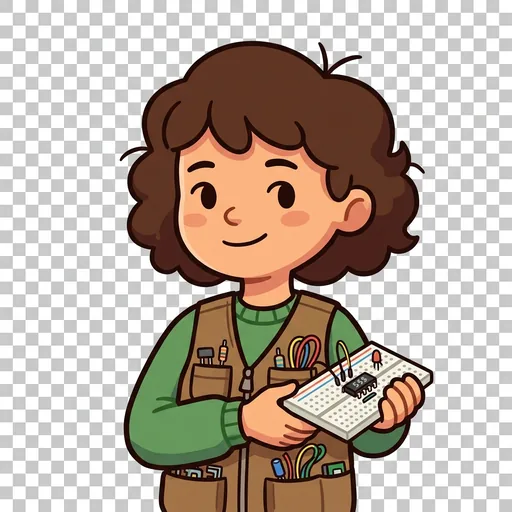
Rootley
ROOTS / BASES — the core part of a word that carries its main meaning; prefixes and suffixes attach to it. The root "port" means "carry" — so transport, import, export, portable, porter all share that meaning. Find the root and you often know the whole word's meaning.
Loading audio…
Press play to listen along. The line being read lights up as you go.
Show full transcript
Loading transcript…

If Prefa is the fast one and Blenda is the juggler, Rootley is the still one. He sits at a wide, worn workbench near the back, and he doesn't rush anywhere, and things tend to gather around him.
Rootley's job is to hold the core — the piece in the middle of a long word that carries its real meaning. Take the little root port. On its own it just means one thing: carry. But watch what gathers around it. Put people on the front and end and you get transport — carry across. import — carry in. export — carry out. portable — able to be carried. porter — a person who carries. Five different words, five different sizes, and every single one is built on Rootley's small, steady core.
"The chunks on the front and back get all the attention," Rootley says, in no hurry. "Prefa flips the meaning, Fixby changes the ending. But everything they do, they do to me. Find the root, and you've usually found what the whole word is actually about."

Rootley was not a flashy kid, and for a long time that felt like a problem.
He wasn't the fastest or the loudest or the one who won things. In every group he was the reliable one — the kid who remembered the plan, who showed up, who held the middle steady while flashier kids spun around the edges. And nobody makes a big deal about the reliable one. Trophies go to the star. So Rootley grew up quietly wondering if being steady was the same as being boring. Being forgettable. Being less.
Reading fed the same feeling. He'd meet a word like transportation and it felt like a wall of important-looking chunks — trans, tion — parts that seemed to matter more than plain little port sitting in the middle. He tried to read from the fancy outsides in, and got lost every time.
The thing he couldn't see yet was that the plain little middle was the only part that told you what the word meant. trans just means "across." tion just makes it a thing. But port — carry — that's the heart. Strip away the flashy chunks and the quiet core is what's left standing. Same as him.

An old woodworker taught him, using a real tree. She pointed at the branches waving around in the wind — showy, loud, always moving. "Everybody looks at those," she said. "But cut the roots and the whole tree's dead by morning. The loud parts are only up there because something quiet is holding them." She wrote port on a board and then built words off it, one after another. "The root's the part nobody claps for. It's also the part the whole family is standing on."
Rootley looked at the little word holding up all the big ones, and felt something settle in his chest that had been unsettled for years.
So when a boy named Marcus — quiet, dependable, convinced he was the boring one — got stuck on a page full of long words, Rootley knew him on sight.
Marcus stared at unbreakable, predict, transport like they were three separate enemies. "There's too many," he said. "Every long word is a whole new thing to learn."

"They're not new," Rootley said, unhurried. "Most of them are old friends wearing different coats. Watch." He wrote port — small, plain, in the middle of the bench. "This means carry. That's all. Just carry." Then he built outward. "Carry across — transport. Carry in — import. A thing you can carry — portable." He tapped the little root each time. "Same heart. Different coats."
"So if I know the middle bit..." Marcus said slowly.
"...you know what the whole family's about. You don't learn a hundred long words. You learn a handful of roots, and the long words start explaining themselves." Rootley wrote spect — "look" — and built inspect, respect, spectator off it, watching Marcus's face change with each one. "See? You just read four hard words. You only learned one small thing."
Marcus read them again, finding the quiet core in the middle of each. The walls turned back into families.

But Rootley could tell the reading wasn't the part that had landed hardest.
"The middle bit," Marcus said. "The plain one. That's the important one? Not the fancy parts on the ends?"
"The plain one's the important one," Rootley said. "The fancy parts change how — across, in, again, not. But the root is what. It's the thing everything else is standing on." He let that sit. "I spent a long time thinking the quiet steady piece didn't count for much. That you had to be flashy to matter. Took me years to figure out the flashy parts only work because something plain and dependable is holding them up. That's not boring. That's the most important job there is."
And that's what Rootley gives to every kid who's quietly decided that being steady means being less: the plain, reliable core isn't the forgettable part. It's the part everything else is built on. Being dependably, quietly yourself — the one who holds the middle while others spin — isn't a lesser way to be. It's the root. And you cannot grow a single big thing without one.
Marcus started collecting roots the way some kids collect cards — port, spect, dict, struct — small plain words that quietly held up hundreds of bigger ones. He said they reminded him of himself, and for once that felt like a good and steady thing to be. Rootley told him that was exactly the right thing to notice.
The DecodeForge ensemble
Rootley is part of DecodeForge's distributed-narrative cast. Each character embodies a different curricular primitive; together they teach the full subject.
-

Segwyn
Segment & blend (mentor) — the master decoder who slides a word apart into its sounds and back together, and coaches the rest
-

Chip
Syllable division — chips a big word into syllable chunks you can actually say
-

Digby
Digraphs — fuses two letters into ONE sound (the 'one-breath' trick)
-

Blenda
Consonant blends — smashes a cluster together so each sound still shows
-

Silent Ellie
Silent / magic-e — stands silent at a word's end and makes the vowel say its name
-

Sylva
Vowel teams — pairs two vowels so the first does the talking
-

Prefa
Prefixes — clips a meaning-unit onto the FRONT of a word
-

Fixby
Suffixes — tacks a meaning-unit onto the END and guards the spelling-change rule
-

Fluenna
Fluency — reads the same passage until it flows, keeping the beat (repeated reading)
-

Mapper
Phoneme-grapheme mapping — maps each sound to its spelling tile on the board