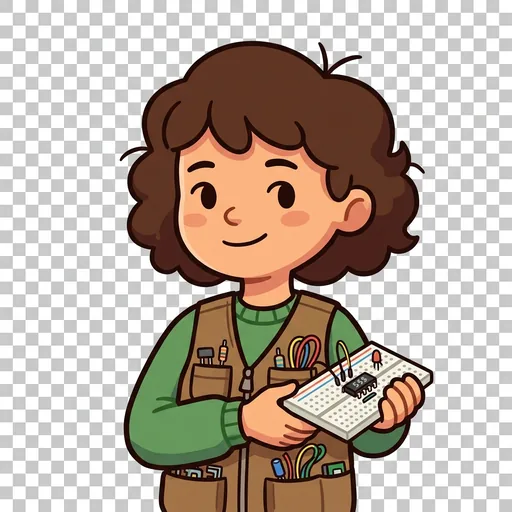
Fluenna
FLUENCY — smooth, expressive reading at a comfortable pace. It comes from REPEATED READING: read a passage once (rough is fine), again (smoother), again (it flows). Accuracy comes first; smoothness is earned by going back through, the way a musician practices a piece.
Loading audio…
Press play to listen along. The line being read lights up as you go.
Show full transcript
Loading transcript…

Fluenna reads like there's music in it, and there sort of is. She keeps a small drum by her chair, and when she reads a passage out loud she taps a soft beat, so the words come out with a rhythm instead of in lonely, stumbling clumps.
Here's her secret, and it surprises everybody: Fluenna's first read of anything is bumpy. She'll pick up a page she's never seen and read it aloud, and she'll stumble, backtrack, land on a word wrong, fix it. She does this on purpose, right in front of you, so you can see it.
Then she reads the same page again. Smoother. Fewer stumbles. Then a third time — and now it flows, now it has feeling, now it sounds like a person talking instead of a person decoding.
"That's the whole thing," she says, tapping her drum. "Nobody reads it beautiful the first time. Not me. Not anybody. Smooth isn't how you start. Smooth is what you get for going back through."

Fluenna had to learn this, because as a kid the bumpy first read nearly made her quit reading forever.
She could decode. She'd worked with the others — she could take a word apart and get it right. But when she read out loud, it came out in choppy little chunks: "The... dog... ran... to... the..." Each word separate, no flow, no feeling, like reading a grocery list of unrelated items. And it sounded so bad to her own ears — so un-smooth compared to how grown-ups read — that she decided the choppiness meant she wasn't a real reader. Real readers, she figured, just opened a book and it poured out beautiful. Hers came out in gravel.
What nobody had told her was that everybody's first read is gravel. The smooth, pouring, beautiful reading she was comparing herself to? That was somebody's third or tenth pass at that kind of sentence, not their first. She was holding her rough draft up against everyone else's polished performance and concluding she was broken.
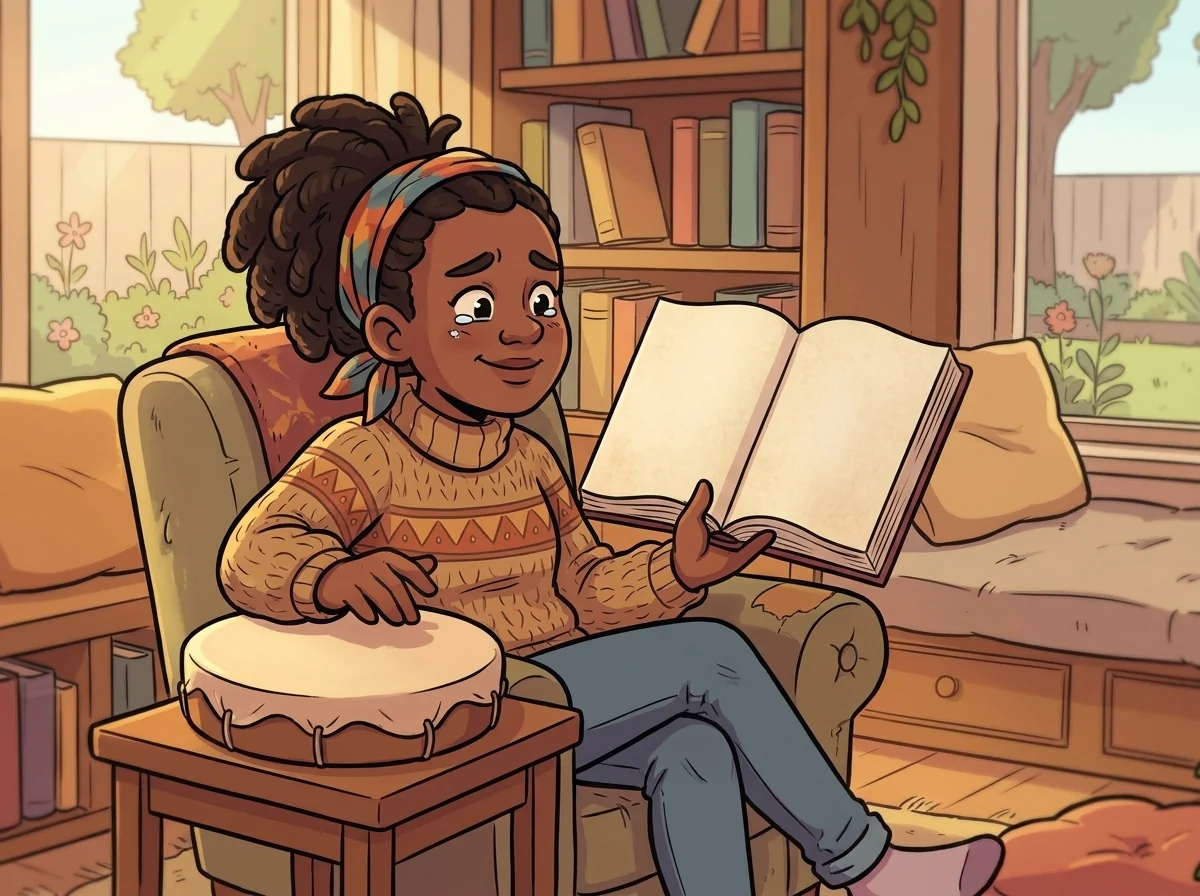
Her aunt, who played the fiddle, is the one who cracked it. Fluenna heard her practice a tune one evening — and the first time through it was awful. Screechy, halting, wrong notes. Fluenna was shocked; her aunt was good. "That's the first pass," her aunt shrugged. "It's supposed to sound bad. Nobody's heard it yet — including my own hands." She played it again. Better. A third time. And by the fifth time it was the beautiful thing Fluenna knew her aunt could play.
"You thought I just picked up the fiddle and it sounded like this?" her aunt laughed. "Nobody does anything smooth the first time. Reading's the same. Read it again. And again. The smooth is in the again."
Fluenna went home and read the same short page five times. By the fifth it flowed. She cried a little, honestly — not from sadness, from relief. She wasn't broken. She'd just been quitting after the rough draft.
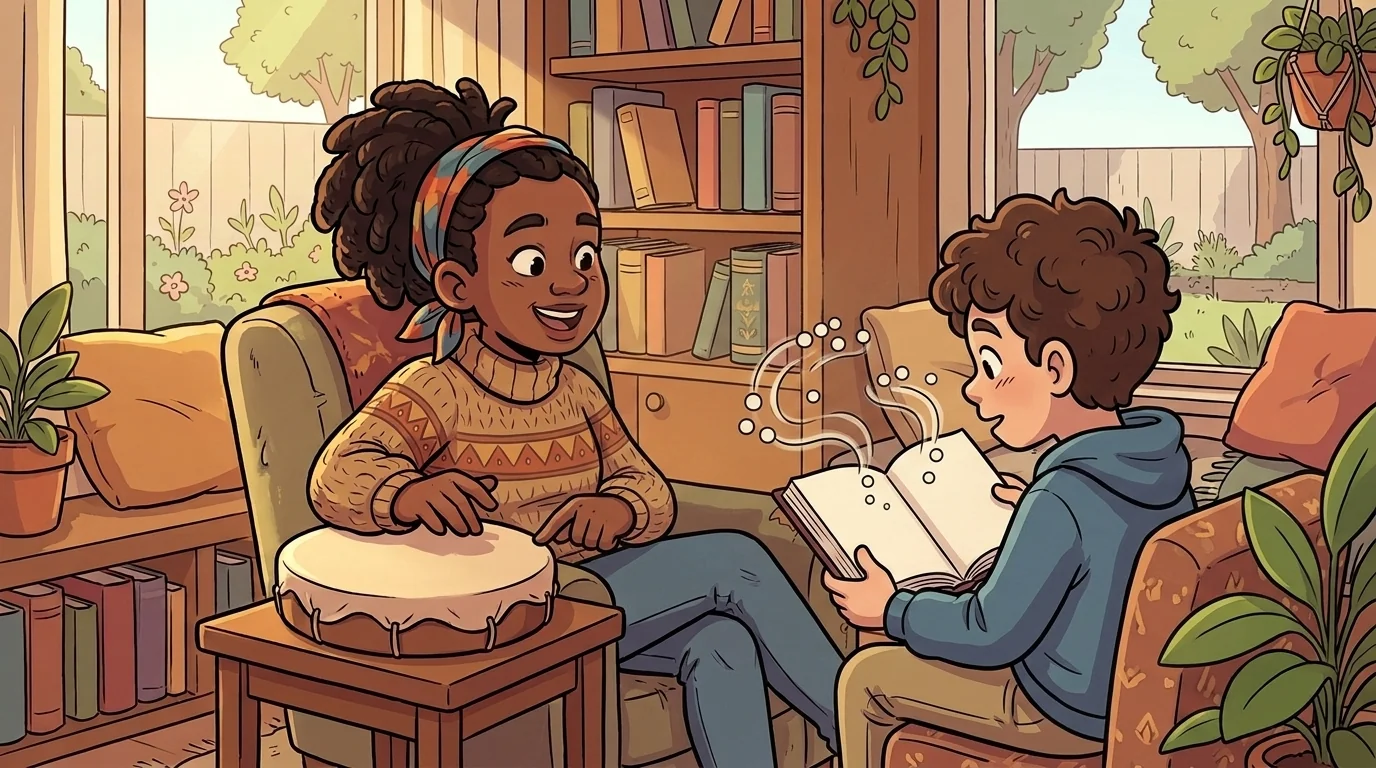
Which is why she was exactly right for a boy named Owen, who read every word correctly and still called himself a bad reader.
"I can say all the words," Owen said, miserable. "But listen." He read a sentence, and it came out in that flat, chopped, word-by-word way. "See? It sounds like a robot. Real readers don't sound like that. I'm accurate but I'm... bad."
"You're not bad. You're on pass one," Fluenna said. "And pass one is supposed to sound like that. You've got the hard part already — you're getting every word right. Smoothness isn't a different, better kind of person. It's just the same page, read again." She tapped her drum, soft. "Read it once more. Don't try to be smooth. Just let the words lean toward each other a little."
Owen read it again. A hair smoother.
"Again. Ride the beat."
Third time — and something loosened. The words started bunching into little phrases instead of standing alone. It started to sound like talking.

Owen stopped, kind of stunned at his own voice. "That was way better. That was... it sounded normal."
"That was pass three," Fluenna grinned. "Same words. Same you. You just stopped quitting after the rough one." She set down the drum. "Here's the part I really need you to keep. That first bumpy read? That wasn't you failing. That was you starting. Every single smooth reader you've ever heard sounded like a robot on their pass one of that sentence — you just never got to hear their pass one. You've been judging your first draft against everybody else's final take. Of course it felt bad. It was never a fair fight."
And that's the thing Fluenna hands to every kid who's decided they're a bad reader because it doesn't pour out smooth: the bumpy first read is not the verdict. It's the beginning. Smoothness was never something you either have or don't — it's something you earn, one more pass at a time, and needing another pass isn't shameful, it's how literally every good and smooth thing in the world got that way. You were never bad. You were on pass one. Go again.
Owen started reading his favorite short pages three times each, out loud, just for the feeling of pass three. He said pass three felt like the words finally belonged to him. Fluenna said that's because they did.
The DecodeForge ensemble
Fluenna is part of DecodeForge's distributed-narrative cast. Each character embodies a different curricular primitive; together they teach the full subject.
-

Segwyn
Segment & blend (mentor) — the master decoder who slides a word apart into its sounds and back together, and coaches the rest
-

Chip
Syllable division — chips a big word into syllable chunks you can actually say
-

Digby
Digraphs — fuses two letters into ONE sound (the 'one-breath' trick)
-
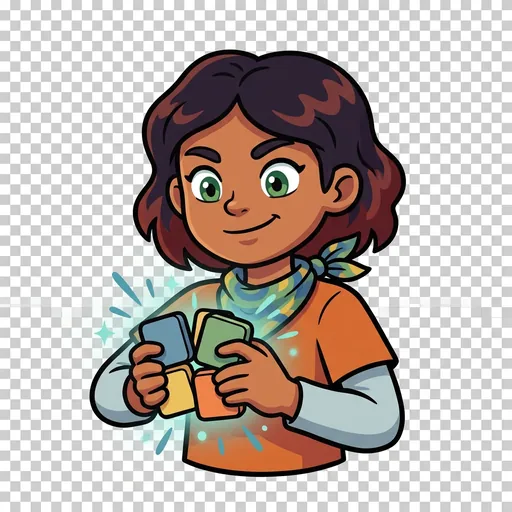
Blenda
Consonant blends — smashes a cluster together so each sound still shows
-
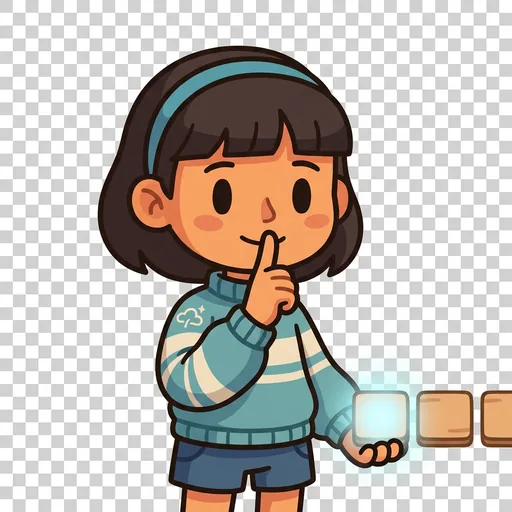
Silent Ellie
Silent / magic-e — stands silent at a word's end and makes the vowel say its name
-

Sylva
Vowel teams — pairs two vowels so the first does the talking
-

Prefa
Prefixes — clips a meaning-unit onto the FRONT of a word
-

Rootley
Roots / bases — holds the meaning core everything attaches to
-

Fixby
Suffixes — tacks a meaning-unit onto the END and guards the spelling-change rule
-

Mapper
Phoneme-grapheme mapping — maps each sound to its spelling tile on the board