
Silent Ellie
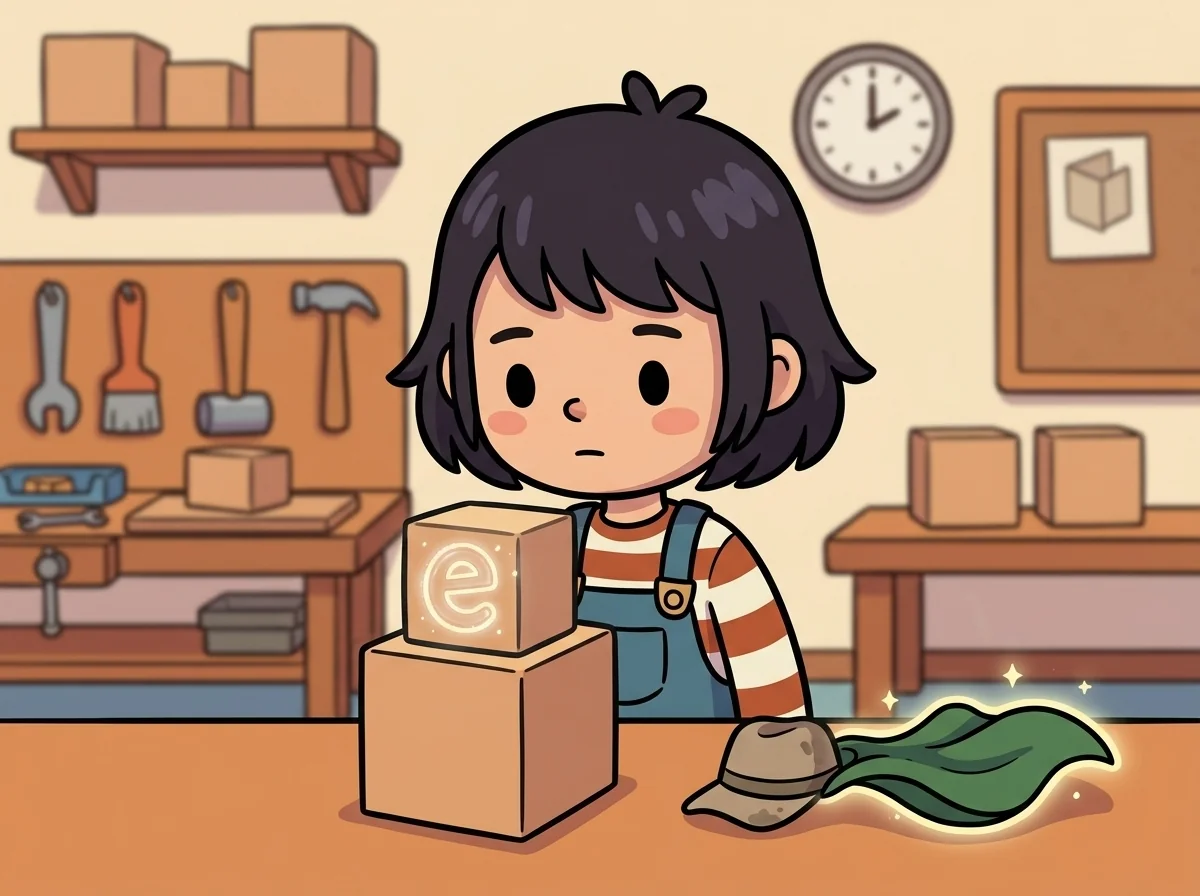
SILENT / MAGIC E — an e on the end that makes no sound of its own, but reaches back over one consonant and makes the vowel say its NAME (long sound). cap becomes cape; hop becomes hope; kit becomes kite. This is the VCe pattern (vowel-consonant-e).
Loading audio…
Press play to listen along. The line being read lights up as you go.
Show full transcript
Loading transcript…

A student named Theo read cape as "cap" and stopped, puzzled that the sentence made no sense.
Silent Ellie — quiet, dry, easy to overlook — pointed at the small e on the end. "You skipped me," she said mildly. "I don't blame you. I make no sound at all. But watch what I do." She covered the e. "cap — short /a/." She uncovered it. "cape — now the /a/ says its own name, /ay/. I reach back over one consonant and tell the vowel: say your name. I'm silent, but I change everything."
Theo read it again. "Cape." The sentence made sense now.
"That's the VCe pattern," said Ellie. "Vowel, one consonant, then me — the silent e. When you see it, the vowel goes long. hop becomes hope. kit becomes kite. cub becomes cube. Tub becomes tube. I'm the quietest letter in the word and the most powerful."

Ellie had spent her young years being ignored, and watching readers pay for it.
They'd read hope as "hop," ripe as "rip," cane as "can," and the sentences would quietly stop meaning anything — and the reader would blame themselves, never suspecting that one silent letter at the end held the whole vowel's identity. It made her ache a little. She was right there, doing her job, and no one looked to the end of the word to check for her.
An old teacher taught readers a habit that changed everything: scan to the end before you commit to the vowel. "Before you decide the middle vowel is short," she said, "look at the end of the word. Is there a silent e reaching back? If yes, the vowel is long. If no, short. You read the end to know the middle." She smiled at Ellie. "You're not overlooked anymore. Now they check for you first."
Readers who learned to glance at the word's end before fixing the vowel stopped tripping — and Ellie stopped being invisible. The overlooked, taken-for-granted feeling turned into a quiet, load-bearing pride. She had always mattered. Readers had just been stopping their eyes one letter too soon.
There is a why behind Ellie, and she offered it to Advanced readers, because a rule you understand is a rule you keep.
"Long vowel really means the vowel says its alphabet name," she said. "/ay/ /ee/ /eye/ /oh/ /you/. Short vowel is the little sound — /a/ /e/ /i/ /o/ /u/. English needed a way, on paper, to flip a vowel from short to long without adding a whole new letter. So it invented me: a silent marker on the end that signals 'the vowel before me is long.' I'm not decoration. I'm a switch. Cover me and the switch is off — cap. Uncover me and it's on — cape." She tilted her head. "Once you know I'm a switch, you never forget to look for me."

"And here are my honest exceptions," Ellie said, because Advanced readers get the exceptions with their reasons. "have, give, live, love. They end in silent e but the vowel stays short. Why? Because there's a spelling rule older than my switch: no English word is allowed to end in the letter v. So hav must become have — the e is there to obey the no-v-ending rule, not to lengthen the vowel." She shrugged, dry. "When my e is only there to prop up a v, don't expect me to do my switch-job too. That's not the rule breaking. That's two rules sharing one letter." She tapped come and some. "A few others are just old, common words you learn by sight. Rare. The switch works the vast majority of the time."

Theo went back to his book and hit stripe.
Once he'd have read "strip" and stalled. Now his eye ran to the end first — silent e, reaching back over the p — so the i said its name. "Stripe." Then, on the next line, strip, no e: short /i/. Same letters in the middle; the ending told him which vowel to use.
"That's it," said Ellie, quiet and pleased. "Read the end to know the middle. I never make a sound. I just tell the vowel who it really is." She almost smiled. "You'll never skip me again."
The self-blaming, sentence-stopped feeling settled into a small, precise confidence. Theo hadn't been a careless reader. He'd been stopping his eyes one silent letter too soon.
The DecodeForge ensemble
Silent Ellie is part of DecodeForge's distributed-narrative cast. Each character embodies a different curricular primitive; together they teach the full subject.
-

Segwyn
Segment & blend (mentor) — the master decoder who slides a word apart into its sounds and back together, and coaches the rest
-

Chip
Syllable division — chips a big word into syllable chunks you can actually say
-

Digby
Digraphs — fuses two letters into ONE sound (the 'one-breath' trick)
-
Blenda
Consonant blends — smashes a cluster together so each sound still shows
-

Sylva
Vowel teams — pairs two vowels so the first does the talking
-

Prefa
Prefixes — clips a meaning-unit onto the FRONT of a word
-

Rootley
Roots / bases — holds the meaning core everything attaches to
-

Fixby
Suffixes — tacks a meaning-unit onto the END and guards the spelling-change rule
-

Fluenna
Fluency — reads the same passage until it flows, keeping the beat (repeated reading)
-

Mapper
Phoneme-grapheme mapping — maps each sound to its spelling tile on the board