
Block Bodhi
BLOCKING — occupying the single empty point of an opponent's almost-mill so the line can never close; the discipline is triage, blocking only the threats that can truly complete this turn and would truly cost you
Loading audio…
Press play to listen along. The line being read lights up as you go.
Show full transcript
Loading transcript…
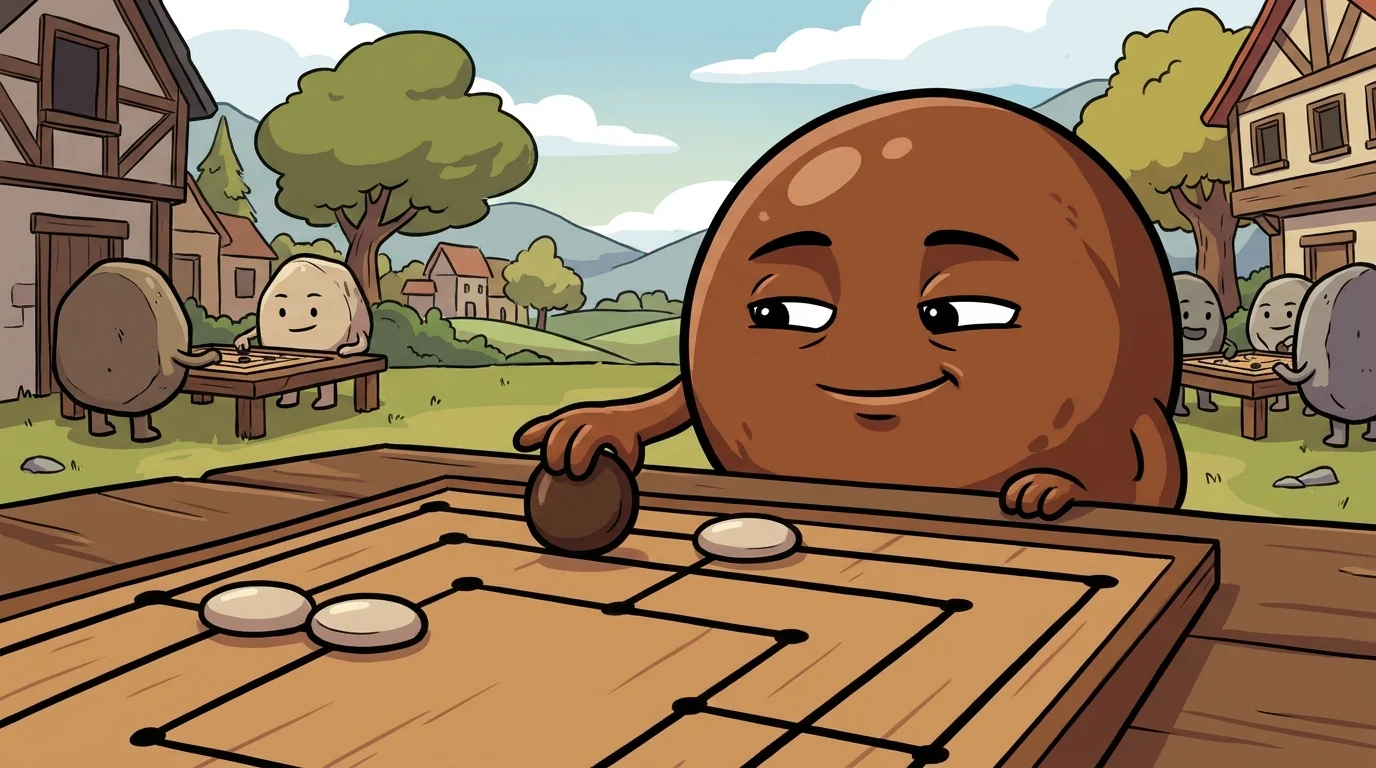
The Elder set the board between them mid-game — nine pieces already placed on each side, the sliding phase well underway — and let Bodhi study it in silence.
"There are four almost-mills on this board," the Elder said at last. "Three are yours to worry about. Name them."
Bodhi's eyes moved along the sixteen mill-lines the way another student might read a sentence. An almost-mill, he had learned to see, was any line holding two enemy pieces and one empty point — a threat one slide away from closing. He found them quickly: the opponent's two stones on the top edge needing only the corner; two on the left spoke needing the cross-point; two in the inner ring, a gap between them; and one more, a pair on the bottom that pointed at a filled point.
"That last one," Bodhi said, "isn't a threat. The empty point it needs — there's no enemy piece adjacent that can slide into it this turn. They'd have to spend two moves getting there. It's a phantom."
"Good," said the Elder. "You've done the arithmetic. Most beginners see two enemy stones in a line and panic. They block every pair on the board and lose — not because they blocked wrong, but because they blocked everything, and a player who spends every turn plugging holes never digs a well of his own."

Bodhi remembered that lesson in his bones, because he had once been that panicked beginner.
He told the younger students about it plainly. "When I was new, every pair of enemy stones looked like a knife. I'd race around the board dropping pieces onto every gap — this line, that line — feeling very busy and very safe. And I lost every game, slowly and completely, because I never built a single mill of my own. I stopped a dozen threats and captured nothing. Defense that never turns into offense is just a long, tidy way to lose."
The subtext, the older students understood, was not really about morris. It was about the difference between being busy and being effective — between reacting to every alarm and choosing which alarms were real.

The genuine skill, Bodhi taught, had three questions, asked in order, before you ever touched a piece.
First: can they actually close this mill on their next turn? Not eventually — this turn. A threat that needs two moves to arrive is not urgent; you have a free tempo to build while they set up. Second: would it hurt if they did? Some mills, even if closed, capture a piece you can spare, or a piece already safe inside a mill of your own. A closing mill that costs you nothing is not worth a defensive turn. Third, and only if the first two were yes: is the blocking point also useful to me? The best block is a piece that denies their line AND sits on one of your own almost-mills — a move that guards and builds in the same breath.
"Block the mill that can close now and would cost you something," Bodhi said, "on a point that also helps you. Let the phantoms go. Every turn you save from blocking a false threat is a turn you can spend closing a mill of your own."

The Elder tested him with a cruel little position: two enemy almost-mills, both real, both able to close next turn, and only one Bodhi could block.
Bodhi did not rush. He counted what each closing mill would take. The first would capture a spare piece sitting uselessly in a corner — a piece he'd been meaning to move anyway. The second would capture the keystone of his own swinging setup, the piece that made three of his lines work at once.
"I block the second," Bodhi said, sliding his stone onto the point the enemy needed. "The first mill closes — let it. It takes a piece I don't need. If I'd blocked the first and lost the keystone, I'd have saved a pebble and lost the machine."
"You let a mill close on purpose," the Elder observed.
"I let the cheap one close," Bodhi corrected. "That's not surrender. That's arithmetic. You can't block both, so you block the one that matters and you pay the small bill without flinching."

Later, watching two younger students play, Bodhi saw the older lesson land in real time.
One of them, anxious, blocked every pair the instant it formed, ran her pieces ragged, and built nothing. The other ignored the phantoms, blocked only the two threats that could truly close, and spent his saved turns quietly assembling a mill of his own. Halfway through, the difference became a chasm — one board all defense and no gain, the other advancing turn by turn.
"See it?" Bodhi murmured to no one in particular. "She's not losing because she blocks badly. She's losing because she can't tell the real threat from the noise, so she treats them all the same. And when everything is urgent, nothing gets built."
He set a fresh board for them afterward and gave them the only rule that had ever mattered to him: before you block, ask whether it can close, whether it would hurt, and whether the block helps you too. If you can answer those three, you'll spend your turns on the threats that are real — and you'll have turns left over to win.
The MillSong ensemble
Block Bodhi is part of MillSong's distributed-narrative cast. Each character embodies a different curricular primitive; together they teach the full subject.
-

Miller Mila
The mill: lining up three stones on a line
-

Snatch Nadia
Capture-on-mill: removing a piece the moment a mill closes
-

Guard Gwen
The not-in-a-mill rule: a stone inside a mill is safe
-

Spoke Sami
Prime points: the strong spoke midpoints (three mill lines each)
-

Corner Cato
Corner points: the low-value corners (two mill lines each)
-
Placer Pell
The placement phase: building a mill network with the nine
-

Slide Sile
The movement phase: sliding a stone to an adjacent point
-

Swing Sena
The swinging (running) mill: opening and re-closing to capture again
-

Flyer Faye
The flying phase: hopping anywhere once down to three men
-
Reduce Remy
The endgame: winning by reducing the opponent to two
-

Elder Merel
The mills-puzzle elder (mentor): find-the-mill / which-to-take puzzles