Guard Gwen
The PROTECTION RULE — a piece that stands inside a mill cannot be captured, unless every one of the opponent's pieces is inside a mill (then any may be taken)
Loading audio…
Press play to listen along. The line being read lights up as you go.
Show full transcript
Loading transcript…
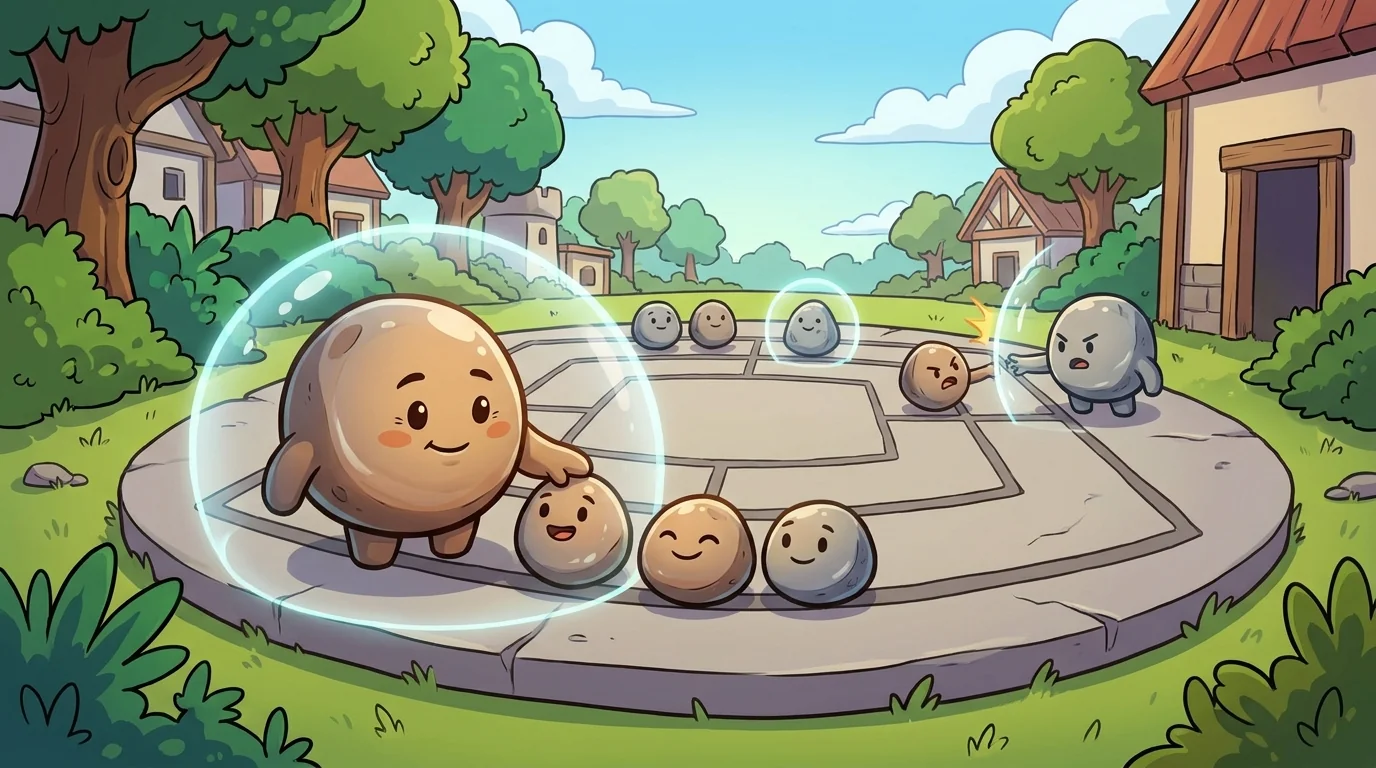
Where Nadia loved to take pieces, there was a quiet, watchful piece named Gwen who devoted her whole game to making sure her own pieces could not be taken — and the rule she lived by was one of the game's cleverest.
The rule was this: a piece standing inside a completed mill could not be captured. When an opponent closed their line and reached across to snatch, they were not allowed to pluck a stone that was safely part of a mill — they had to take an unprotected one instead. (Unless, of course, every one of your pieces was tucked inside a mill; then the protection lifted and any could be taken. But that was rare, and Gwen made sure it never happened to her by accident.)
So Gwen played like a careful shepherd. Whenever she could, she nestled her important pieces into finished mills, where the rule wrapped around them like a stone wall. "People chase mills for the capture," she said, arranging her pieces snugly into their safe rows. "I build them for the shelter. A piece in a mill is a piece nobody can touch. There's a deep comfort in that — knowing the ones you care about are somewhere the enemy simply isn't allowed to reach."
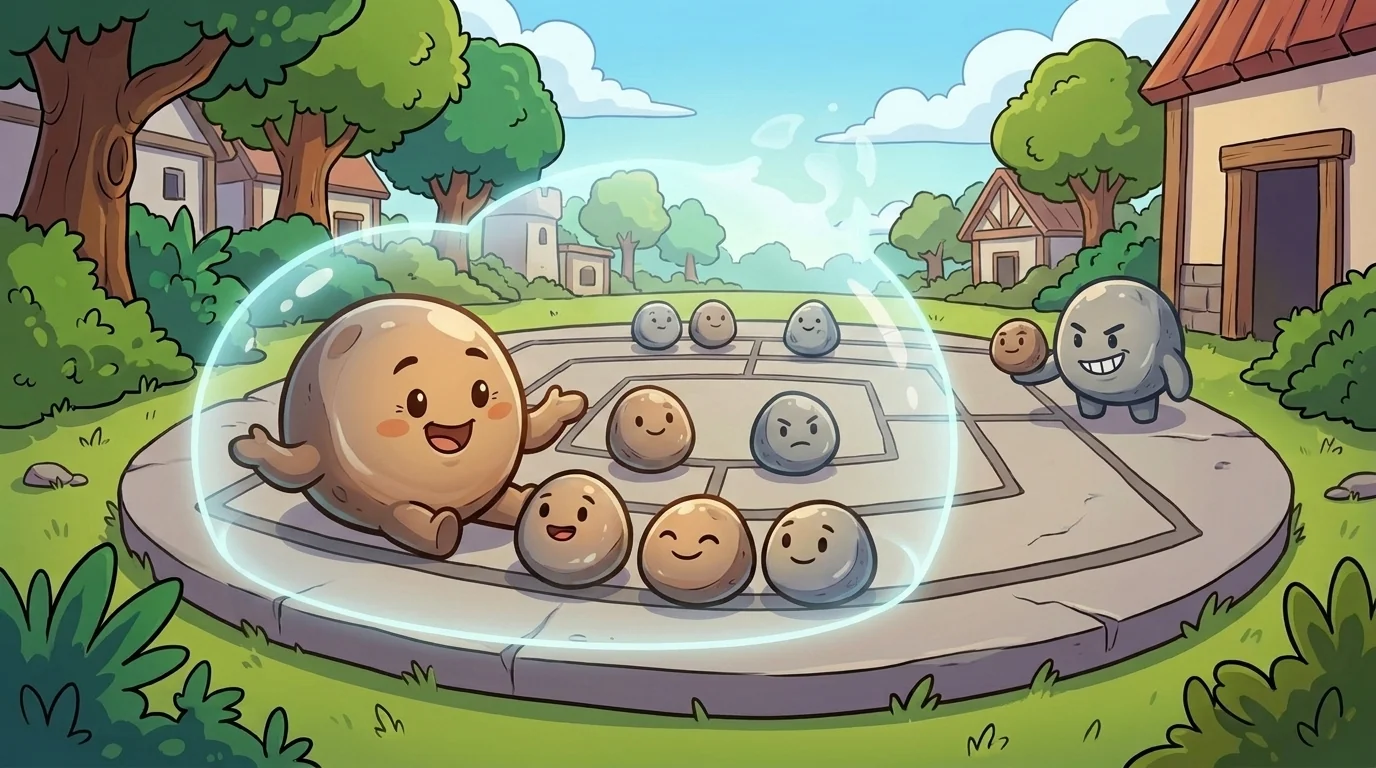
Gwen had learned the shadow-side of safety on a day she'd made her whole board too safe.
She'd been so pleased with the protection rule that she'd tucked everything into mills — every last piece nestled into a completed line, snug, sheltered, untouchable. She'd sat back, delighted. Nothing of hers could be captured! And then she'd tried to actually play — to move, to threaten, to close a new mill — and discovered, with a sinking feeling, that she couldn't. Every piece she owned was locked into a finished mill; to move any of them she'd have to break a mill, un-nesting a piece into danger. She'd made herself so safe she'd made herself helpless. She could not do anything at all without giving up the very safety she'd hoarded.
Worse — because every one of her pieces was now inside a mill, the protection rule lifted entirely, and her gleeful opponent snatched one of her "safe" stones with a grin. Perfect safety had curdled into perfect vulnerability.
An old careful piece found her sulking at her frozen, over-safe board. "Safety's a good roof, child," she said, "but a house that's all roof and no doors isn't a home — it's a box. A piece in a mill is safe, yes. But a piece that can never leave its mill is doing nothing, protecting nothing, going nowhere. The trick isn't to hide everything. It's to shelter what matters, and keep enough pieces free to actually play the game." Gwen sat with that a long time. She had confused safe with useful, and they were not the same thing at all.

At the House of the Board, Gwen arrived with the watchful calm of a piece who knew where all her stones were, and the Elder regarded her warmly.
"The protection rule," the Elder said. "The shelter of the mill. A gentle thing to teach — but you'll meet two kinds of student. The reckless ones who shelter nothing and lose everything. And the timid ones who shelter everything and freeze solid. Which will you teach?"
"Both, from opposite sides," said Gwen. "To the reckless, I'll teach that a mill is a safe home for the pieces you can't afford to lose — tuck them in. To the timid, I'll teach the harder thing: that safety you never leave is a cage. The art isn't hiding everyone. It's sheltering the ones that matter and keeping enough free to move. A good player is safe and able to act. Most pick one and lose."
"Teach the balance," said the Elder. "It's rarer than either extreme."
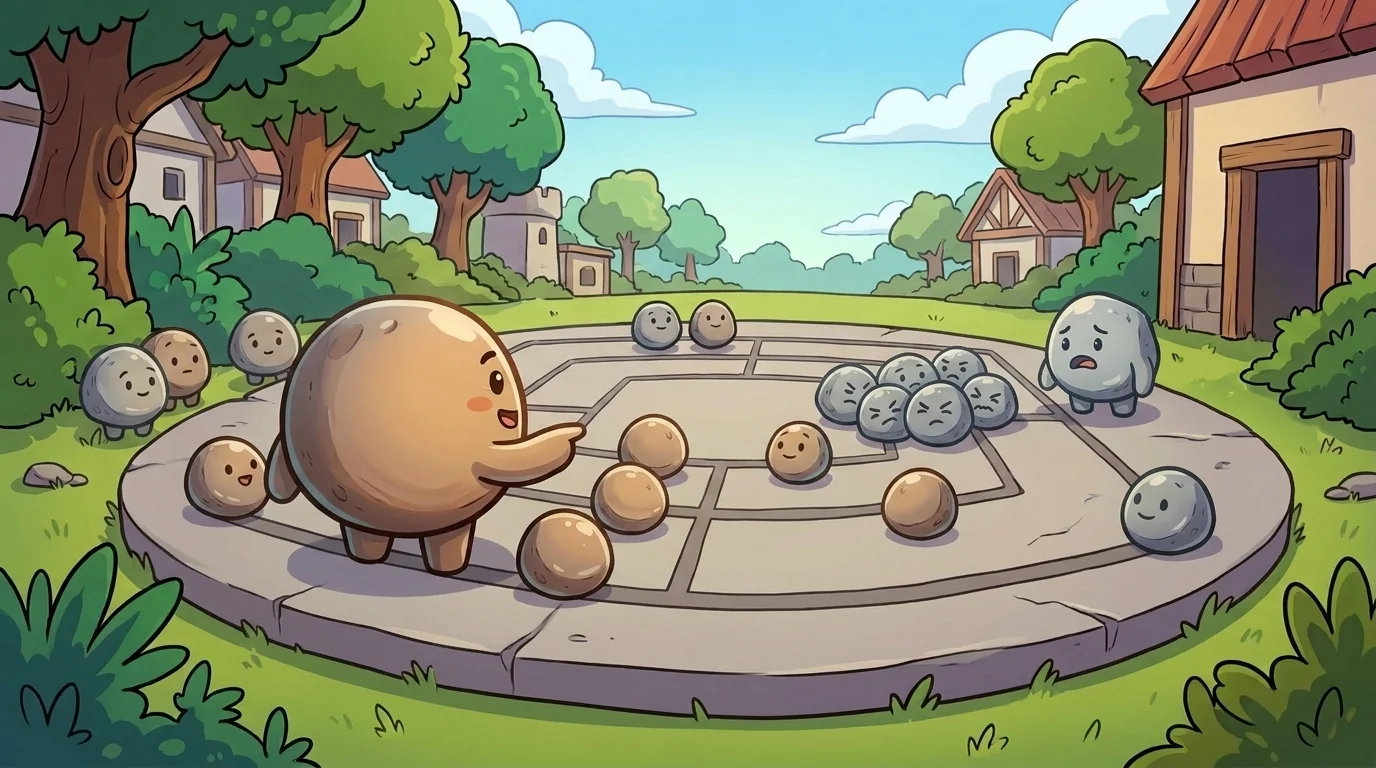
Gwen's student was a fearful piece named Wren who had learned about the protection rule and gone straight to Gwen's old mistake — hiding every piece she could inside a mill, playing scrunched-up and untouchable and utterly stuck.
"Every one of your pieces is nested in a mill," Gwen observed. "You feel safe, don't you?"
"Completely," said Wren proudly. "Nothing can take my stones!"
"Now make a threat," said Gwen. "Close a new mill. Take one of theirs." Wren reached out — and stopped. Every piece she had was locked into a finished line; to move one, she'd have to break its shelter. She was frozen. And worse, Gwen pointed out gently, because all her pieces were now in mills, the protection had lifted — her "safe" stones weren't even safe anymore. "You made yourself a box," Gwen said kindly. "Watch instead." She showed Wren a balanced board — two or three important pieces sheltered in mills, and the rest free, mobile, able to threaten and build and take. "Shelter what you'd hate to lose. Keep the rest able to move. That's not less safe, Wren. It's the only kind of safe that can still win."
Wren un-nested half her stones, wincing — and found that a board with some pieces safe and some pieces free could actually do things: threaten, build, take. She was less hidden and far, far stronger.
"Being able to move is part of being safe," Wren said slowly.
"The most important part," said Gwen.
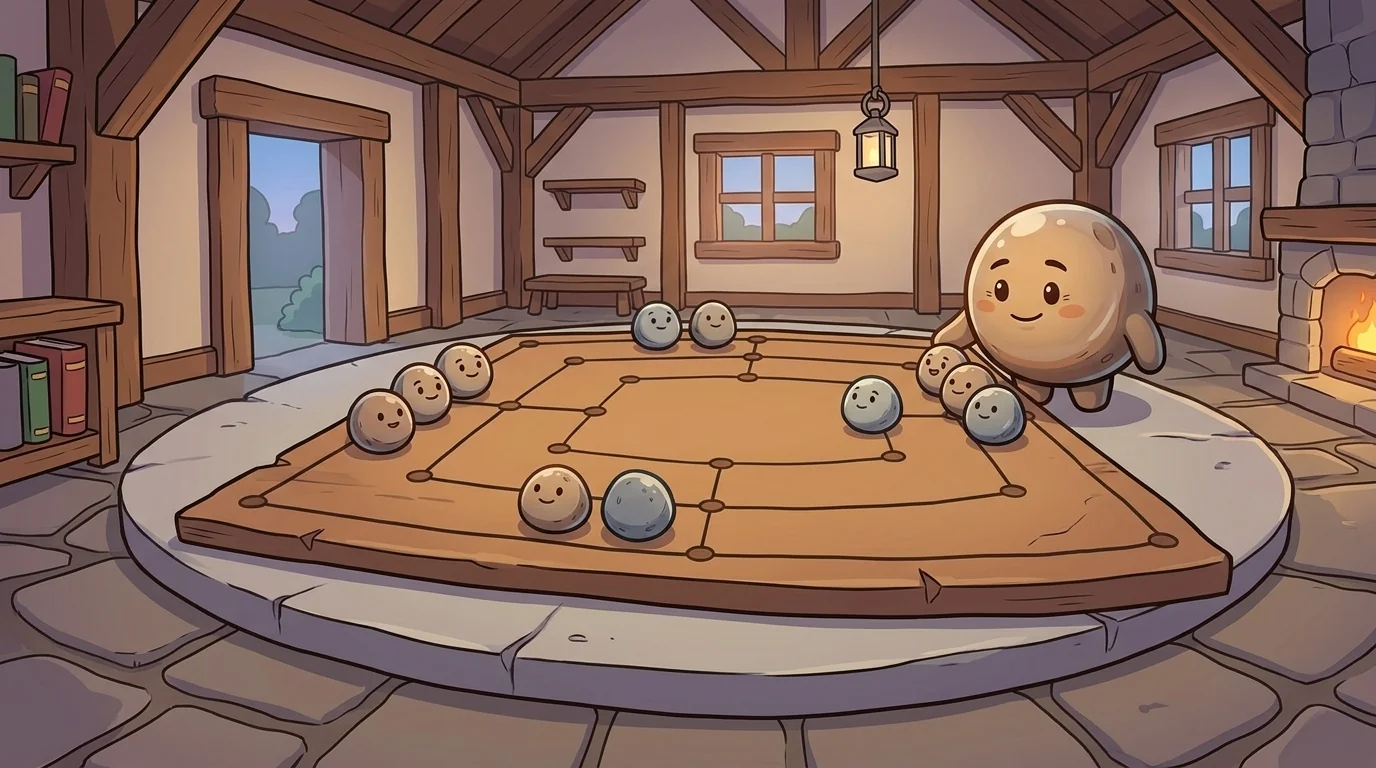
That evening Gwen arranged a small, balanced board in the empty House — two pieces snug inside mills, the rest out in the open, free — and looked at it with the satisfaction of a shepherd who knew the difference between a fold and a cage.
She thought about the day she'd tucked everything away and made herself so perfectly safe she couldn't move a single stone, and the old piece who'd told her that a house of all roof and no doors is just a box. She still loved the shelter of the mill; she always would. But she had learned that safety is only good when it serves something — when it protects the pieces that matter so the free pieces can be brave.
There was a quiet, grown-up contentment in that balance — in knowing which of her stones to tuck away safe and which to leave out in the weather, doing the work. Perfect safety, she'd learned, was a kind of slow surrender; a wall around nothing. Real safety was a warm fold for the ones who needed it and an open gate for the ones who were ready to play. Gwen had found the middle of it at last, and there was a peace in that middle that no amount of hiding had ever given her.
The MillSong ensemble
Guard Gwen is part of MillSong's distributed-narrative cast. Each character embodies a different curricular primitive; together they teach the full subject.
-

Miller Mila
The mill: lining up three stones on a line
-

Snatch Nadia
Capture-on-mill: removing a piece the moment a mill closes
-

Block Bodhi
Blocking: dropping onto the empty point of an almost-mill
-

Spoke Sami
Prime points: the strong spoke midpoints (three mill lines each)
-

Corner Cato
Corner points: the low-value corners (two mill lines each)
-
Placer Pell
The placement phase: building a mill network with the nine
-

Slide Sile
The movement phase: sliding a stone to an adjacent point
-

Swing Sena
The swinging (running) mill: opening and re-closing to capture again
-

Flyer Faye
The flying phase: hopping anywhere once down to three men
-
Reduce Remy
The endgame: winning by reducing the opponent to two
-

Elder Merel
The mills-puzzle elder (mentor): find-the-mill / which-to-take puzzles