Block Bodhi
BLOCKING — placing a piece on the single empty point the opponent needs to complete their almost-mill, denying the line
Loading audio…
Press play to listen along. The line being read lights up as you go.
Show full transcript
Loading transcript…
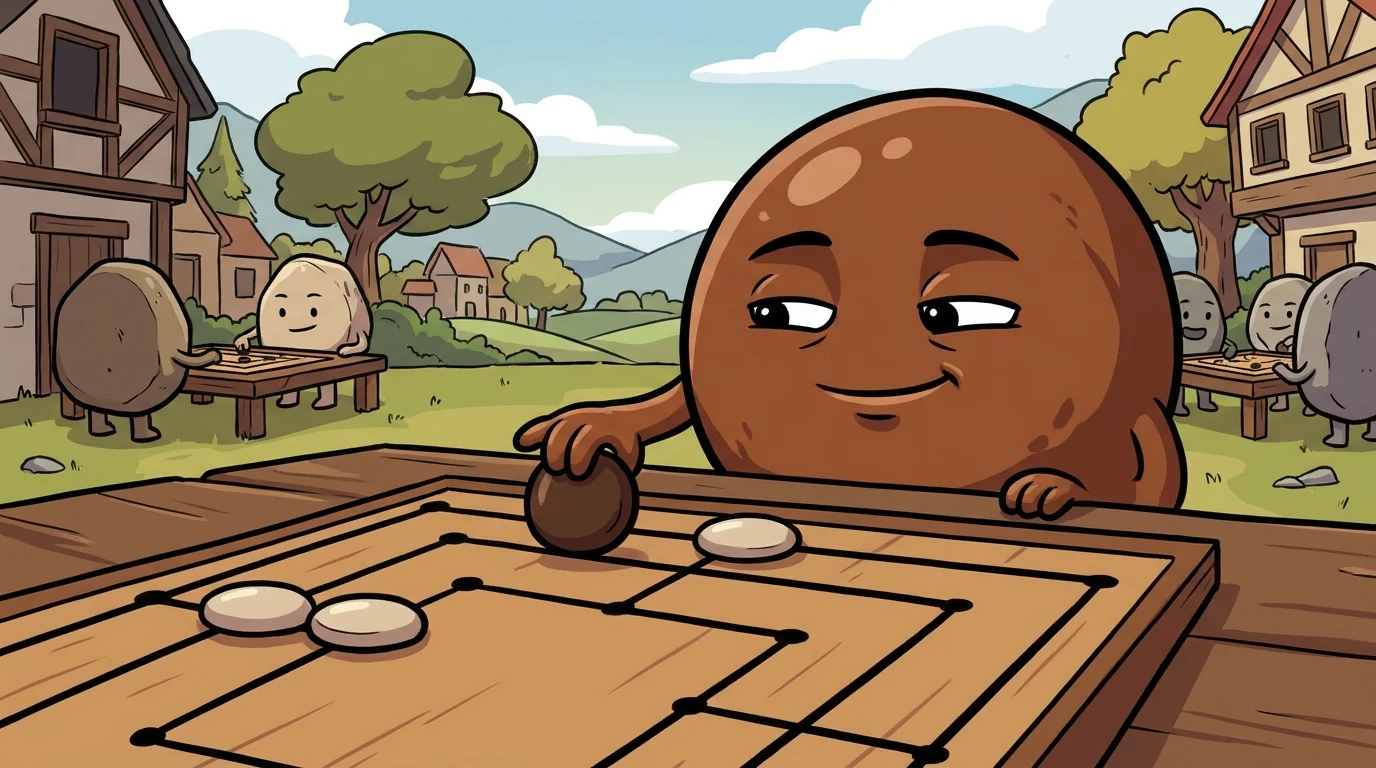
Most pieces on the village boards were busy thinking about their own lines — their own mills, their own plans. Not Bodhi. Bodhi spent the whole game watching the other player, and he was famous for one uncanny skill: he always saw the mill coming before it arrived.
Bodhi was a blocker. When an opponent had two pieces on a line and only needed a third to close a mill, Bodhi would quietly drop a stone onto that third point — the one empty spot they needed — and the mill would simply never happen. No drama. No capture. Just a line that never closed, a plan that never paid off, an opponent staring at the point Bodhi had calmly taken half a heartbeat before they reached it.
"Everyone else plays their own game," Bodhi said, scanning the board with his patient, sideways attention. "I play theirs. I watch where their stones are pointing — two here, a gap there — and I ask: what are they about to do? Then I stand in the gap." He tapped an empty point an opponent hadn't even reached for yet. "A mill you block is a capture that never happens. It's not as loud as taking a piece. But a game is won as much by the mills the enemy didn't get as by the ones you did."

Bodhi had learned the limits of blocking on an exhausting day he'd tried to stop everything.
He'd been young and anxious, and he'd seen almost-mills everywhere — every pair of enemy stones looked like a threat. So he'd scrambled to block them all: this gap, that gap, running his pieces ragged plugging every possible line. And in his frantic all-blocking he'd never once built a mill of his own, never taken a single piece, spent every turn on defense — and slowly, inevitably, lost, because a player who only ever blocks never actually gets ahead. He'd stopped a dozen enemy mills and won nothing, because he'd been so busy denying that he'd forgotten to do.
Worse, he realized later, half the "threats" he'd blocked weren't threats at all — pairs of enemy stones that couldn't actually complete, or almost-mills the enemy had no intention of finishing. He'd wasted whole turns blocking phantoms.
An old watchful piece sat with him after that draining loss. "You can't block everything, child," she said. "Nobody can. If you try, you'll spend your whole game plugging holes and never dig a well of your own. The skill isn't blocking every threat. It's telling the real threat from the false one — the almost-mill they can truly close this turn, that would truly hurt — and blocking that, while you let the harmless ones go and use the saved turns to build." Bodhi took it to heart. He stopped panicking at every pair of stones. He learned to ask, coolly, can they actually close this, now, and would it matter? — and to block only when the answer was yes.

At the House of the Board, Bodhi arrived watching everyone else rather than announcing himself, and the Elder smiled at the sideways attention of him.
"The blocker," the Elder said. "You read the other player better than anyone. But you'll meet the two failures of defense — the students who never block and lose to mills they never saw coming, and the ones who block everything and lose because they never build. Which will you teach?"
"Both need the same lesson from different ends," said Bodhi. "To the blind ones: watch your opponent — a mill you see coming is a mill you can stop. To the panicky ones: you can't stop them all, so judge — block the real threat, let the phantom go, and spend the saved turns building your own line. Good defense isn't stopping everything. It's stopping the right thing, and having the wisdom to know which that is."
"Teach the judging," said the Elder. "Seeing is half of it. Knowing what's worth acting on is the rest."

Bodhi's student was a jumpy piece named Tam who saw threats everywhere and blocked frantically — plugging every pair of enemy stones, running himself ragged, never building anything of his own.
"You just spent your turn blocking that pair," Bodhi said. "Could they actually have closed that mill this turn?" Tam looked. "...No. The point they need is behind one of their own stones. They can't reach it." "So you blocked a mill that couldn't happen, and wasted a turn you could've used to build. Watch." Bodhi ignored two harmless almost-mills — coolly, on purpose — and used those turns to grow his own line. Then, when the enemy set up a threat that was truly about to close, and would truly hurt, he blocked that one, and only that one, dropping his stone in the gap a heartbeat before they reached it. "See? I let the phantoms go. I stopped the real one. And because I didn't waste turns on the fakes, I had a mill of my own half-built the whole time."
Tam stopped plugging every hole. He learned to ask, coolly, can they close it, now, and would it hurt? — and to block only then. His frantic all-defense turned into calm, chosen defense, with a growing line of his own besides.
"I don't have to stop everything," Tam breathed, almost relieved.
"You just have to stop the right thing," said Bodhi. "The rest is noise."

That evening Bodhi sat in the empty House watching an imagined opponent's stones, practising the cool question that had taken him so long to learn: can they close it, now, and would it matter?
He thought about the anxious young blocker he'd been, running ragged plugging every gap, stopping a dozen phantom mills and losing anyway because he'd never built a thing. He did not panic at almost-mills anymore. He had learned to sit still inside a threat, to read it clearly, to separate the mill that was truly coming from the one that only looked like it — and to spend his stones on the real one alone.
There was a calm, watchful satisfaction in it that his younger frantic self would never have believed — the quiet of a piece who had stopped fearing every shadow and learned to see which ones had teeth. He still played the other person's game more than his own; that was simply who he was. But he played it coolly now, choosing his blocks the way a good gatekeeper chooses which doors to hold — not all of them, never all of them, only the ones that truly mattered — and there was a deep, unhurried steadiness in knowing the difference at last.
The MillSong ensemble
Block Bodhi is part of MillSong's distributed-narrative cast. Each character embodies a different curricular primitive; together they teach the full subject.
-

Miller Mila
The mill: lining up three stones on a line
-

Snatch Nadia
Capture-on-mill: removing a piece the moment a mill closes
-

Guard Gwen
The not-in-a-mill rule: a stone inside a mill is safe
-

Spoke Sami
Prime points: the strong spoke midpoints (three mill lines each)
-

Corner Cato
Corner points: the low-value corners (two mill lines each)
-
Placer Pell
The placement phase: building a mill network with the nine
-

Slide Sile
The movement phase: sliding a stone to an adjacent point
-

Swing Sena
The swinging (running) mill: opening and re-closing to capture again
-

Flyer Faye
The flying phase: hopping anywhere once down to three men
-
Reduce Remy
The endgame: winning by reducing the opponent to two
-

Elder Merel
The mills-puzzle elder (mentor): find-the-mill / which-to-take puzzles