Slide Sile
THE MOVEMENT PHASE — once all nine are placed, a turn is sliding one piece one step along a line to an adjacent empty point; small moves, but each one can open or close a mill
Loading audio…
Press play to listen along. The line being read lights up as you go.
Show full transcript
Loading transcript…
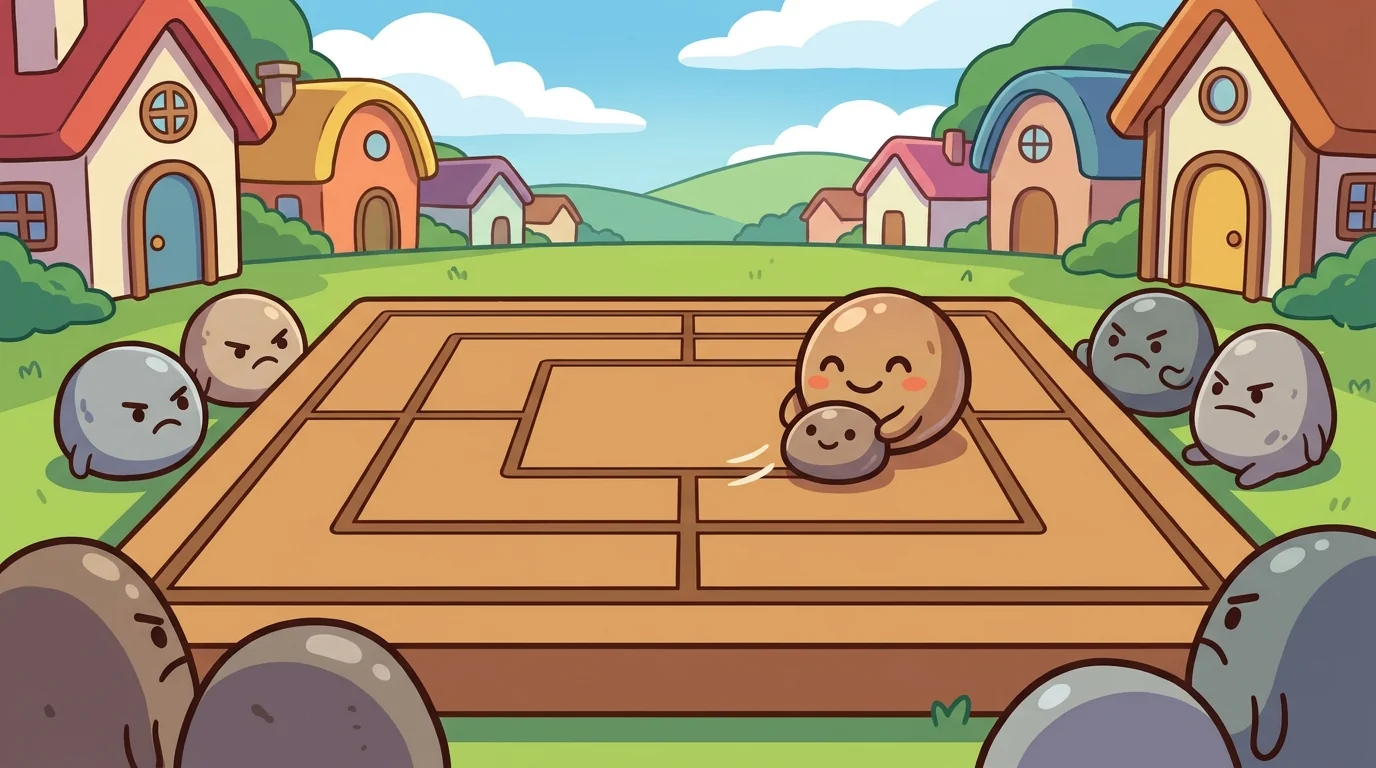
When the placement phase ended and all the stones were down, the game changed. Now nobody could drop a new piece anywhere they liked. Now a turn meant sliding — moving one piece, one small step, along a line, to a single empty point right next door. And the keeper of that small, patient motion was a piece named Sile.
Sile could not leap like a knight from some other game, or dash across the board, or drop a piece from the sky. She could take exactly one step, to an adjacent point, if that point was empty and a line connected them. That was all. It seemed a tiny power after the free placing of the opening — and the impatient pieces chafed at it, wishing they could still drop stones wherever they pleased.
But Sile had learned to love the smallness of it. "One step, next door, along a line," she'd say, sliding a stone gently over. "It doesn't sound like much. But watch what one small step can do." Because in the moving game, a single slide could break open one of your own mills — and then, next turn, slide back to close it again, snatching a piece each time. One step could threaten a new mill while un-guarding an old one. Every small move was a hinge the whole board could turn on. "The opening is about where you put things," Sile said. "The moving is about the tiny, careful steps that make everything you placed finally pay off. Small steps. Big consequences."

Sile had learned to respect the small step on a day she'd wasted a dozen of them wandering.
When the free placing ended and the sliding began, young Sile had felt hemmed in — after dropping stones anywhere she liked, being able to move only one step to the next point felt like a cage. So she'd shuffled about aimlessly, sliding pieces this way and that with no plan, just to feel like she was doing something, moving for the sake of moving. And her steps had added up to nothing — worse than nothing, because each aimless shuffle had let her careful opening slowly fall apart while her opponent made small, purposeful steps that each did real work.
An old slider watched her fritter away her tiny moves and said: "You're moving as if the steps don't matter because they're small. Child — in this phase, only the small steps matter; they're all you've got. A step with no purpose is a turn thrown in the river. But a step with a purpose — one that opens a mill you'll close next turn, or blocks a threat and builds one of your own — a small step like that is the most powerful thing on the board. Don't move to feel busy. Move so that this step sets up the next one." Sile stopped shuffling. She started asking of every single small step: what does this one step do — and what does it set up? And her tiny moves stopped being fidgets and started being a plan, unfolding one careful step at a time.
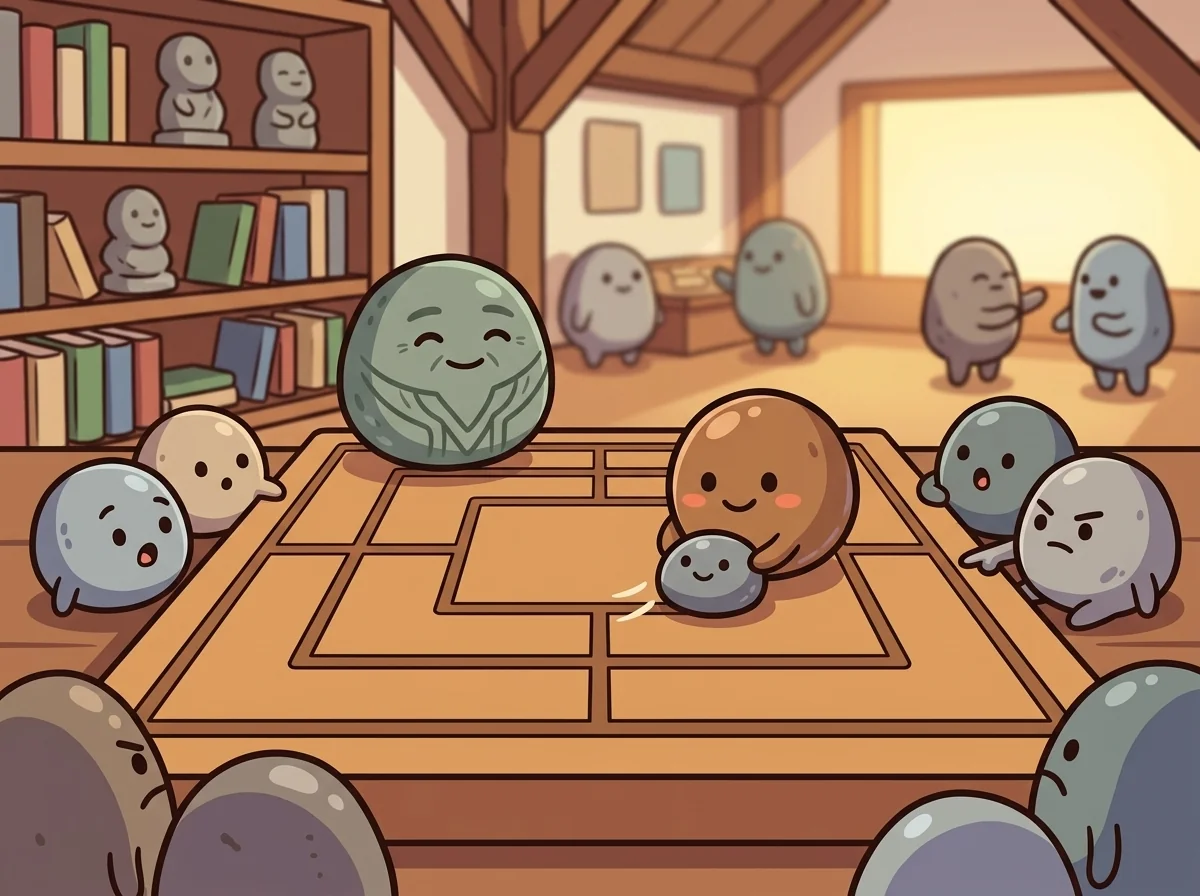
At the House of the Board, Sile arrived one modest step at a time, and the Elder smiled at the patience of her.
"The movement phase," the Elder said. "One step, next door, along a line. The young players find it cramped after the free placing. What will you teach them?"
"To love the small step," said Sile. "They come out of the opening used to dropping stones anywhere, and then they feel trapped by moving one point at a time — so they either shuffle aimlessly or freeze up. I'll teach them that the small step is where the whole game finally happens — that one careful slide can open a mill, threaten another, block a danger, all at once, if you choose it instead of just making it. And I'll teach them to think one step ahead: to take the step that sets up the next good step. Small moves, chosen well, win games. Small moves, made idly, lose them."
"Teach them to make each step count," said the Elder. "It's the phase where most games are quietly decided."

Sile's student was a fidgety piece named Bram who, once the sliding began, moved constantly and pointlessly — shuffling pieces back and forth just to be doing something, watching his good opening dissolve.
"You've made six moves," Sile said, "and the board is worse than when you started. What was that last step for?" Bram blinked. "I... wanted to move something." "That's not a reason, that's a fidget. Watch." Sile took one small step — sliding a stone out of a mill — which looked, for a heartbeat, like she was breaking her own good line. Bram winced. But next turn she slid it back, closing the mill again, snatching a piece. "One step out, one step back — a piece captured, and the mill still stands. That's a small step with a purpose. And see how the out-step also threatened a second mill over here? One tiny move, two jobs." She looked at him kindly. "Stop moving to feel busy. Before each step, ask: what does this do, and what does it set up? A small step is only small until you aim it."
Bram stopped fidgeting. He started asking his one small question before each slide — what does this do, what does it set up? — and his aimless shuffling turned into a slow, purposeful unfolding, one meaningful step at a time.
"The steps are small, but they're not nothing," Bram said.
"Aimed right," said Sile, "they're everything."
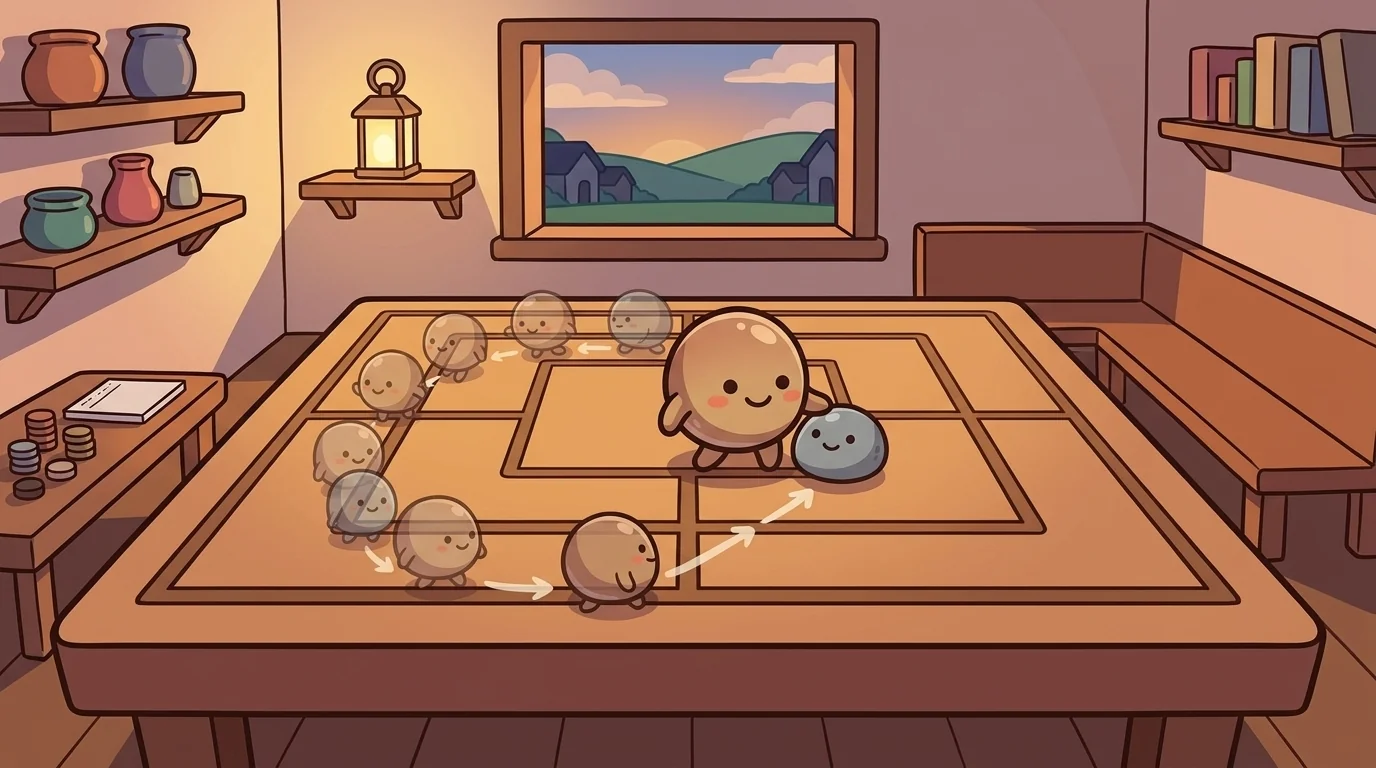
That evening Sile slid quietly around the empty House, one small step at a time, practising the little question that had turned her fidgets into a game: what does this step do, and what does it set up?
She thought about the impatient young slider who'd felt caged by the one-step rule and shuffled her opening to pieces, and the old slider who'd taught her that in this phase the small steps aren't a limitation — they're the whole point, and the whole power. She never moved idly anymore. She had learned that a small step chosen with purpose — one that does a job and sets up the next — is worth a hundred restless shuffles.
There was a quiet, unhurried pleasure in it that the drop-anywhere freedom of the opening had never given her — the pleasure of patient, purposeful motion, of watching a careful plan unfold one modest step at a time, each step making the next one better. She could not leap or dash or drop from the sky. She could only step, once, next door, along a line. But she had learned to make each of those small steps mean something — and there was a deep satisfaction in moving slowly and well, one purposeful step after another, toward a finish she could feel coming.
The MillSong ensemble
Slide Sile is part of MillSong's distributed-narrative cast. Each character embodies a different curricular primitive; together they teach the full subject.
-

Miller Mila
The mill: lining up three stones on a line
-

Snatch Nadia
Capture-on-mill: removing a piece the moment a mill closes
-

Guard Gwen
The not-in-a-mill rule: a stone inside a mill is safe
-

Block Bodhi
Blocking: dropping onto the empty point of an almost-mill
-

Spoke Sami
Prime points: the strong spoke midpoints (three mill lines each)
-

Corner Cato
Corner points: the low-value corners (two mill lines each)
-
Placer Pell
The placement phase: building a mill network with the nine
-

Swing Sena
The swinging (running) mill: opening and re-closing to capture again
-

Flyer Faye
The flying phase: hopping anywhere once down to three men
-
Reduce Remy
The endgame: winning by reducing the opponent to two
-

Elder Merel
The mills-puzzle elder (mentor): find-the-mill / which-to-take puzzles