
Flyer Faye
THE FLYING PHASE — when a player is reduced to their last three pieces they may jump a piece to ANY empty point, not only an adjacent one; a rule that gives the losing side a real fighting chance
Loading audio…
Press play to listen along. The line being read lights up as you go.
Show full transcript
Loading transcript…
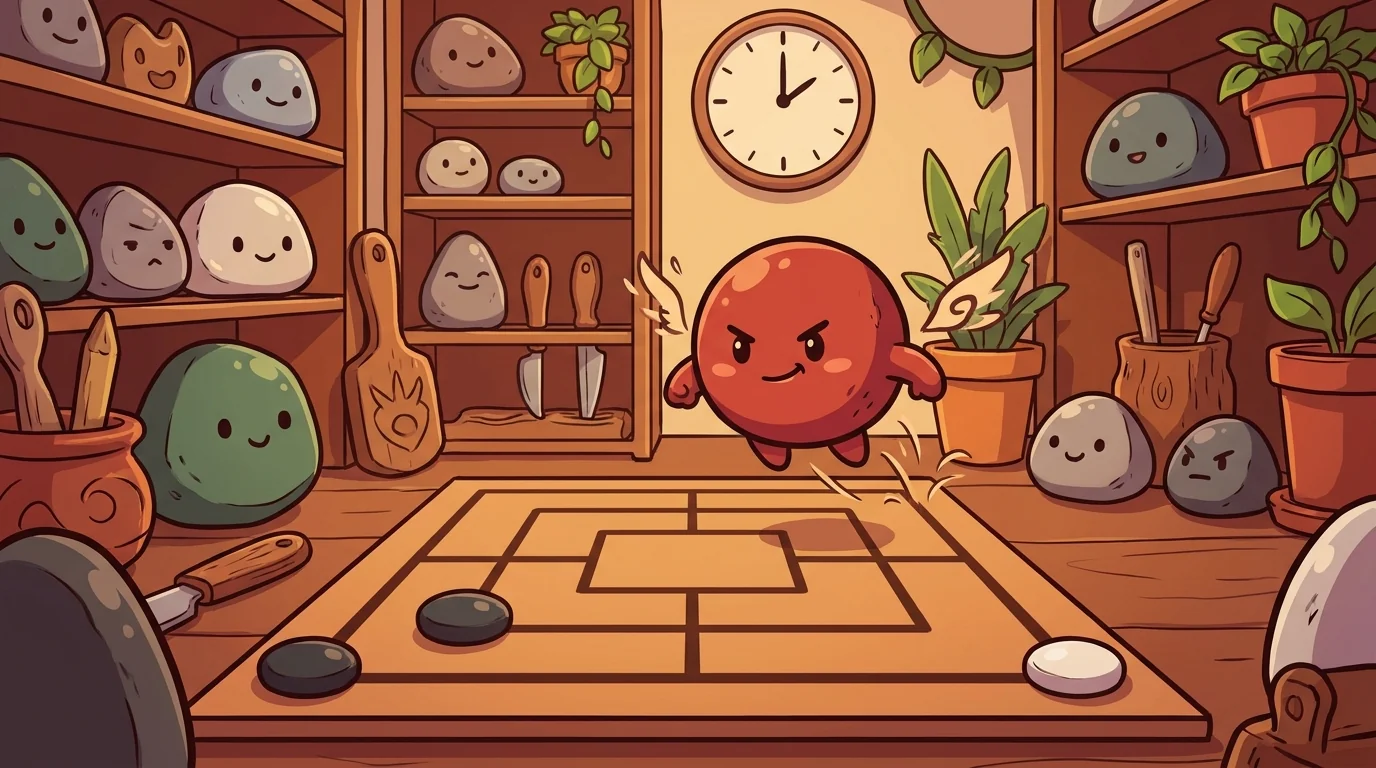
Faye taught the rule that most students dreaded reaching, and she taught it as if it were a gift.
"When you're down to your last three pieces," she said, "you are almost beaten. One more capture and you have two, and two pieces can never form a mill, so the game is lost. Everyone knows this part." She let a silence sit. "Here's the part they forget: at exactly that moment, the rules change for you. Down to three, you may fly — pick up any of your pieces and set it on ANY empty point on the whole board, not just the one step to an adjacent point. While your opponent still crawls one slide at a time, you can leap anywhere."
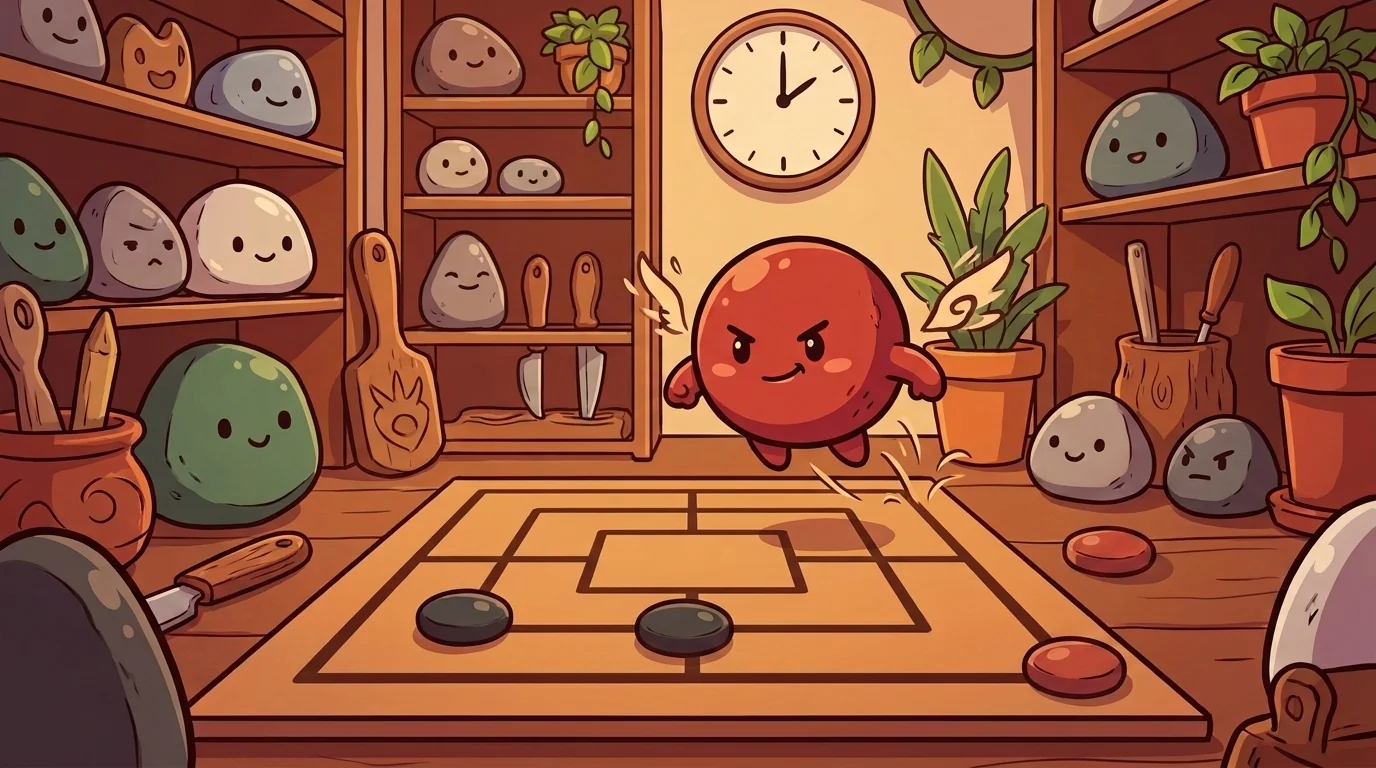
The mechanism mattered, and Faye made students feel its shape.
In the ordinary sliding phase, a piece can only move to a neighbouring empty point — so a mill you want takes patient setup, moving pieces one step at a time into place. But a flyer ignores that. "Two of your three pieces already sit on a mill-line with one gap? Fly your third piece straight into the gap — from anywhere — and close the mill. No walking. No setup. The whole board is one step away." This is why, she explained, three pieces that can fly are far more dangerous than four pieces that can only slide: freedom of movement is worth more than one extra stone.
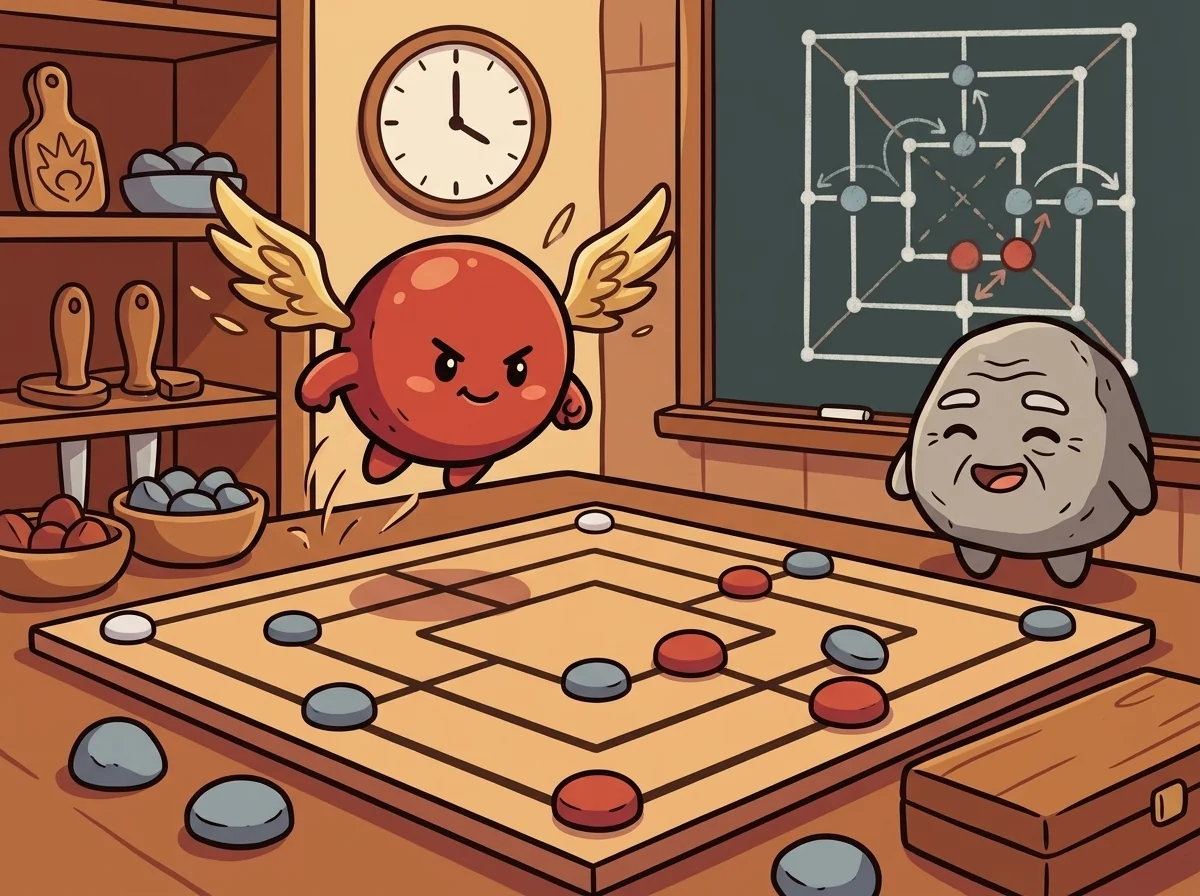
Faye had lived the comeback, and she told it without pride, only wonder.
"I was down to three. My opponent had seven and was grinning. He slid a piece to set up his next capture, one crawling step, sure it was over. And I flew — dropped my loose piece onto the one point that closed my own mill from across the board — and captured. Down to three, he thought I was a corpse. But a flying corpse closes mills he can't see coming, because he's still thinking in single steps and I'm thinking in leaps." She shrugged. "I didn't win because I was better. I won because the rule handed the desperate the one thing the comfortable didn't have: reach."
The older students heard the subtext under it — that being cornered can strip away hesitation, that the freest, boldest move is sometimes the one you'd never make from safety.

But Faye was honest about the rule's second edge.
"Flying is a fighting chance, not a magic escape. Your opponent knows you can fly the moment you hit three pieces, so a good one stops leaving open mills for you to fly into. And you still have only three pieces — one bad trade and you're at two and finished. So the flyer plays tight: every fly must either close a mill or block a mill that would end you. There's no room to waste a leap on hope. Freedom without discipline just loses faster." She set a three-piece position. "You can fly anywhere. That's exactly why you must be sure where."

The student she was teaching reached three pieces in their practice game and froze, certain of defeat.
"Read it," Faye said. "You have three pieces. Two of them share a mill-line with one empty gap. Where do you fly the third?"
The student's eyes widened. "Into the gap. From the corner where it's stuck. It closes the mill — and I capture, and I'm not losing anymore."
"You're still at three," Faye warned. "One mistake ends you."
"But I'm not crawling," the student said, sliding — no, flying — the piece across the board and lifting an enemy stone. "I'm flying. The whole board is one move away now."
Faye grinned. "That's the phase nobody wants to reach and nobody forgets once they've flown out of it. Down to three isn't the end of the game. Sometimes it's where the game gets interesting."
The MillSong ensemble
Flyer Faye is part of MillSong's distributed-narrative cast. Each character embodies a different curricular primitive; together they teach the full subject.
-

Miller Mila
The mill: lining up three stones on a line
-

Snatch Nadia
Capture-on-mill: removing a piece the moment a mill closes
-

Guard Gwen
The not-in-a-mill rule: a stone inside a mill is safe
-

Block Bodhi
Blocking: dropping onto the empty point of an almost-mill
-

Spoke Sami
Prime points: the strong spoke midpoints (three mill lines each)
-

Corner Cato
Corner points: the low-value corners (two mill lines each)
-
Placer Pell
The placement phase: building a mill network with the nine
-

Slide Sile
The movement phase: sliding a stone to an adjacent point
-

Swing Sena
The swinging (running) mill: opening and re-closing to capture again
-
Reduce Remy
The endgame: winning by reducing the opponent to two
-
Elder Merel
The mills-puzzle elder (mentor): find-the-mill / which-to-take puzzles