
Capture Koro
CAPTURING — when your final sown seed lands in an opponent's pit and makes its total exactly two or three, you lift that whole pit into your store
Loading audio…
Press play to listen along. The line being read lights up as you go.
Show full transcript
Loading transcript…
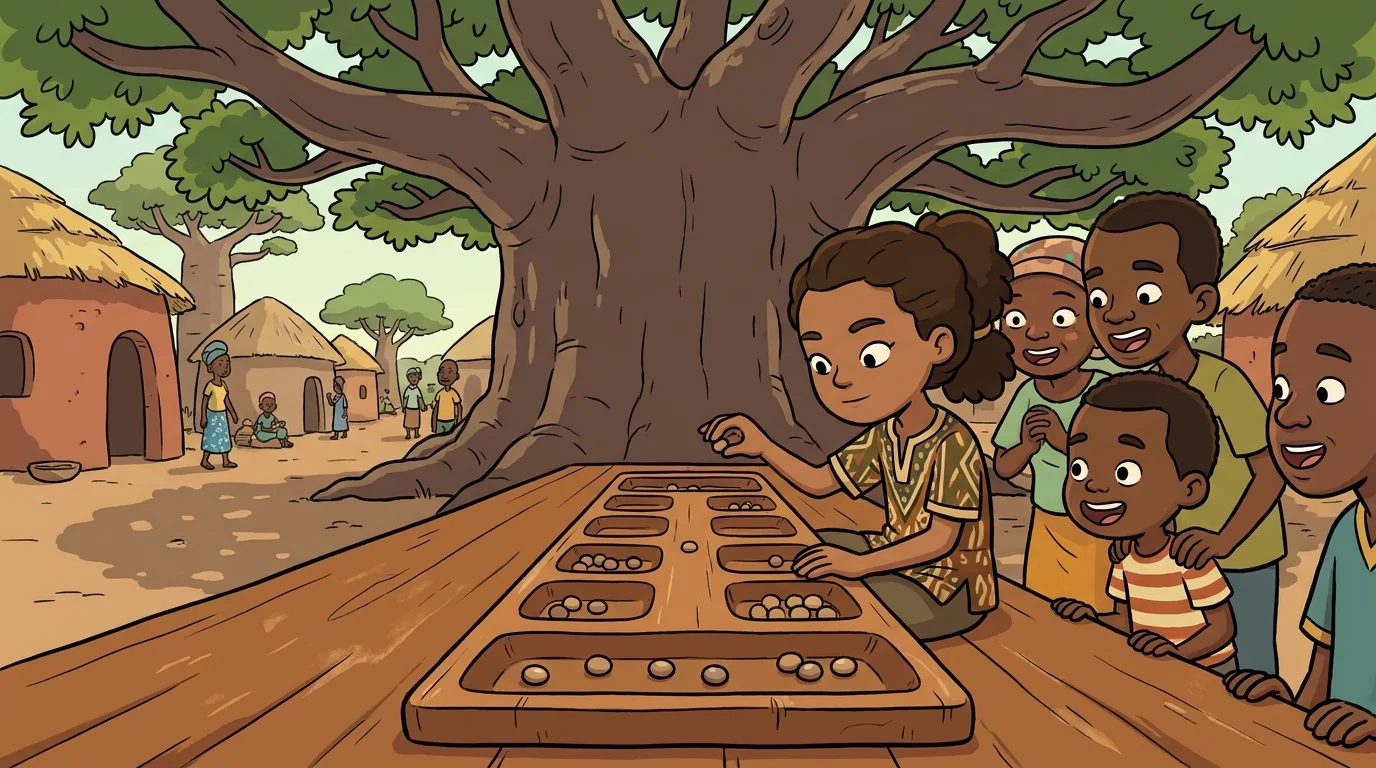
There was a girl at the great baobab board named Koro, and everyone watched her final seed. Koro sowed like anyone else — one seed to each house round the ring — but the whole village held its breath for where her last seed fell, because Koro had a gift for landing it in exactly the right pit to bring in a harvest.
Here was the rule that ruled her: when her final seed dropped into one of her opponent's pits and made that pit hold exactly two seeds, or exactly three — no more, no fewer — Koro could scoop the whole pit up and pour it into her store-house. Two or three, and it was hers. One, and nothing. Four, and nothing. It all came down to the number her last seed made as it landed. She wasn't greedy about it; she was precise about it. She'd study the far row, find the pit sitting at one seed or two, and count her sowing so that her very last seed would tip it up into the harvesting number.
"You always know which one to grab," a small boy marvelled after she'd swept a pit clean into her store.
"I don't grab any of them," Koro said. "I land on them. The seed I drop last has to make it two or three. If it makes four, I've got nothing but a nice-looking pit I can't touch. It's the ending that counts, not the wanting."
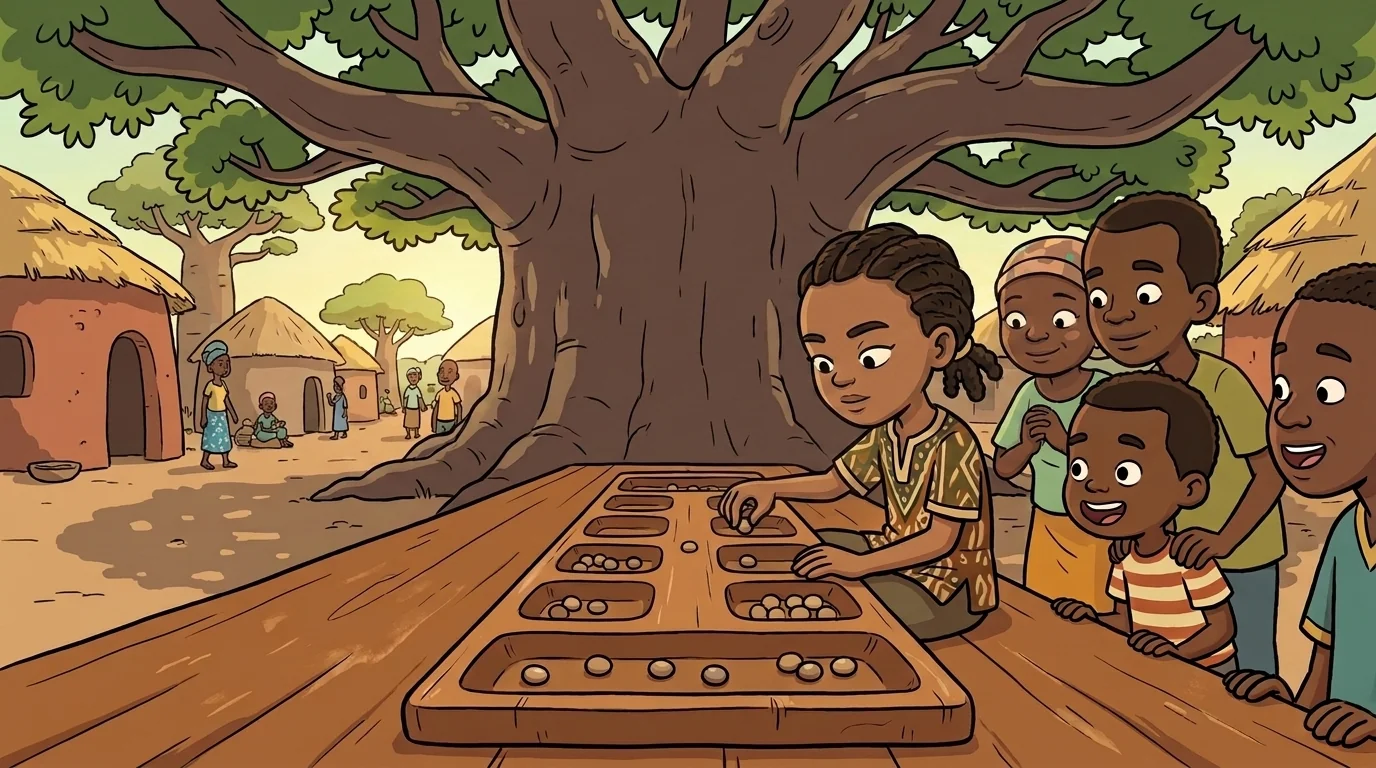
Koro had once been the worst harvester at the board, precisely because she wanted it too much. She'd fling seeds toward any fat enemy pit, hungry to take it, and of course a fat pit stayed fat — her last seed made it seven or eight, and there was nothing there for her, only a bigger pile for her opponent to use against her later.
The lesson had come from picking groundnuts with her aunt. Her aunt only pulled a plant when the nuts underneath were just ready — not the biggest, greenest, most tempting plant, but the one that had come to exactly the right point. "You harvest the ready ones," her aunt had said, wiping her hands, "not the ones you wish were ready." Koro had thought about that all the way home, and the next day she'd stopped chasing the fattest enemy pits. Instead she looked for the ones sitting at one or two seeds — the ones her last seed could tip into two or three — and she began, quietly, to bring in a harvest every single game. She had learned to want the ready pit, not the big one.
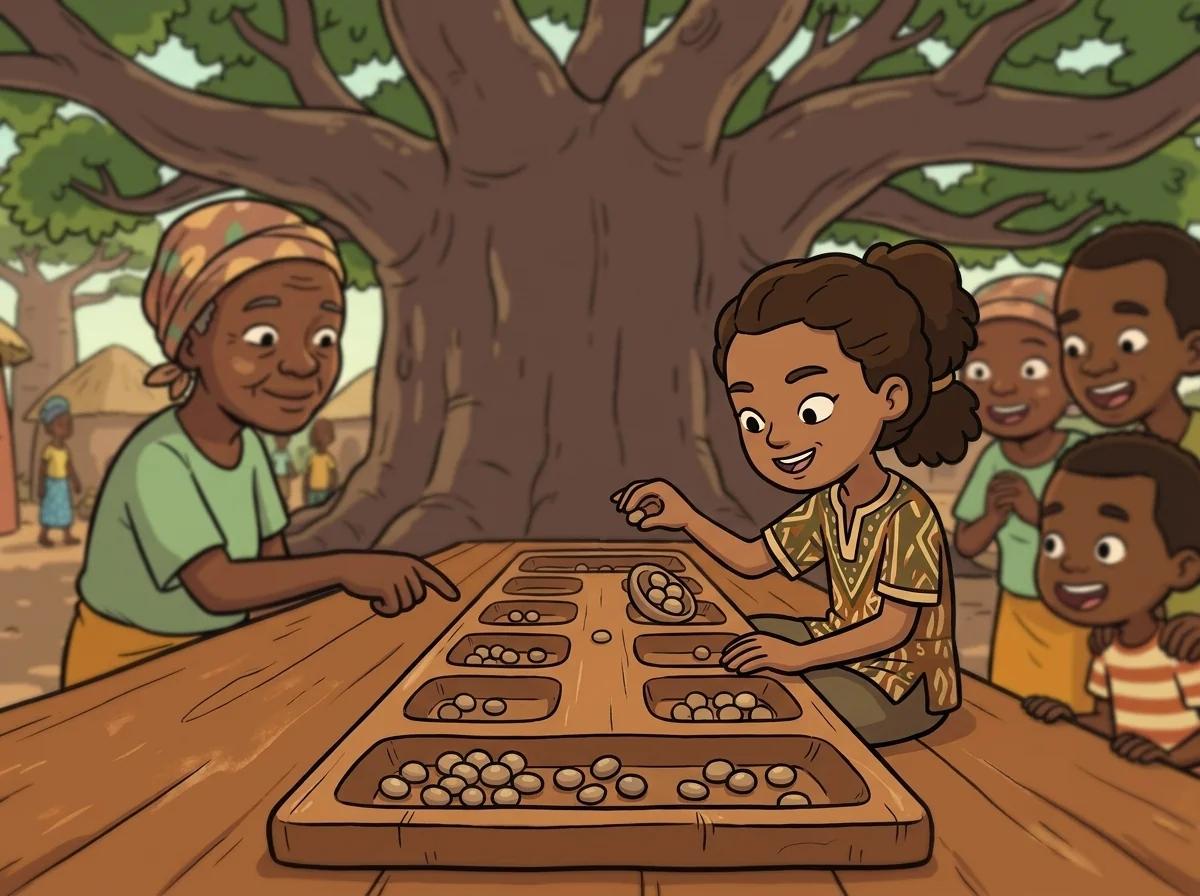
Nana the Sowing Elder set her a hard board on purpose: a long row of enemy pits, some fat, some thin, one temptingly huge.
"Take what you can," Nana said, "and only what you can."
Koro's eyes passed right over the huge pit — she knew her last seed would only make it huger. She found a pit sitting at two, worked out that a certain sowing would drop her final seed there and make it three, and she sowed it, seed by seed, her lips counting, until the last one fell into that pit — three — and she lifted it, gently, into her store. Then she looked, and saw the very next pit down was now sitting at one, and a small further sow would make that one two as her last seed landed. She took it too. She left the tempting giant untouched the whole time.
Nana clapped once, delighted. "Every hungry child in this village reaches for the biggest pile and comes away with air," she said. "You reach for the pit your last seed can finish, and you come away full. That is the whole art of the harvest — the ending makes the take. Sit at my board and teach these children to count to the two-or-three, not to grab for the most."
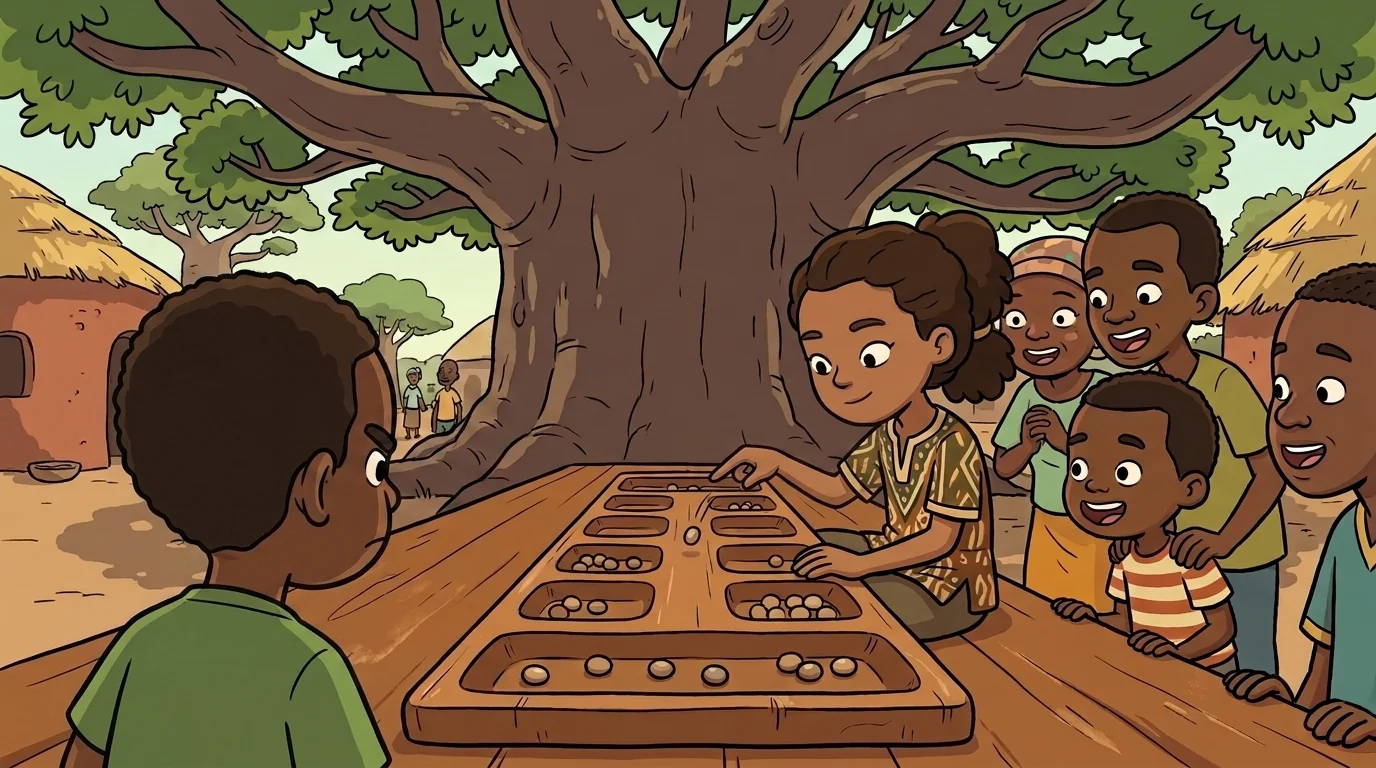
Koro's student was a fierce little boy called Juba who lunged. Juba would spot the fattest enemy pit and pour everything toward it, howling when his last seed made it five and gave him nothing. He captured almost never, and he sulked about it loudly.
"You're aiming at the biggest, aren't you," Koro said. "That's why you keep going home empty. Watch — I'm not going to look at the big ones at all." She scanned the far row and pointed at a modest pit holding two. "That one. My last seed will make it three. That's a harvest. The giant next to it? My last seed there would make it nine. That's a gift to my opponent." She sowed carefully; her final seed dropped into the pit-of-two, made it three, and she swept it in. "The number the last seed makes — two or three — that's the only thing that turns a pit into seeds in your store."
Juba, scowling, made himself ignore the fat pit for once. He found a pit at one, counted a sow that would drop his last seed there to make it two, and did it — and lifted his first honest harvest, blinking, into his store. "It was the little one," he said, half amazed, half offended. "The little one gave me seeds and the big one never did."
"The ready one," Koro corrected, smiling. "Not the big one. The ready one."
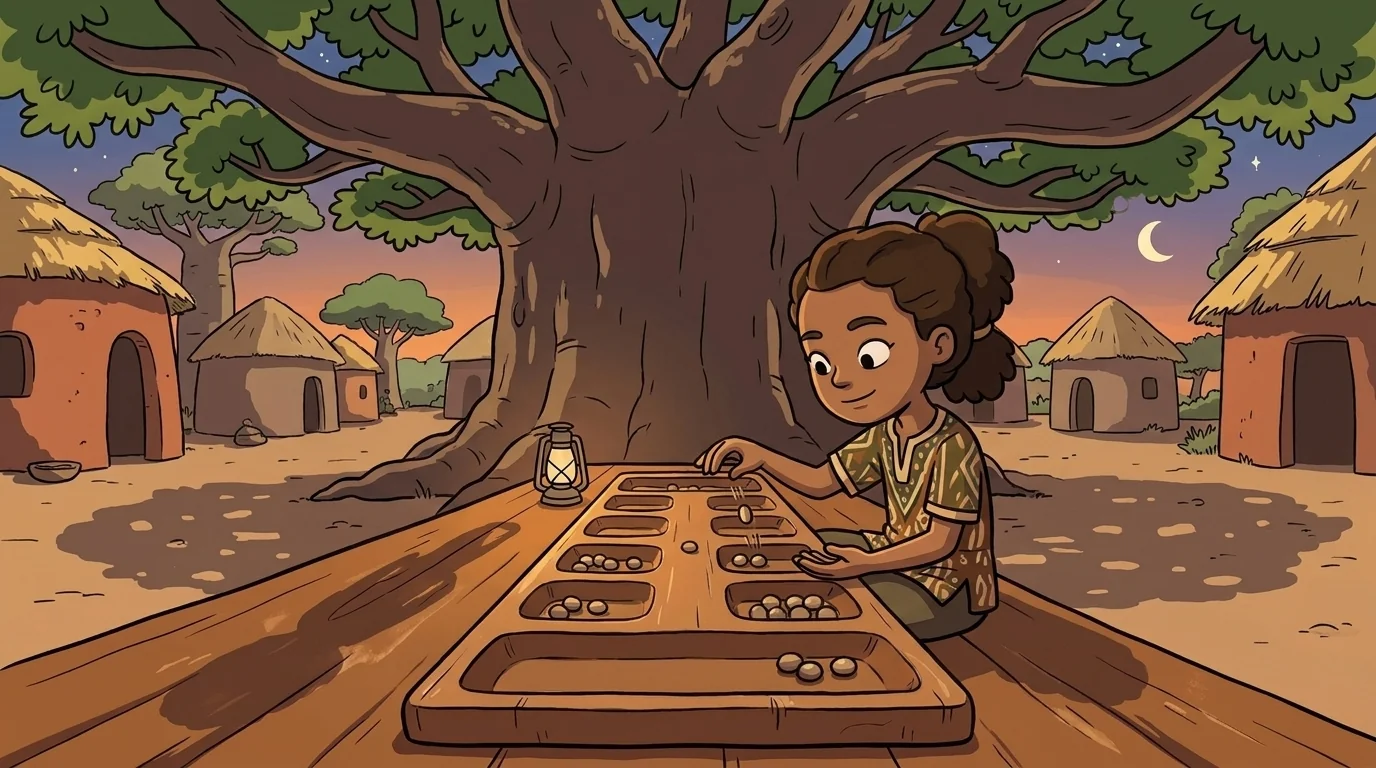
That evening Koro sat alone at the board and set up an old harvest just to watch it work — a pit at two, a last seed falling to make three, the gentle lift into the store.
She thought about the greedy girl who used to fling everything at the fattest pile and come home with nothing, and her aunt's steady hands pulling only the ready groundnuts, and how the whole difference between a full store and an empty one was one small, exact number made by one last seed. There was a keen joy in a capture done right — but it was the joy of a thing finished cleanly, not the joy of beating a friend. Across the board sat people she liked. She never crowed when she harvested from them; she just counted, and landed, and lifted, and said "good game" and meant it.
The last seed carried all the weight in the world, and she had learned to love that — the held breath, the careful count, the soft two-or-three at the very end. She poured her practice pit back where it came from, ready for tomorrow, and felt the deep contentment of someone who had stopped grabbing at the most and learned instead to finish, exactly, on the number that counts.
The SeedSong ensemble
Capture Koro is part of SeedSong's distributed-narrative cast. Each character embodies a different curricular primitive; together they teach the full subject.
-

Sower Sefu
Sowing: pick up a pit and drop exactly one seed in each pit counterclockwise
-
Count Kesi
Counting / subitizing: read how many seeds a pit holds at a glance
-
Reap Rafiki
Multi-capture chain: read a run of 2s and 3s backward and reap them all
-

Subitize Sisi
Look-ahead arithmetic: compute the landing pit without sowing it out
-
Lapwing Lulu
Lapping: sow a full loop around the board (skipping the start pit)
-

Store-Keeper Kito
The store (kroo) + win count: bank seeds safely; the store count is the win
-
Starve-Guard Nne
The must-feed rule: when the opponent has no seeds, you must give them some
-
Pitkeeper Pemba
Building a threat: load a pit to reach a target pit exactly
-

Doublesow Dembe
Staging / relay: stage seeds across turns to set up a big sweep
-
Seedling Sanaa
Opening patterns: the first-move sowing plan
-
Endgame Enzi
Endgame count-out: force the last seeds; parity and counting to the win
-

Nana Sowing Elder
The sowing elder (mentor): poses which-sow-captures puzzles; credits the tradition warmly
