Reap Rafiki
MULTI-CAPTURE / CHAIN — after a capturing landing, if the pit just before it (walking back toward your own side) is ALSO a two or a three, you sweep that too, and keep sweeping backward as long as the run of twos-and-threes continues
Loading audio…
Press play to listen along. The line being read lights up as you go.
Show full transcript
Loading transcript…
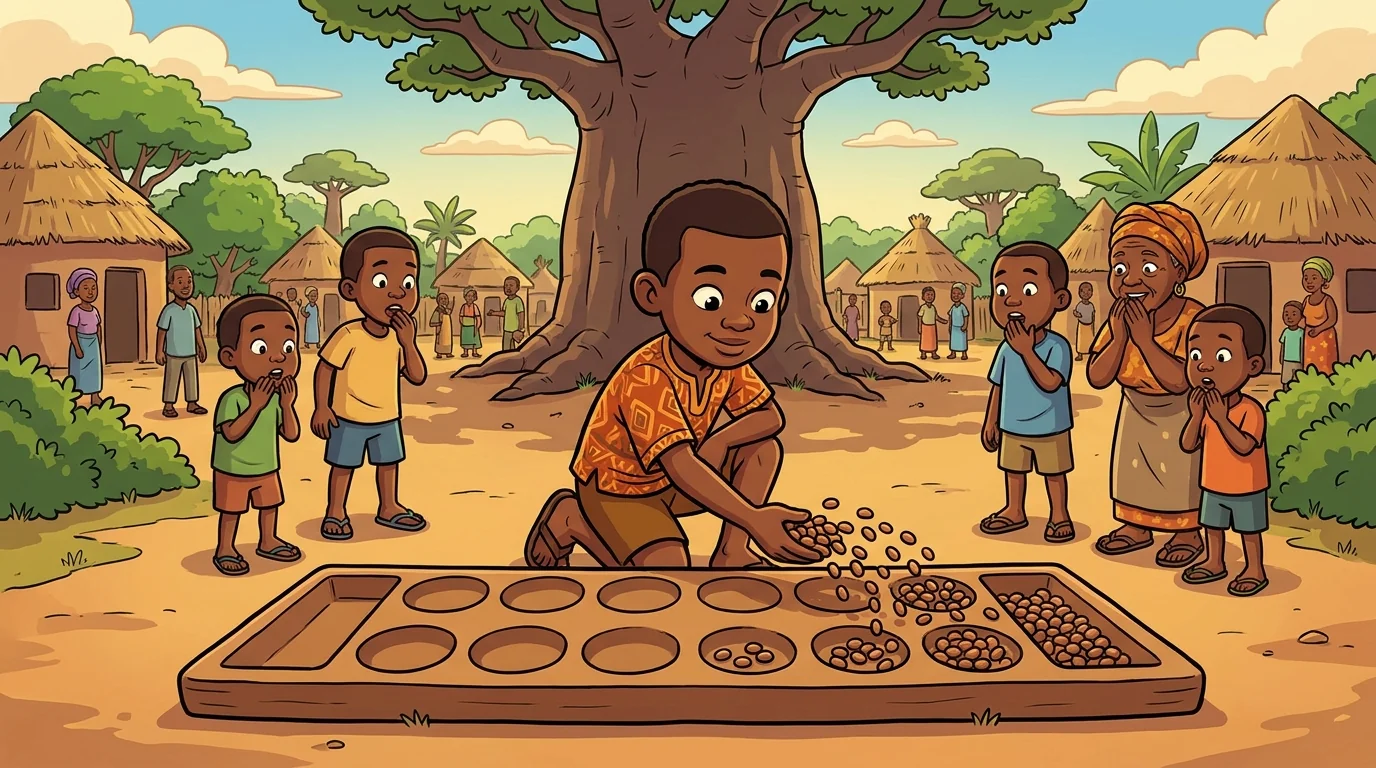
Reap Rafiki did not capture one pit. Reap Rafiki captured runs.
Where his friend Koro was famous for the single clean harvest — a last seed making a pit two or three, lifted into the store — Rafiki was famous for the moment after, when he'd land such a capture and then, instead of stopping, turn his eyes backward along the enemy row. Because here was the deeper part of the rule: once your last seed captures a pit, you look at the house just before it, the one nearer your own side — and if that one is also a two or a three, you sweep it too. And then the one before that. As long as the run of twos-and-threes keeps going backward, you keep reaping, pit after pit after pit, until the run finally breaks.
So Rafiki's great harvests were never a single lucky landing. They were a whole quiet row of pits that had, over many turns, come to rest at two or three each — a chain lying there fully loaded — and Rafiki's last seed was simply the spark that unzipped the entire thing into his store at once.
"You took five pits," a boy breathed, watching Rafiki sweep an entire stretch of the enemy row in one turn.
"I took one," said Rafiki, "and then I looked behind it. Five pits in a row were all sitting at two or three. My last seed only had to reach the first of them. The rest fell like the row of them it always was."
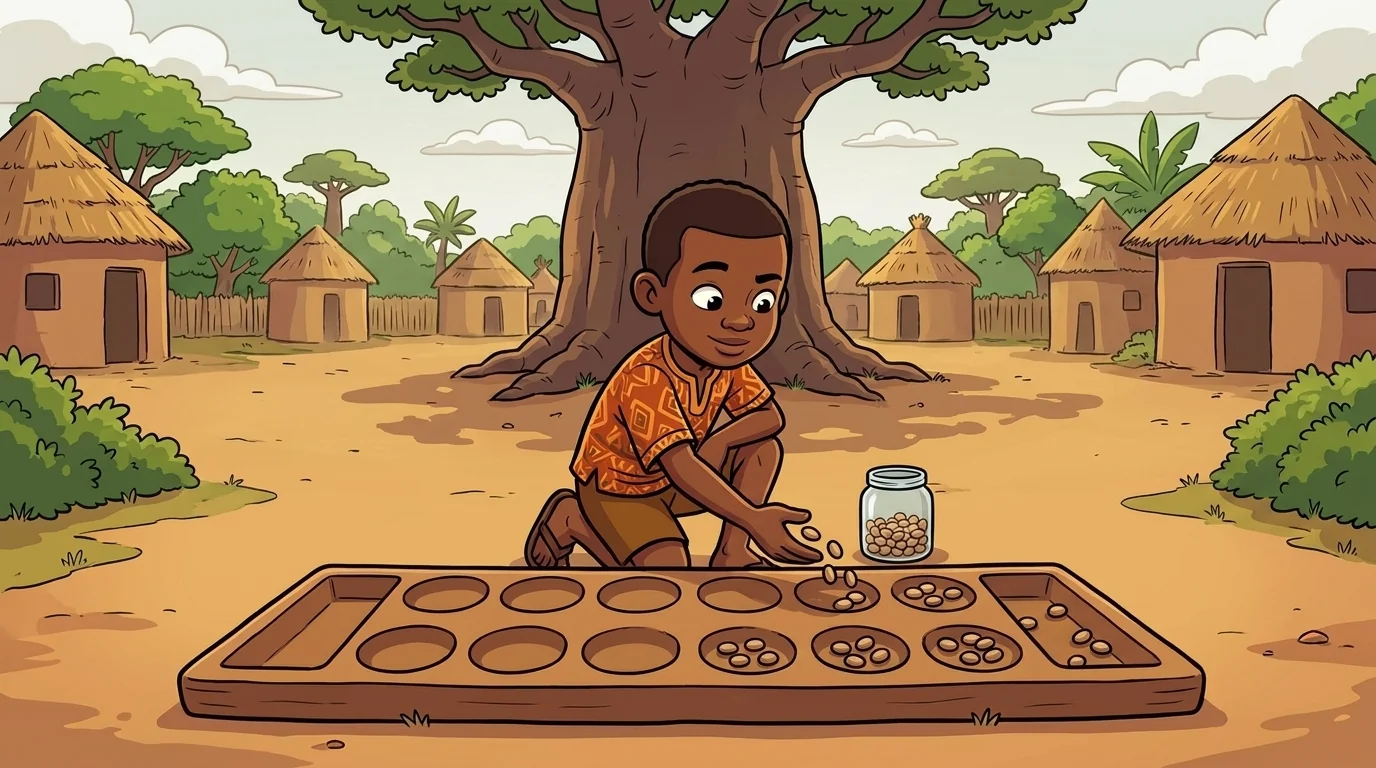
Rafiki had spent a long time being merely a good single-harvester like everyone else, taking one pit and stopping there, never noticing the loaded rows he kept walking past. He captured, and pocketed his one pit, and moved on — leaving a whole backward run of twos and threes sitting untouched because it simply never occurred to him to check behind the pit he'd hit.
The lesson came from his uncle, who fished the river with a line of hooks. His uncle didn't set one hook and haul it in the moment a fish bit; he ran a whole string of baited hooks along the current, and when he pulled the line, sometimes the whole string came up heavy, fish after fish after fish. "One bite tells you the string is working," his uncle said. "So you don't yank at the first. You draw the whole line and see what else was waiting on it." Rafiki had watched that heavy string come up, glittering, and something clicked. The next day at the board, when his last seed captured a pit, he did not stop and pocket it. He looked back — at the pit behind, and the pit behind that — and found three more twos-and-threes quietly waiting, and he drew the whole line in.
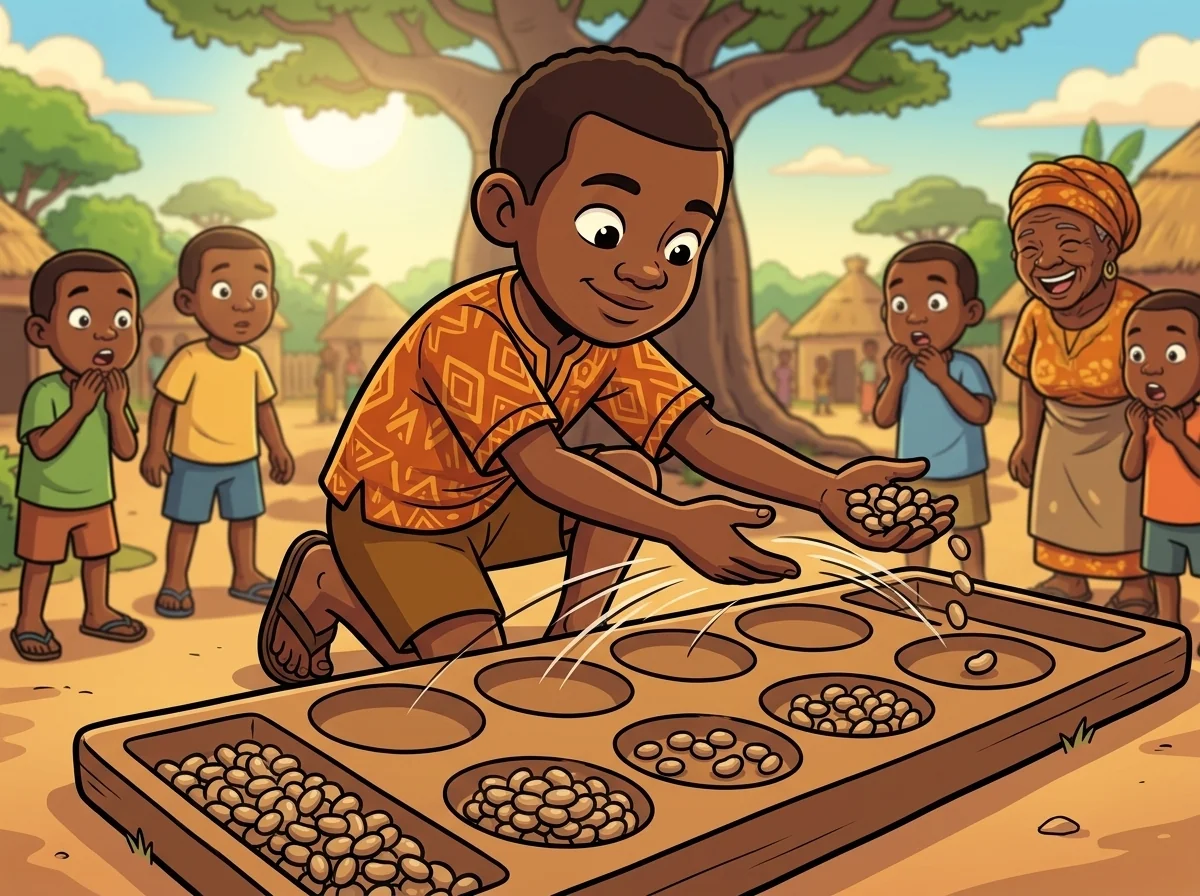
Nana the Sowing Elder built him a board with a long backward run set up on purpose: a stretch of enemy pits sitting two, three, two, two, three, and one lone pit at the front his last seed could just reach.
"Take what's there," Nana said, watching him carefully. "All of what's there."
Rafiki sowed so his final seed landed in the front pit — making it three, a capture. And then he did the thing that was truly his: he looked backward. The pit behind it: three. Swept. The one behind that: two. Swept. And two. And three. He reaped the whole loaded row into his store, pit after pit, until at last he reached a house holding five — the run broken — and he stopped there, exactly where the chain ended, not one pit further.
Nana laughed with pure delight. "Every ordinary player takes the pit their seed lands in and walks away rich by one," she said. "You take the pit your seed lands in and then you read the story behind it — the whole row that led up to that landing — and you walk away rich by five. And you stop, cleanly, the instant the run breaks. Sit at my board. Teach these children that a capture is a door, and that they must always look through it, backward, to see how far the harvest really goes."
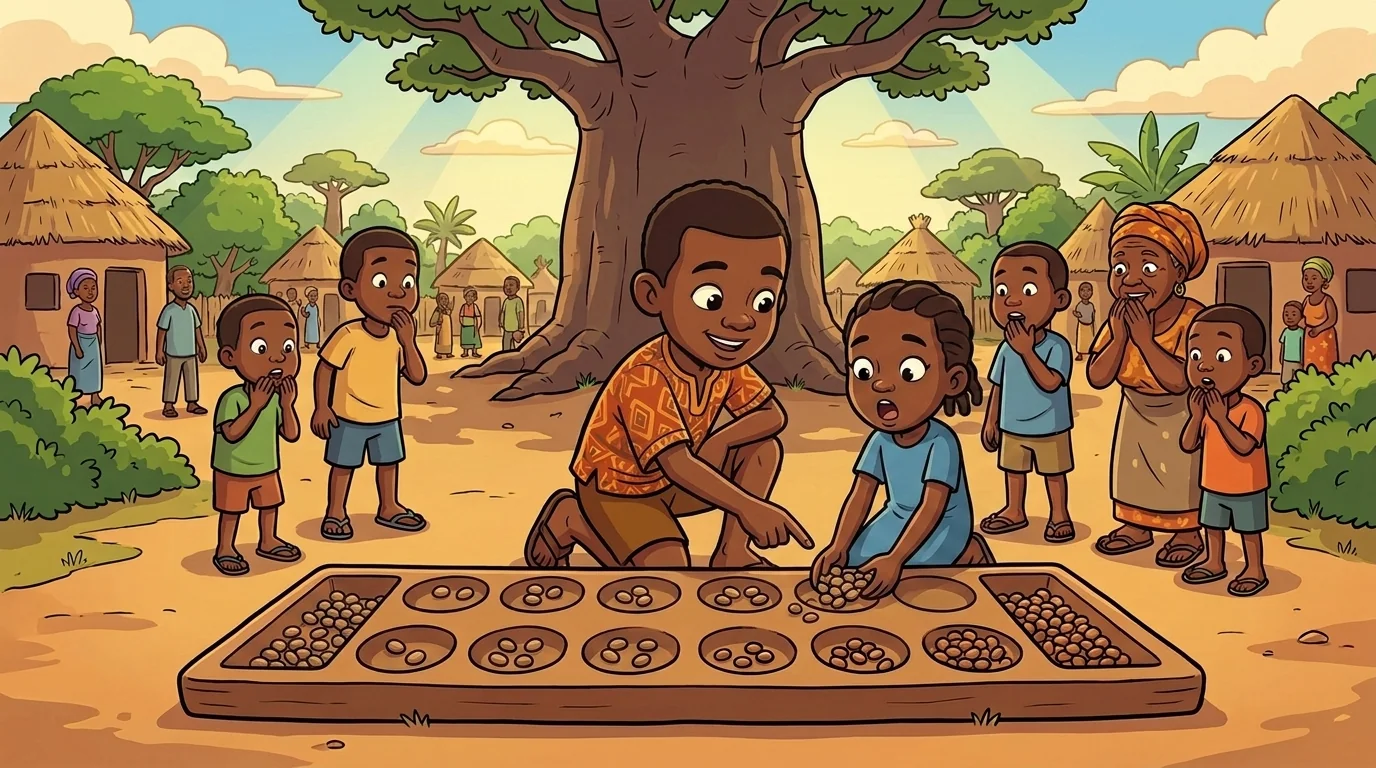
Rafiki's student was a quick, satisfied girl named Nia who captured well but always stopped at one. She'd land her harvest, lift her single pit, beam, and end her turn — never once glancing at the loaded run of twos and threes sitting right behind it, seeds she left for her opponent to scoop up later.
"You captured beautifully," Rafiki told her. "And then you left four more sitting right there. Look — after you lift the pit you hit, don't smile and stop. Turn your eyes backward, toward your own side, one house at a time." He pointed her gaze along the row behind her capture. "Two. That's yours too. Three. Yours. Two. Yours. You keep going back as long as they're twos or threes. The moment you hit a house that isn't — that's four, that's five — you stop. But not before." Nia's mouth fell open as she followed the run she'd been about to abandon. She swept the whole backward line into her store, pit after pit, and stopped, correctly, at the five where it broke.
"I nearly left all of that," she said, staring at the seeds now filling her store. "I thought the capture was the end. It was only the start of the row."
"A capture is a beginning," said Rafiki. "Always look behind it."
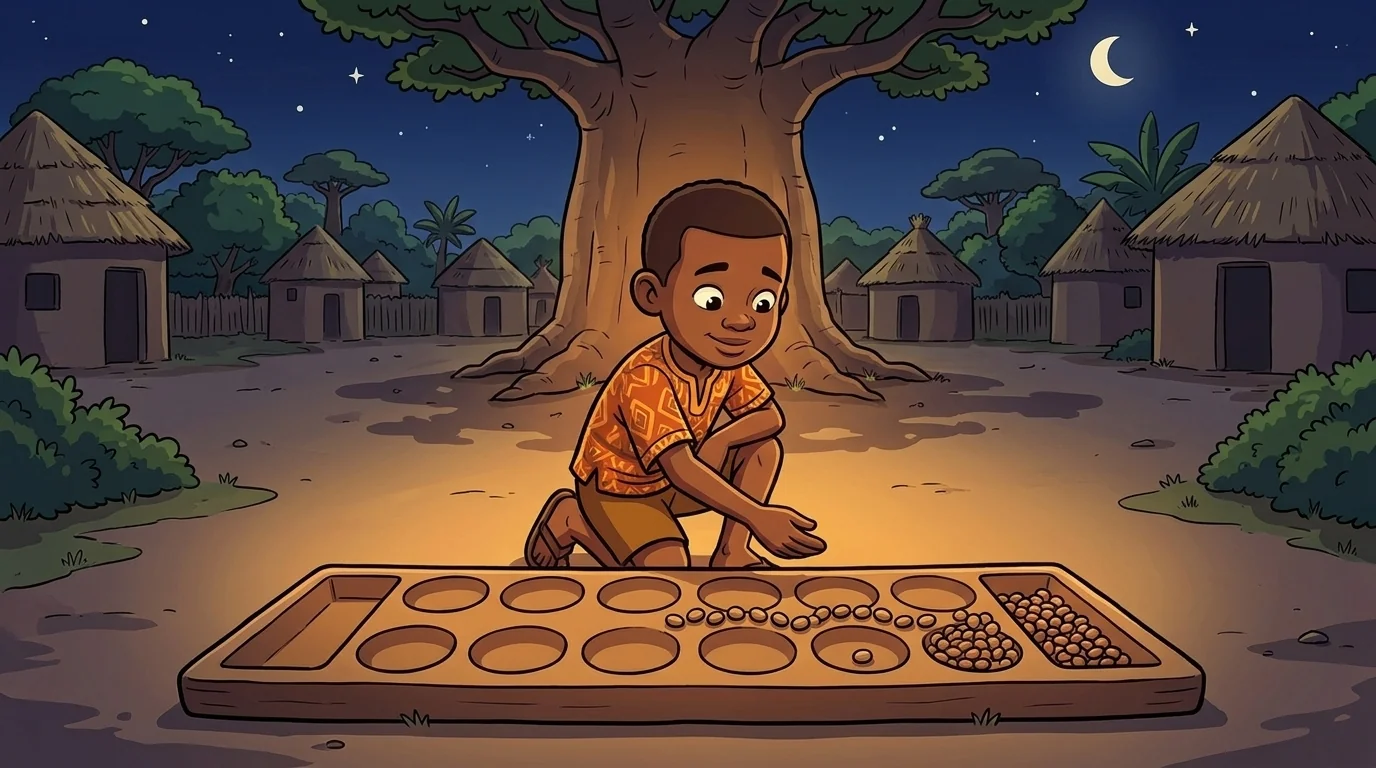
That night Rafiki sat alone and laid out a long backward run of twos and threes just to draw it in slowly, savouring it — the front pit captured, then the reading-backward, house by house, the whole loaded line unzipping into his store until it broke.
He thought about the single-pit boy he used to be, walking past loaded rows without a glance, and his uncle's heavy string of hooks rising glittering from the river, and how the biggest harvests of his life were never one lucky landing but a patient row of small readied things that had lined up, quietly, over many turns, waiting for someone to look back far enough to claim them all. There was a swelling gladness in a chain reaped whole — not the sharp joy of a single win, but the wide, satisfied joy of seeing how everything had connected, how the last seed was only the key to a door a whole row had been building behind.
He reset the pits and sat a moment in the dark under the baobab, warm with the knowledge that the richest thing on the board was almost never the pit in front of you. It was the story behind it — and all you had to do to claim it was to remember, always, to turn around and read the whole line.
The SeedSong ensemble
Reap Rafiki is part of SeedSong's distributed-narrative cast. Each character embodies a different curricular primitive; together they teach the full subject.
-

Sower Sefu
Sowing: pick up a pit and drop exactly one seed in each pit counterclockwise
-
Count Kesi
Counting / subitizing: read how many seeds a pit holds at a glance
-

Capture Koro
Capturing: when the last seed makes an enemy pit two or three, sweep it
-

Subitize Sisi
Look-ahead arithmetic: compute the landing pit without sowing it out
-

Lapwing Lulu
Lapping: sow a full loop around the board (skipping the start pit)
-

Store-Keeper Kito
The store (kroo) + win count: bank seeds safely; the store count is the win
-

Starve-Guard Nne
The must-feed rule: when the opponent has no seeds, you must give them some
-

Pitkeeper Pemba
Building a threat: load a pit to reach a target pit exactly
-

Doublesow Dembe
Staging / relay: stage seeds across turns to set up a big sweep
-

Seedling Sanaa
Opening patterns: the first-move sowing plan
-
Endgame Enzi
Endgame count-out: force the last seeds; parity and counting to the win
-

Nana Sowing Elder
The sowing elder (mentor): poses which-sow-captures puzzles; credits the tradition warmly