
Count Kesi
COUNTING & SUBITIZING — see how many seeds a pit holds without counting one-by-one for small groups (up to about four at a glance), and count on quickly for the larger ones
Loading audio…
Press play to listen along. The line being read lights up as you go.
Show full transcript
Loading transcript…
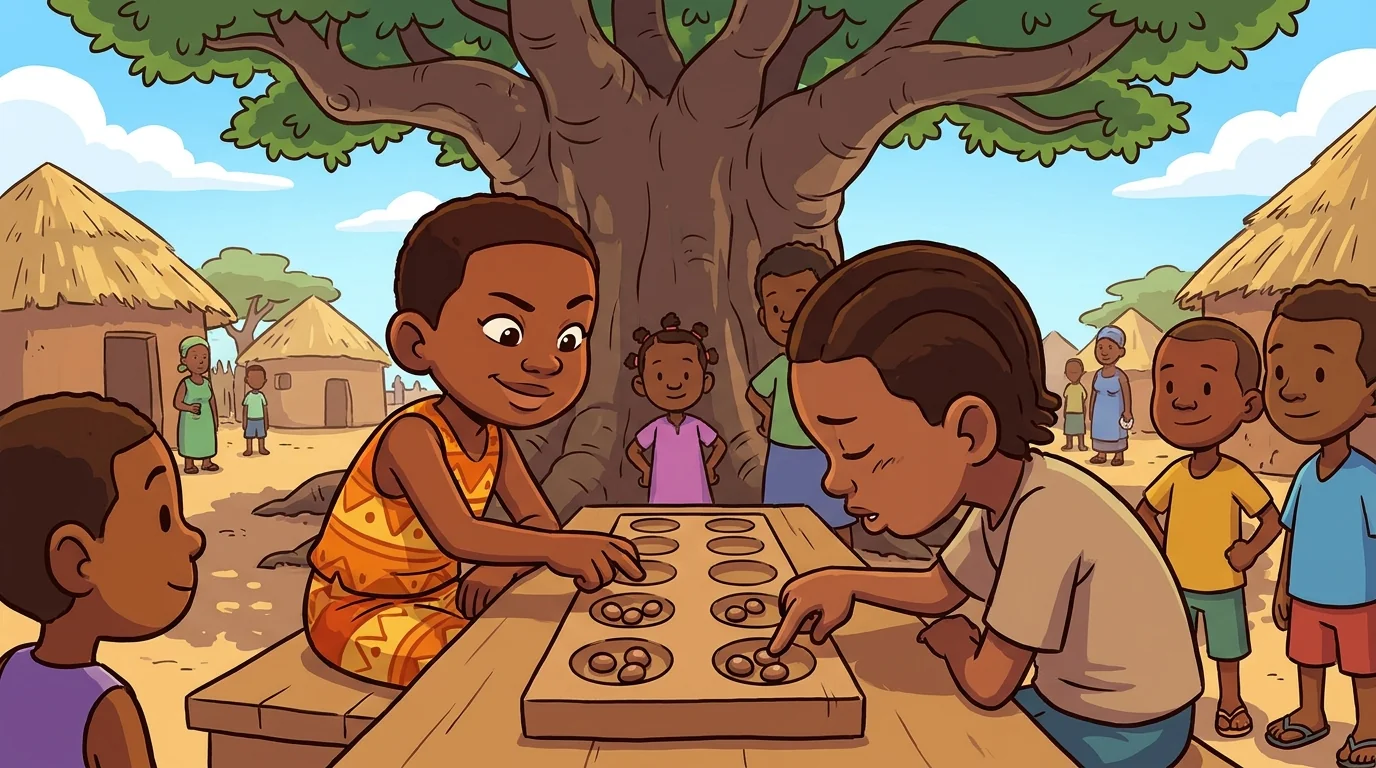
At the great baobab board, while other children still bent close and touched each seed with a fingertip — one, two, three — a girl named Kesi would glance at a pit and simply say the number, quick as a bird calling.
"Four," she'd say of a little cluster, not counting at all, just seeing it. "Two. Three. One." For the small heaps she didn't count so much as recognise them, the way you know a friend's face without adding up their eyes and nose. Only when a pit grew fat — six, eight, ten seeds crowded together — did she slow down, and even then she didn't crawl seed by seed; she'd catch a clump of three she knew on sight, then count on from there. Four... then five, six, seven. The little glance-numbers were the stepping stones; she counted the rest by hopping between them.
Knowing how many seeds sat in each pit, instantly and truly, turned out to be the eyes of the whole game. You could not sow to the right place, or set a capture, or dodge one, unless you knew — right now, without stopping the game to fumble — how many seeds each house held.
"How do you do that?" a boy asked her, still poking his own pit. "You didn't even count."
"For the little ones I don't have to," Kesi said. "Three just looks like three. It's only the big pits I count — and even then I start from a bunch I already know."
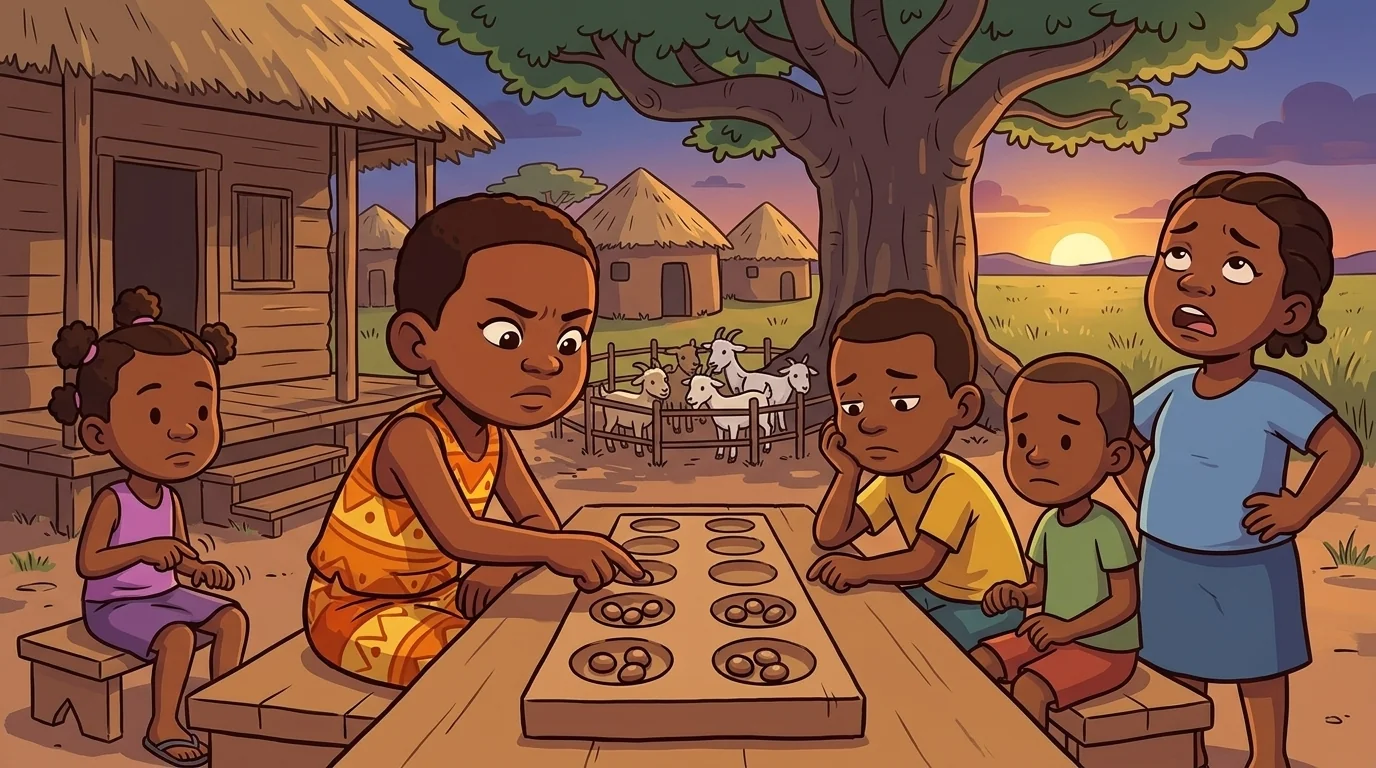
Kesi had not been born knowing her numbers at a glance. Once she'd been the slowest counter at the board, so anxious about miscounting that she touched every single seed twice to be sure, and the bigger children groaned and drummed their fingers waiting for her turn.
The change had come from the goats, of all things. Her family kept a small herd, and each evening she had to know they were all home — and there was never time to line up seven fidgety goats and count them nose by nose. So she'd learned to see the flock the way you see anything familiar: this many is right, that many is short one. Her eyes learned the shape of three, the shape of four, so surely that a missing goat left a hole she felt before she could even name the number. When she carried that same trick back to the board — letting her eyes learn the shape of a pit of three, a pit of four — the groaning stopped. She wasn't slow anymore. She was simply sure, and fast because she was sure.
"You stopped counting," a big girl said, half accusing.
"I stopped counting the small ones," Kesi corrected. "I still count the big ones. I just don't start from nothing."
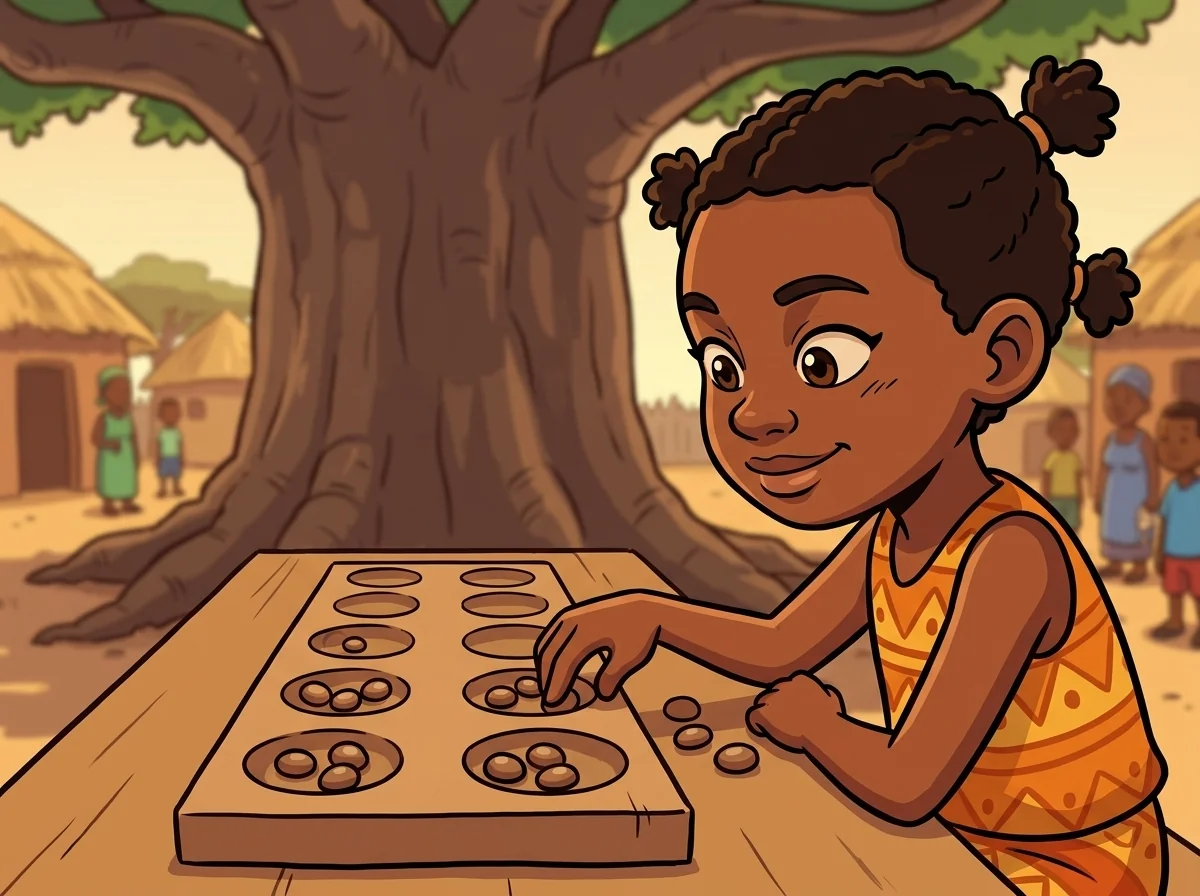
Nana the Sowing Elder tested her on a busy afternoon, with the board half-played and pits of every size scattered across both rows.
"Around the board, child," Nana said. "Every house. As fast as they're true — not faster."
Kesi's eyes swept the ring. "Three. One. Two. Four." — the little pits fell out of her like breath — and then at a crowded house she paused, honestly paused, caught a familiar clutch of three inside it, and counted on from there, her voice steady: "...that's three, and four, five, six — six." Not a single number was wrong, and not a single one had been a careless guess. Nana nodded slowly.
"Some children rush and call a nine a seven and lose everything," Nana said. "Some children are so afraid of that they crawl seed by seed and bore the whole village to sleep. You do neither. You know the small ones on sight and you count the big ones honestly. That is the eyesight this whole game plays through. Sit at my board and teach the children how to see how many."
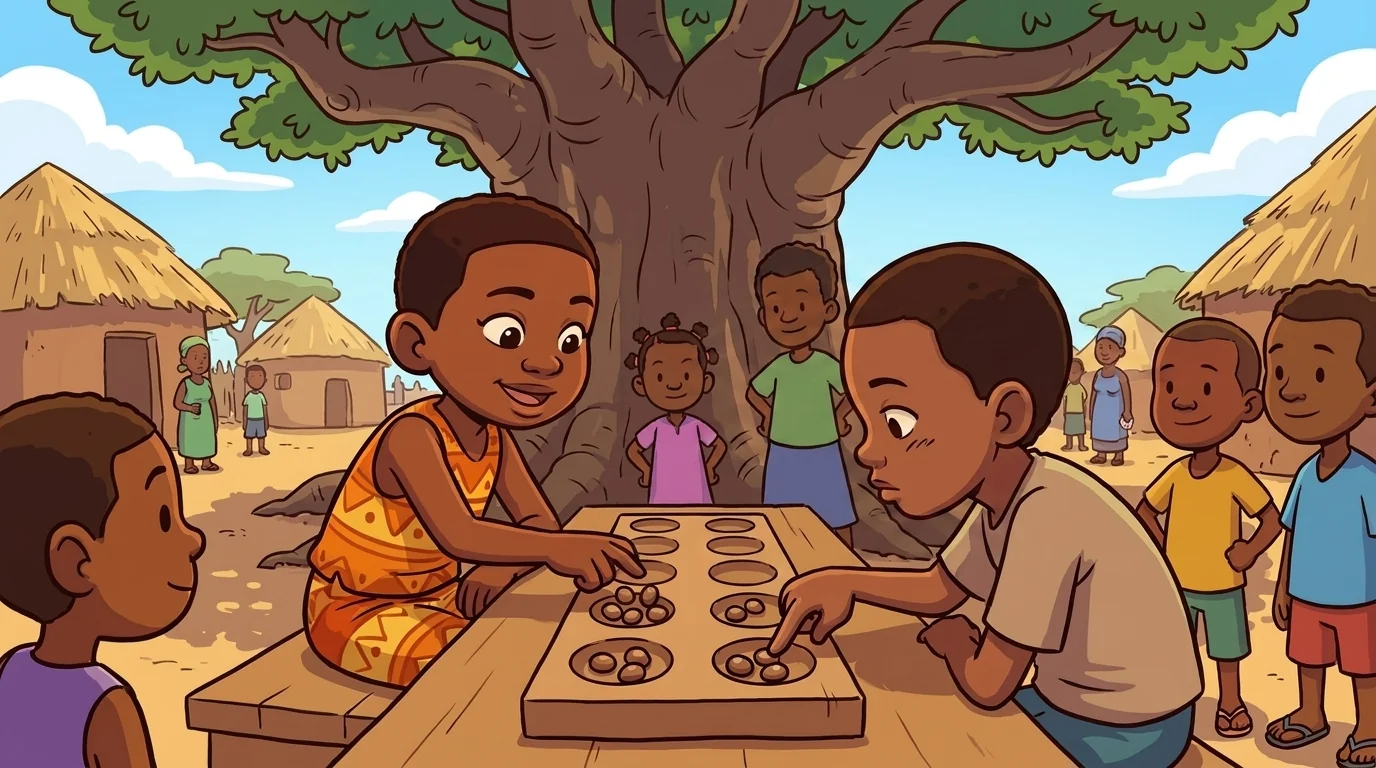
Kesi's student was a jittery girl named Ama who guessed. Ama would flick her eyes at a pit, blurt "five!" when it was seven, sow to the wrong place, and lose seeds she should have kept — all because she'd rather be fast-and-wrong than slow-and-right.
"You're not seeing, you're wishing," Kesi told her gently. "Watch. For the little pits, I'll teach your eyes to know." She cupped her hands to show Ama just three seeds. "Don't count. Just look. That's three, forever. Now four. Now two. Let your eyes keep those shapes." Ama practiced until three looked like three without a single point of her finger. "Now the fat pits," Kesi went on. "Here you slow down — but you don't crawl. Find a little bunch you already know inside the big one, and count on from it." She showed her: a clump of three, then four, five, six. "Fast where you can be sure, careful where you can't. Never the guess in between."
Ama tried it on a real turn. She named the small pits at a glance, then reached a crowded house and made herself slow, found a three inside it, and counted on — and got it right. She sowed to exactly the pit she'd meant. "I didn't lose them," she breathed. "I knew how many, so I knew where to send them."
"That's seeing," said Kesi. "Wishing loses seeds. Seeing keeps them."
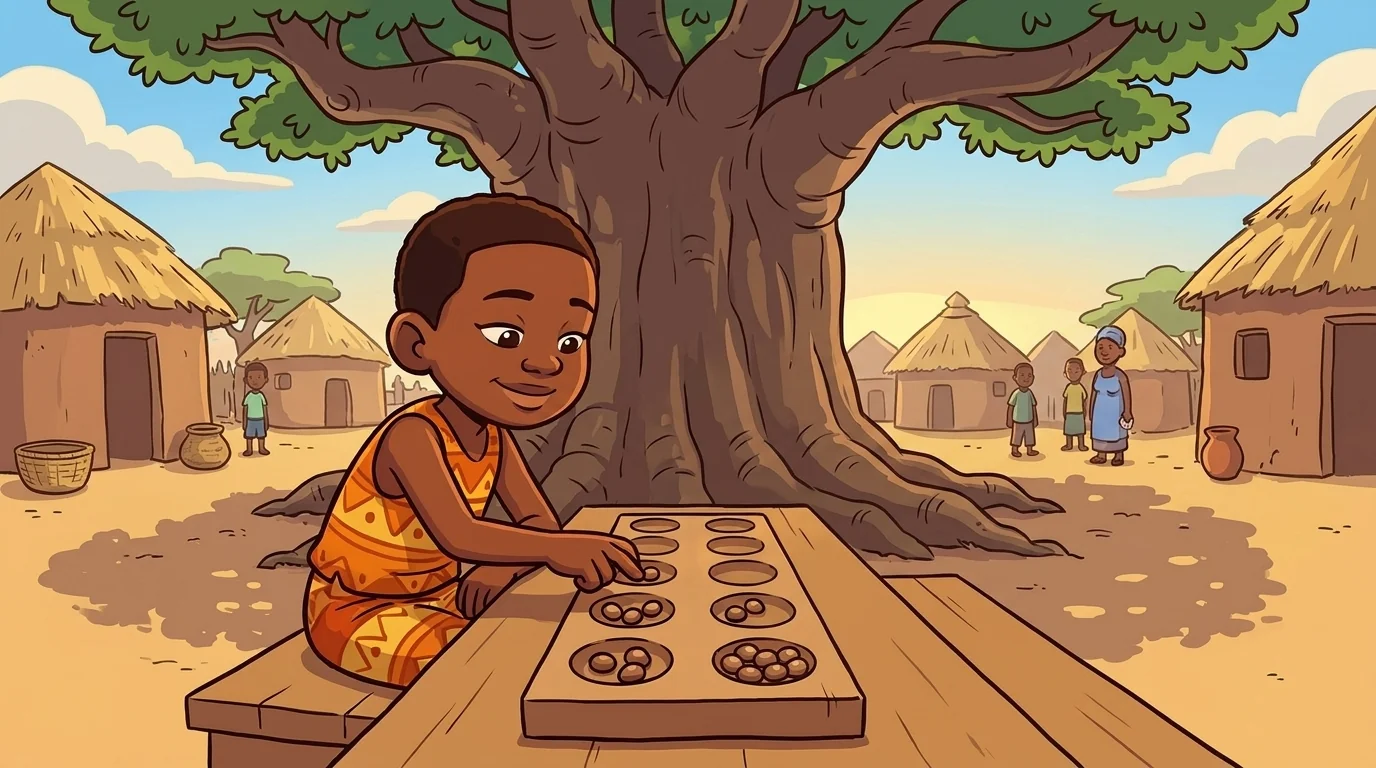
That evening Kesi walked the quiet board alone, letting her eyes drift over the leftover pits — three, one, four, two — naming them without trying, the way you can't help reading a word you already know.
She remembered the small anxious girl who'd touched every seed twice and still felt unsure, and the seven fidgety goats that had taught her eyes to trust themselves, and how strange it was that the thing she now did fastest of all was the very thing she'd once done slowest. Knowing how many was such a quiet skill. Nobody cheered it. But nothing on the board could happen without it — every sow, every capture, every plan began with somebody, somewhere, simply knowing the number that was there.
There was a calm pleasure in it, the pleasure of trusting her own eyes at last. She was not afraid of a pit of seeds anymore, big or small. Three looked like three. And when the number was too big to trust at a glance, she was no longer ashamed to slow down and count it true — because she had learned that the bravest kind of knowing is the kind that stops, when it needs to, to be sure. She looked once more around the whole ring of pits, knew every number in it, and felt wonderfully, quietly awake.
The SeedSong ensemble
Count Kesi is part of SeedSong's distributed-narrative cast. Each character embodies a different curricular primitive; together they teach the full subject.
-

Sower Sefu
Sowing: pick up a pit and drop exactly one seed in each pit counterclockwise
-

Capture Koro
Capturing: when the last seed makes an enemy pit two or three, sweep it
-
Reap Rafiki
Multi-capture chain: read a run of 2s and 3s backward and reap them all
-

Subitize Sisi
Look-ahead arithmetic: compute the landing pit without sowing it out
-
Lapwing Lulu
Lapping: sow a full loop around the board (skipping the start pit)
-

Store-Keeper Kito
The store (kroo) + win count: bank seeds safely; the store count is the win
-
Starve-Guard Nne
The must-feed rule: when the opponent has no seeds, you must give them some
-

Pitkeeper Pemba
Building a threat: load a pit to reach a target pit exactly
-

Doublesow Dembe
Staging / relay: stage seeds across turns to set up a big sweep
-

Seedling Sanaa
Opening patterns: the first-move sowing plan
-

Endgame Enzi
Endgame count-out: force the last seeds; parity and counting to the win
-

Nana Sowing Elder
The sowing elder (mentor): poses which-sow-captures puzzles; credits the tradition warmly