
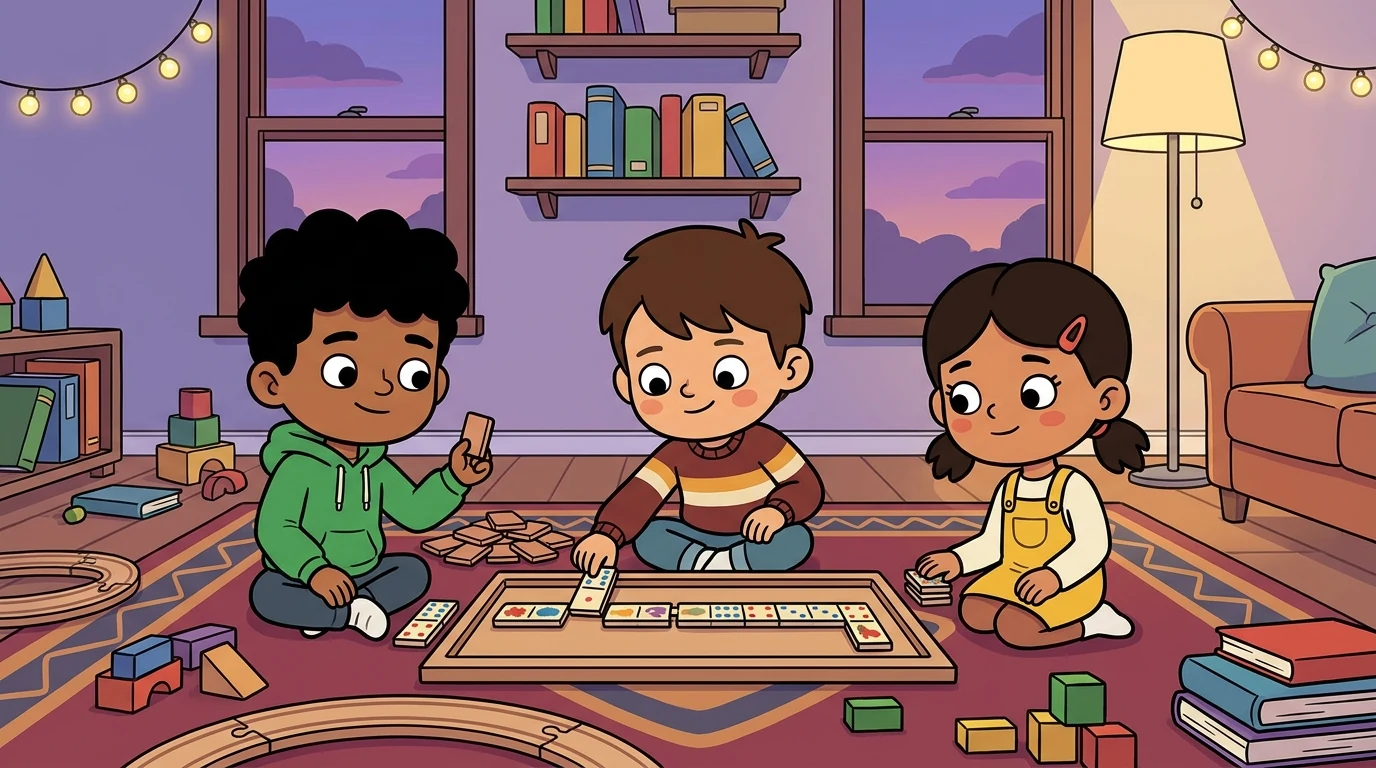
Train Tomás · Draw Dilan · Block Bianca
THE TRAIN-PLANNING + HAND-MANAGEMENT COMBINATION — Tomás's planned sequence + Dilan's draw-or-pass when stuck + Bianca's read of when to block, working together so a Mexican Train is built, kept moving, and defended
Ensemble — All Aboard the Train
Three of them set out to build a train together one evening, and it took all three to run it right: Train Tomás, who could plan a whole sequence of tiles before laying a single one; Draw Dilan, who never panicked when the track ran into a number he didn’t have; and Block Bianca, who could read the exact moment to stop building and start defending. A Mexican Train, they knew, isn’t just laid — it’s planned, adapted, and defended, and no one of them could do all three at once.
“A train’s a journey,” said Tomás, laying the first rails off the hub. “I can see the route — three, four tiles ahead. But routes hit trouble. When my track wants a number I don’t have, that’s Dilan. And when the smart move stops being build and starts being stop them — that’s Bianca. Plan, adapt, defend. That’s the whole trip.”
Tomás’s train ran beautifully at first — he laid a planned sequence, each tile feeding the next, a double answered right on time. Then the track wanted a two, and Tomás had no two. His careful plan hit a wall.
He didn’t force it. “Dilan?” he said. And Dilan, calm as ever, drew from the boneyard. “No two,” Dilan reported, turning the tile. He drew again — “still no. If I can’t play, I don’t jam a wrong tile in; I draw while there are tiles, and if there aren’t, I pass and let the turn go.” One more draw — a two-five. “There’s the two.” He handed the moment back to Tomás, whose planned route could now roll on. The plan hadn’t failed; it had just needed Dilan’s steady adapting to get unstuck.
Then Bianca, who’d been quietly counting the whole time, held up a hand. “Don’t keep building,” she said. “Look at the table. Nana’s train is one tile from finishing, and the boneyard’s nearly empty. This isn’t a build moment anymore. It’s a block moment.”
Tomás blinked — his instinct was always to lay more track. But Bianca was reading something he wasn’t: not their own train, but everyone else’s chances. “Almost every four’s been played,” she said. “If we steer the open ends to fours, Nana can’t play — she’ll have to draw from an empty boneyard, and pass.” She worked the ends toward fours; Nana, out of fours and out of boneyard, knocked the table and passed. The threat was smothered.
Nana Fives, doing the passing, laughed. “Every player learns one mode and leans on it,” she said. “Tomás builds. Dilan adapts. Bianca defends. The three of you have learned the harder thing — when to switch. A train that only ever builds gets blocked. A train that only ever defends never scores. You read the moment, and you pick the mode the moment is asking for.”
It was Bianca who named the real lesson, resetting the hub afterward. “The hard part was never the building, or the drawing, or the blocking,” she said. “It was knowing which one the moment wanted. I used to block all the time, even when I should’ve been building. Tomás used to build even when he was about to get blocked. Dilan—”
“—used to think drawing meant I’d failed,” Dilan finished. “It doesn’t. Being stuck is just a signal — draw, or pass, or hand it to one of you. Adapting isn’t losing.”
“So we watch for each other’s moment,” said Tomás. “When my plan stalls, I don’t force — I call Dilan. When building stops being smart, Bianca calls the block. Nobody does one thing all game. We read what the moment needs and switch.” He slid the hub tile into the centre. “Plan when there’s road. Adapt when there’s a wall. Defend when they’re about to win. The trick is telling which is which.”
That evening the three of them stayed and ran one long train together, calling their modes aloud as the moment turned — Tomás’s “I’ve got a route, four tiles,” Dilan’s “stuck, drawing,” Bianca’s “hold it, block now” — a little relay of plan, adapt, defend, handing the moment back and forth.
They thought about how each of them had once leaned on a single mode and been beaten for it: Tomás building straight into a block, Bianca defending when she should have raced ahead, Dilan treating every stuck turn as a small defeat. And they thought about how the whole game had opened up once they’d learned to read the moment — to see whether the board wanted a plan, an adaptation, or a defense, and to hand the turn to whoever’s craft the moment called for. A train isn’t built by one skill, they’d decided; it’s built by three people watching for each other’s moment and switching modes at exactly the right time. They squared the hub, rails ready for tomorrow, and felt the easy warmth of three travellers who had learned that the longest journeys need more than one kind of hands.
The TileTales ensemble
Train Tomás · Draw Dilan · Block Bianca is part of TileTales's distributed-narrative cast. Each character embodies a different curricular primitive; together they teach the full subject.
-

Match Mateo
Matching ends: you may only add a tile whose end equals a number already open
-

Double Dev
Doubles and the spinner: a double is played crossways and opens new arms
-

Block Bianca
Blocking: steering the open ends so the opponent has no legal play
-

Draw Dilan
The boneyard: when you can't match, you draw a tile or pass
-

Count Bello
Pip-counting and subitizing: reading a tile's value at a glance
-

Fiver Odalys
All-fives scoring: land the open-ends total on a multiple of five
-

Threes Thandi
Multiples of three: scoring on multiples of 3 (and on both 3 and 5)
-

Shed Sunil
Shedding to win: be first to play every tile and call 'domino!'
-

Tally Tunde
End-of-round counting-out: tally the pips left in hands, rounded to the nearest 5
-

Train Tomás
Mexican train: grow a personal train off the central hub
-
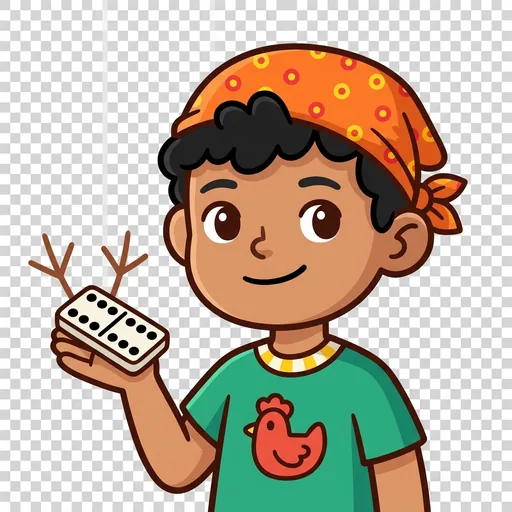
Chicken Cheo
Chickenfoot branching: a double must sprout three branches before play continues