
Chicken Cheo
CHICKENFOOT BRANCHING — when a double is played, the next three tiles must all attach to that double (forming a 'chickenfoot' of three branches) before normal end-play may resume
Chapter 9 — The One Who Grows the Foot
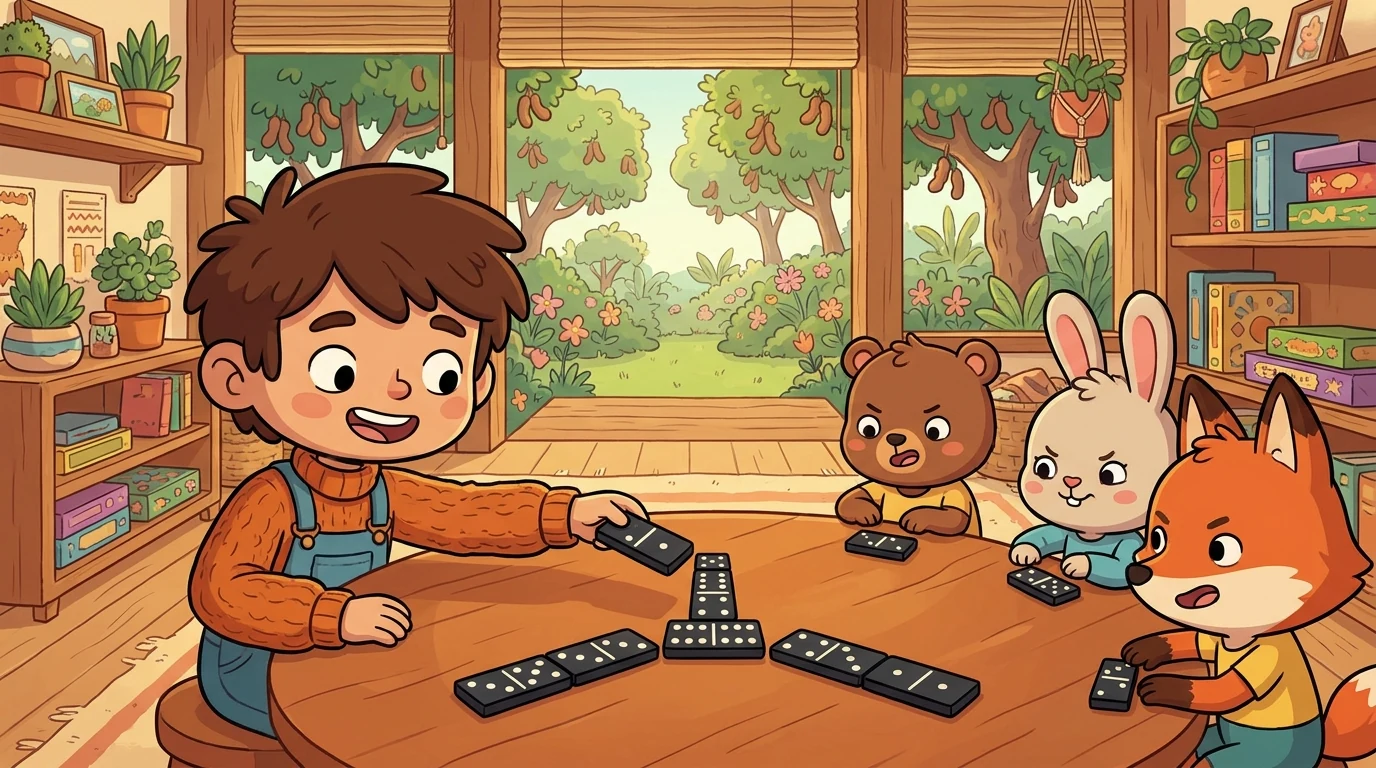
At the tamarind table, in the game they called Chickenfoot, there was a boy named Cheo who understood the game’s strangest rule better than anyone. In Chickenfoot, whenever someone plays a double, the game changes shape: the next three tiles played must all attach to that double, sprouting three branches from it — a shape that looks exactly like a chicken’s three-toed foot. Only once all three toes are grown may the game go back to normal end-play.
Most children found this rule annoying. It interrupted their plans; it made them all pile tiles onto one spot instead of running the line where they wanted. But Cheo loved it. He saw that the double was an invitation the whole table had to answer together — three branches, one foot, everyone contributing a toe before anyone could wander off again. “A double doesn’t just get covered,” Cheo would say, laying a tile onto a fresh double to start the first toe. “A double grows a foot. Three branches, and until they’re all there, the foot is all that matters.”
Cheo had once hated the chickenfoot rule as much as anyone. He’d have a beautiful plan for his line, someone would play a double, and suddenly the rules yanked everyone’s attention onto that one spot — three toes to grow before he could get back to his scheme. It felt like being interrupted mid-sentence, over and over.
The change came when he stopped fighting the interruption and started using it. He realised the double-foot was a place he could plan for — if he saw a double coming, he could hold tiles that matched its number, ready to claim a toe the moment the foot opened. Instead of resenting the pause, he prepared for it. And there was something he came to like in the shape itself: the way the whole table bent toward one point and finished it together before moving on. The rule that had felt like a roadblock became the part of the game he waited for.
Nana Fives tested him the honest way: she played a double herself and said, “Grow it.”
Cheo knew the rule cold. A double was down; three tiles must now attach to it before anything else. He laid the first toe — a tile matching the double’s number branching off one side. Another player added the second toe. Cheo, who’d been holding a matching tile on purpose, added the third — and the foot was complete, three branches grown. Only now did normal play resume, and Cheo, having planned for exactly this, was perfectly placed to keep going.
Nana Fives nodded, amused. “Every child groans when a double drops and the foot must be grown,” she said. “You’ve learned to wait for it, to hold the tiles it will ask for, to see the foot as a place you prepare for instead of a wall you hit. The rule that stops the game is also the rule that rewards the one who saw it coming.”
A grumbling girl named Rosa despised the branching rule. “Why can’t I just play my line?” she huffed, when yet another double forced everyone onto one spot.
“Because a double grows a foot,” Cheo said, “and the foot has to finish first. But look — you can use that.” He pointed at the double someone had just laid. “It’s got three toes to grow. Do you have a tile matching its number?” Rosa did — a couple, in fact. “Then don’t groan — grab a toe. Every toe you grow is a tile off your hand and a spot you chose. And if you see a double coming, hold your matching tiles for it.” Rosa, skeptical, played a matching tile onto the double, claiming a toe, then another. “I finished two of the three,” she said, surprised. “I was part of building it.” “That’s the foot,” Cheo said. “It stops everybody — but it belongs to whoever’s ready for it.”
That evening Cheo sat alone and played a slow Chickenfoot against no one, deliberately dropping doubles just to grow their feet — first toe, second toe, third toe — feeling the shape complete before he let the game run on again.
He thought about the boy who’d once seethed every time a double interrupted his line, and about the day he’d stopped fighting the rule and started holding tiles for it, waiting for the foot the way you wait for a bus you know is coming. He’d grown genuinely fond of the branching — the way it made the whole table lean toward one point and finish it together, three toes, one foot, no one racing ahead until the shared thing was done. The interruption he used to hate had become his favourite move, once he understood it was also an opportunity. He squared the tiles away, one last double sitting foot-complete on the wood, and felt the quiet good humour of someone who had learned to love the very rule he used to fight.
The TileTales ensemble
Chicken Cheo is part of TileTales's distributed-narrative cast. Each character embodies a different curricular primitive; together they teach the full subject.
-

Match Mateo
Matching ends: you may only add a tile whose end equals a number already open
-

Double Dev
Doubles and the spinner: a double is played crossways and opens new arms
-

Block Bianca
Blocking: steering the open ends so the opponent has no legal play
-

Draw Dilan
The boneyard: when you can't match, you draw a tile or pass
-

Count Bello
Pip-counting and subitizing: reading a tile's value at a glance
-

Fiver Odalys
All-fives scoring: land the open-ends total on a multiple of five
-

Threes Thandi
Multiples of three: scoring on multiples of 3 (and on both 3 and 5)
-

Shed Sunil
Shedding to win: be first to play every tile and call 'domino!'
-

Tally Tunde
End-of-round counting-out: tally the pips left in hands, rounded to the nearest 5
-

Train Tomás
Mexican train: grow a personal train off the central hub