
Draw Dilan
THE BONEYARD — when you have no tile that matches an open end you draw from the boneyard (the face-down spares); if it's empty or the rules forbid drawing, you pass your turn
Chapter 5 — The One Who Draws When He’s Stuck
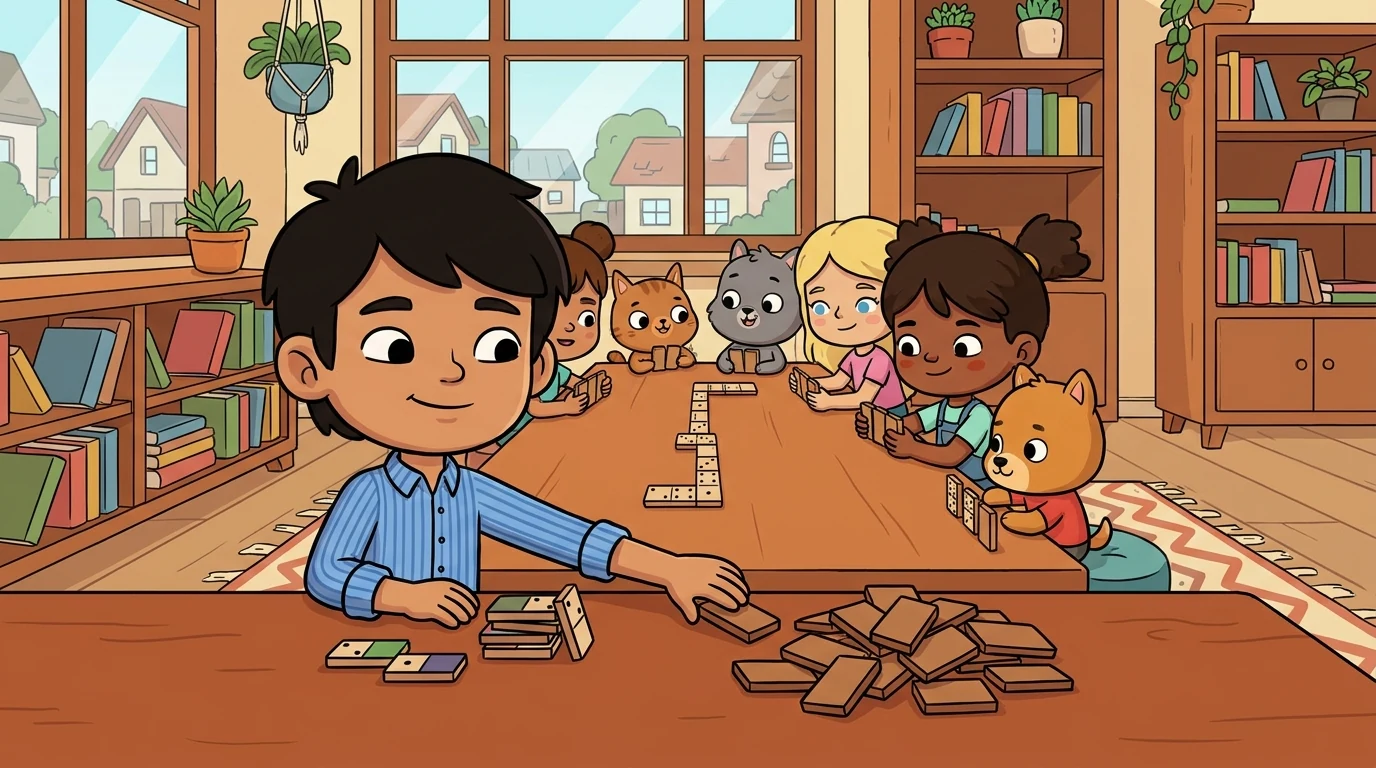
At the tamarind table there was a boy named Dilan who was famous for a thing that sounds like nothing: he knew what to do when he couldn’t do anything. Every player, sooner or later, looks at the open ends of the line, looks at their own tiles, and finds that not one of them matches. The ends want a six and a two; Dilan holds fours and blanks and a lonely three. Stuck. And where other children would sit frozen, or worse, jam a tile down where it didn’t belong, Dilan simply reached for the boneyard.
The boneyard was the pile of face-down spare tiles at the edge of the table — the tiles no one had drawn at the start. When you can’t match, Dilan knew, you draw one from there and hope it fits. And if the boneyard is empty, or the rules of that particular game say you may not draw, then you do the last honest thing: you pass. You knock the table once and let the turn go by. “Being stuck isn’t the end of your turn,” Dilan liked to say. “It’s the start of your draw.”
Dilan had not always been so calm about being stuck. As a smaller boy, a turn he couldn’t play felt like a small disaster. He’d panic, shove a tile against an end it didn’t touch, and Nana Fives would slide it back. Or he’d freeze up entirely, holding his useless tiles, sure he’d already lost. Being unable to play felt like failing.
The change came the day he finally, calmly, drew. The ends wanted numbers he didn’t have, so instead of forcing or freezing, he turned over one tile from the boneyard — and it carried a six, and the line wanted a six, and suddenly he was unstuck. It hadn’t been a disaster at all; it had been a door. And the time the boneyard ran dry and he simply knocked and passed, he learned the other half: passing wasn’t quitting. It was the allowed, honest move for a turn where nothing could be played. Being stuck, he realised, was just a problem with a rule already written for it.
Nana Fives tested him with a mean little hand: the ends wanted a five and a one, and Dilan held nothing but sixes and threes.
“Play,” she said, knowing he couldn’t.
Dilan didn’t force. He drew from the boneyard — a four-two — no help, the ends still wanted five and one. He drew again — a one-blank — and there it was, a one, and he laid it against the open one, unstuck. Later, when Nana emptied the boneyard entirely and gave him another dead hand, he didn’t fret. He knocked the table once, said “pass,” and let the turn move on.
Nana Fives nodded, satisfied. “Every child fears the turn they cannot play,” she said. “You’ve learned the two answers to it — draw while there are tiles to draw, and pass with a clear heart when there aren’t. A player who can’t play but doesn’t panic is stronger than a player who’s never been stuck. Being stuck is not losing. Forcing a tile that doesn’t fit — that’s losing.”
A girl named Suki hated being stuck so much she’d cheat the rule, sliding tiles against ends they didn’t touch. “But it’s my turn,” she protested. “I have to play something.”
“You don’t,” Dilan said gently. “That’s the thing nobody tells you. If nothing matches, you don’t force it — you draw.” He nodded at the boneyard. “Take one from there. Maybe it fits, maybe it doesn’t; if it doesn’t, draw again if the rules allow, and if the pile’s empty—” he knocked the table softly, “—you pass. Knock once. Let the turn go by. That’s not cheating and it’s not quitting. It’s the move for when there is no move.” Suki drew a tile, and it happened to fit, and her face changed. “So being stuck has its own rule,” she said slowly. “Its own move.” “Every kind of stuck does,” said Dilan.
That evening Dilan sat alone and dealt himself a deliberately terrible hand, just to practise being stuck — drawing, drawing again, and once, when he’d emptied his little boneyard, knocking the table and saying “pass” to the empty chairs.
He thought about the panicky boy he’d been, jamming tiles where they didn’t belong, or freezing as if a turn he couldn’t play was the end of the world. And he thought about how much lighter the game had become once he’d learned that stuck was just a situation with its own quiet rules — draw while you can, pass when you can’t, force never. There was a steadiness in it he’d grown to value: you don’t have to conjure a move that isn’t there; you reach for a new tile, or you let the turn pass, and you keep your head. He tidied the boneyard face-down, spares squared, ready for tomorrow, and felt the calm of someone who had made peace with being stuck — and learned the two honest ways through it.
The TileTales ensemble
Draw Dilan is part of TileTales's distributed-narrative cast. Each character embodies a different curricular primitive; together they teach the full subject.
-

Match Mateo
Matching ends: you may only add a tile whose end equals a number already open
-

Double Dev
Doubles and the spinner: a double is played crossways and opens new arms
-

Block Bianca
Blocking: steering the open ends so the opponent has no legal play
-

Count Bello
Pip-counting and subitizing: reading a tile's value at a glance
-

Fiver Odalys
All-fives scoring: land the open-ends total on a multiple of five
-

Threes Thandi
Multiples of three: scoring on multiples of 3 (and on both 3 and 5)
-

Shed Sunil
Shedding to win: be first to play every tile and call 'domino!'
-

Tally Tunde
End-of-round counting-out: tally the pips left in hands, rounded to the nearest 5
-

Train Tomás
Mexican train: grow a personal train off the central hub
-
Chicken Cheo
Chickenfoot branching: a double must sprout three branches before play continues