
Fiver Odalys
ALL-FIVES SCORING — in the Fives family you score whenever the total of all open ends is a multiple of 5 (5, 10, 15, 20…); the multiple you land on IS the points you earn
Chapter 4 — The One Who Lands on a Five
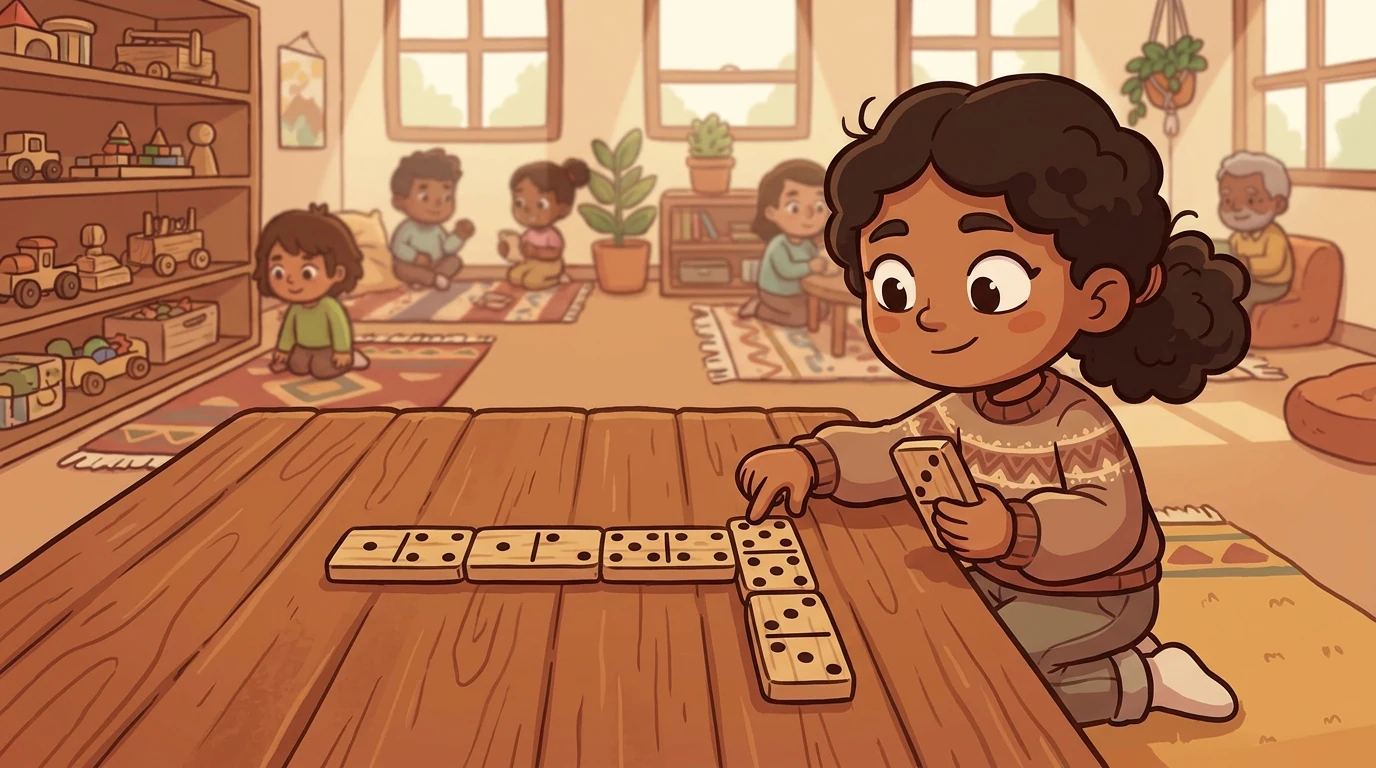
At the tamarind table, in the games where points are kept, there was a girl named Odalys whom everyone called Fiver, because she had a gift for making the open ends of the line add up to a five, or a ten, or a fifteen — a multiple of five — on the very turn she played. And in the Fives family of games, that is exactly what earns points: when the two open ends of the whole line total a five or a ten or a twenty, the player who made it happen scores that number.
Odalys thought in fives. Before she laid a tile, she’d already added the ends in her head and asked, “If I put this here, what will the total be?” If a four was open at one end and she could make the other end a one, the ends would total five — and she’d score five. If she could make it total ten, she scored ten. She didn’t chase the tiles she liked; she chased the totals. “Anyone can play a tile,” she’d say. “I play the tile that lands the ends on a five.”
Odalys had once played like everyone else — grabbing whatever fit, hoping points would somehow happen. She’d lay a tile, and only after would Nana Fives say, “Nine at the ends. No score.” Nine! One away from ten, and she’d never even looked. She was playing tiles and letting the total fall wherever it landed, like tossing seeds and hoping for a garden.
The change came the day she started adding the ends before she played instead of after. She held a tile and thought: the line ends in a six; if I add a four here, the far end becomes… and she worked it through, and saw the ends would total ten, and she played it on purpose — and scored ten. The difference stunned her. She hadn’t gotten luckier; she’d started looking ahead. She’d stopped tossing seeds and started planting them where the harvest would come.
Nana Fives set her the sharpest test she knew. Three open ends after a double: a three, a two, and a double-five turned sideways.
“Score if you can,” said Nana.
Odalys added the ends in her head first, the way she always did now. The double-five counted its full ten. Three plus two plus ten was fifteen — already a multiple of five, worth fifteen points — but only if she could play a tile that kept the total on a five without breaking it. She found a tile that matched an open end and left the ends totalling twenty, and she laid it, and scored twenty, clean.
Nana Fives clapped once. “Every child at this table plays a tile and hopes,” she said. “You add the ends before your hand ever moves, and you play only the tile that lands the total on a five. That is the difference between a player who hopes for points and a player who makes them. The multiple you land on is the score you earn — so land on purpose.”
A restless boy named Tomé kept just missing. “I had nine!” he wailed. “And eleven! And fourteen! Always one or two away!”
“Because you’re playing first and adding after,” Odalys said. “Add first. Look — the line ends in a three. What’s your other open end going to be if you play this tile?” Tomé worked it out: a two. “Three and two — that’s five. So that tile scores five. Play it on purpose.” Tomé laid it and — five, a clean multiple. He blinked at his own points. “Now do it again,” Odalys said. “Every turn, before you play, ask: what will the ends total? If it’s not a five, find the tile that makes it one. If none of yours does, play the tile that sets you up to land on five next time.” Tomé tried again, adding first, and landed on ten. “I keep landing on it now,” he said, amazed. “Because you’re aiming,” Odalys said. “You were always one or two away because you never aimed.”
That evening Odalys sat alone and played a slow scoring game against no one, adding the ends before every single tile, saying the target under her breath — “…that makes fifteen… that makes ten…” — landing on a multiple of five turn after turn, on purpose.
She thought about the girl who used to fling tiles and hope, who’d sat one away from ten a hundred times without ever looking, and about the quiet revolution of adding the ends first, of seeing the total in her mind before her hand moved. She had come to love that small act of foresight — picturing the result, then reaching for the exact tile that made the picture true. Points weren’t luck, she’d decided; points were a plan you could see before you played it. The multiple you landed on was simply the plan, made real, counted out on the table. She squared the tiles away, already adding tomorrow’s ends in her head, and felt the deep, settled joy of someone who had learned to aim.
The TileTales ensemble
Fiver Odalys is part of TileTales's distributed-narrative cast. Each character embodies a different curricular primitive; together they teach the full subject.
-

Match Mateo
Matching ends: you may only add a tile whose end equals a number already open
-

Double Dev
Doubles and the spinner: a double is played crossways and opens new arms
-

Block Bianca
Blocking: steering the open ends so the opponent has no legal play
-

Draw Dilan
The boneyard: when you can't match, you draw a tile or pass
-

Count Bello
Pip-counting and subitizing: reading a tile's value at a glance
-

Threes Thandi
Multiples of three: scoring on multiples of 3 (and on both 3 and 5)
-

Shed Sunil
Shedding to win: be first to play every tile and call 'domino!'
-

Tally Tunde
End-of-round counting-out: tally the pips left in hands, rounded to the nearest 5
-

Train Tomás
Mexican train: grow a personal train off the central hub
-
Chicken Cheo
Chickenfoot branching: a double must sprout three branches before play continues