
Count Bello
PIP-COUNTING / SUBITIZING — reading the value of a pip pattern instantly without counting dot-by-dot, and totalling the open ends of the whole line
Chapter 2 — The One Who Sees the Number
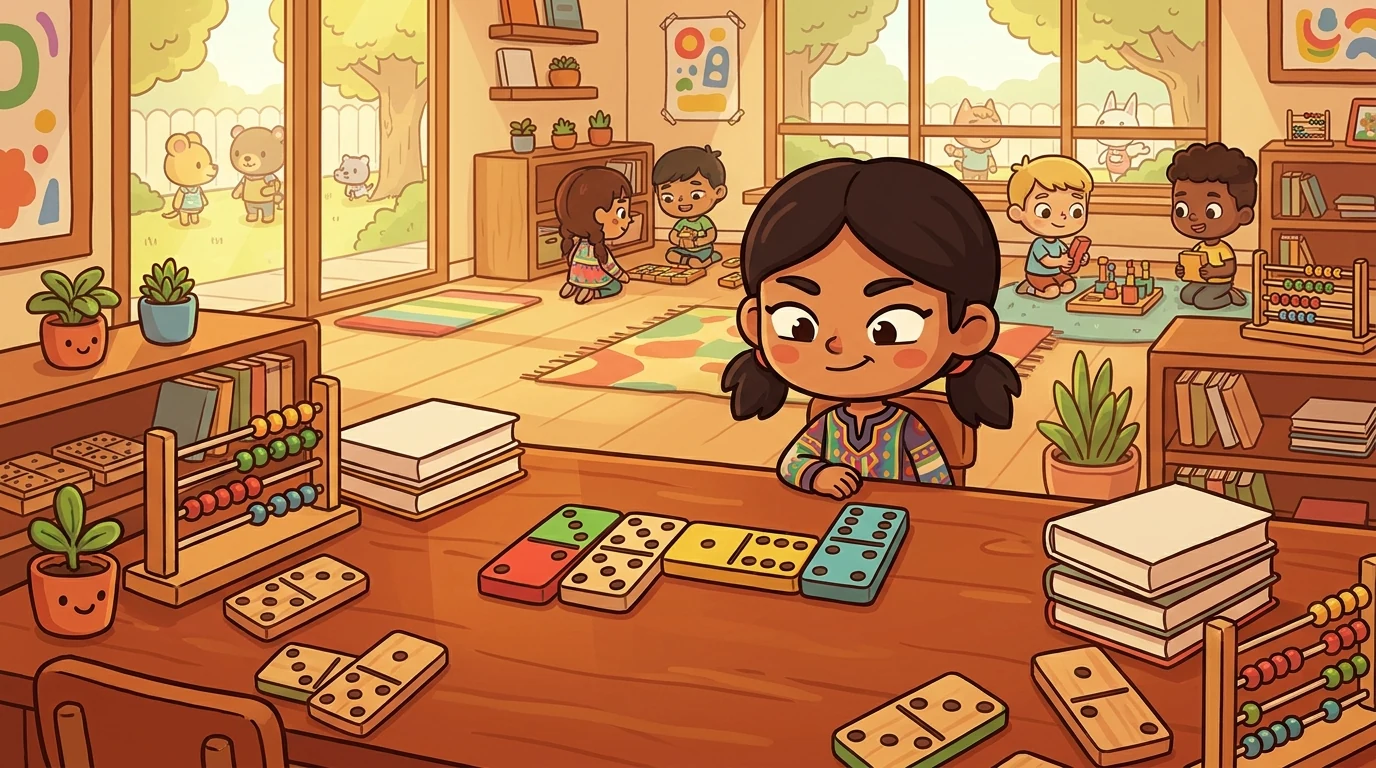
There was a girl at the tamarind table named Bello, and the others called her Count Bello, though she almost never counted out loud. She would glance at a tile — five pips arranged in their little X, or six in two neat rows — and simply know the number, the way you know a friend’s face without adding up the eyes and nose. Where another child would touch each dot and mutter “one, two, three, four, five,” Bello had already said “five” and moved on.
It wasn’t a trick and it wasn’t magic; it was that she had looked at the patterns so many times that the shapes had turned into numbers in her head. The four-corners pattern was four. The little X was five. The two rows of three were six. And because she could read each tile in a heartbeat, she could do the thing that really mattered: look at the two open ends of the whole line and add them up faster than anyone. “The tile is just a shape,” she’d say. “The shape is a number. Once you see the number, you don’t have to count.”
Bello had counted dot-by-dot once, like everyone. She remembered the slow days, tapping each pip with her finger, losing her place, starting over, while the game waited for her. It was tiring, and worse, it was slow — by the time she’d worked out one tile, she’d forgotten what the last one was.
The change came the way it comes for everyone: from seeing the same patterns again and again until they stopped being dots and started being numbers. One afternoon she realised she had said “six” about a tile before her finger even reached it. She hadn’t decided to; her eyes had just done it. After that she practised not counting — daring herself to name the pattern the instant it appeared — and the more she trusted her eyes, the faster and surer she became. The dots had quietly turned into numbers while she wasn’t looking.
Nana Fives, who noticed everything, set Bello a test that wasn’t about playing tiles at all. She laid out a long finished line and said, “Both ends. Total. Now.”
Bello’s eyes went left — a four — and right — a three — and she said “seven” before Nana had finished the word now. Nana added a branch off a double, so there were suddenly three open ends: a four, a three, and a five. “Total,” said Nana. Bello’s gaze swept all three — four, three, five — and she said “twelve,” reading each pattern at a glance and adding them without a single tapped dot.
Nana Fives smiled the particular smile she saved for something done well. “Every child here can count if you give them time,” she said. “You don’t need the time. You see the number in the pattern, and you add the ends before the rest of us have found our fingers. That speed is worth more than any lucky tile — because in the scoring games, the total of the open ends is the whole story.”
A boy called Reza sat down next to her, counting each pip aloud, painfully slow, and getting flustered when the line grew. “I can’t add the ends,” he complained. “By the time I count the second one I’ve forgotten the first.”
“Then stop counting the dots,” Bello said. “Look — this end.” She pointed at a tile showing five in its little X. “Don’t count it. Just look at the shape. What number lives in that shape?” Reza stared, and something clicked. “Five,” he said, surprised. “Right — you didn’t count, you saw. Now the other end — that shape?” A two. “Two,” said Reza, faster this time. “So the ends total—?” “Seven!” he said, and grinned, because he hadn’t tapped a single dot. “The shapes are numbers,” he said wonderingly. “I don’t have to count them.”
“You’ll always be able to count if you need to,” Bello said. “But once you can see, counting is just the slow door into the room you’re already standing in.”
That evening Bello sat alone and played a quiet game against no one, laying tiles and naming the running total of the open ends out loud, just to feel how fast she’d become — “nine… eleven… eight…” — each number arriving the instant the pattern did.
She thought about the slow, finger-tapping girl she used to be, losing her place, holding up the game, and about the strange soft moment when the dots had first turned into numbers on their own. She had come to love that instant recognition — not because it made her win, but because it let her see the whole line at once, the total living in the two open ends, instead of getting lost tile by tile in the pieces. The single tile was never the point, she’d decided; the point was the sum of the ends, the shape of the whole. She squared the tiles away, their patterns already numbers in her mind, and felt the quiet pride of someone who had stopped counting and started seeing.
The TileTales ensemble
Count Bello is part of TileTales's distributed-narrative cast. Each character embodies a different curricular primitive; together they teach the full subject.
-

Match Mateo
Matching ends: you may only add a tile whose end equals a number already open
-

Double Dev
Doubles and the spinner: a double is played crossways and opens new arms
-

Block Bianca
Blocking: steering the open ends so the opponent has no legal play
-

Draw Dilan
The boneyard: when you can't match, you draw a tile or pass
-

Fiver Odalys
All-fives scoring: land the open-ends total on a multiple of five
-

Threes Thandi
Multiples of three: scoring on multiples of 3 (and on both 3 and 5)
-

Shed Sunil
Shedding to win: be first to play every tile and call 'domino!'
-

Tally Tunde
End-of-round counting-out: tally the pips left in hands, rounded to the nearest 5
-

Train Tomás
Mexican train: grow a personal train off the central hub
-
Chicken Cheo
Chickenfoot branching: a double must sprout three branches before play continues