
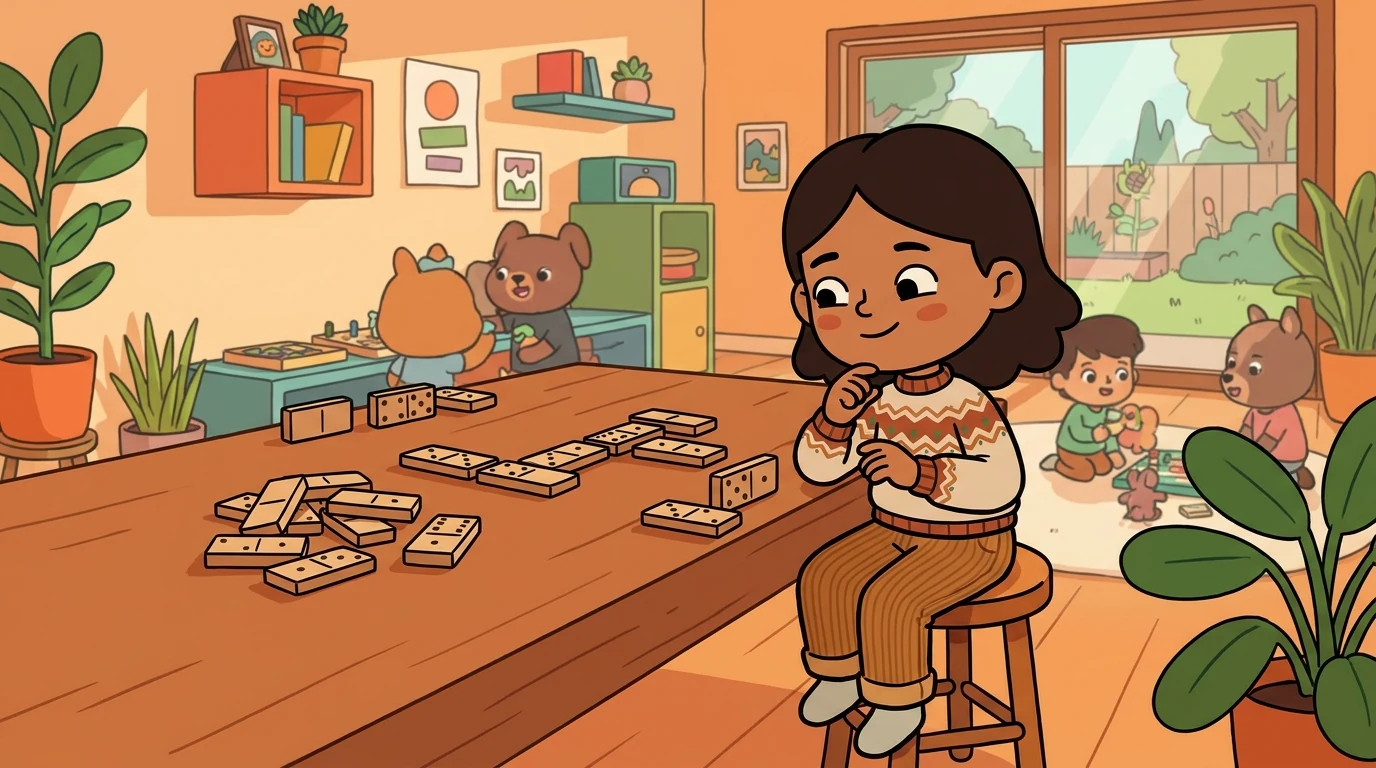
Threes Thandi
MULTIPLES OF 3 (ALL THREES / FIVES-AND-THREES) — the sister scoring rule to All-Fives: score when the open-ends total is a multiple of 3; in Fives-and-Threes you score for BOTH divisibility rules at once
Chapter 8 — The One Who Counts by Threes (and Fives)
At the tamarind table, Fiver Odalys was famous for landing the ends on a multiple of five. But there was a girl beside her named Thandi who counted a different way — by threes — and, in the trickiest game of all, by threes and fives at the same time. In Fives-and-Threes, you score when the total of the open ends is a multiple of three, or a multiple of five, and best of all when it’s a multiple of both. Thandi lived for that overlap.
Where Odalys asked “is the total a five?”, Thandi asked two questions of every total: “Is it a three? Is it a five?” A total of six — a three, score. A total of nine — a three, score. A total of ten — a five, score. And a total of fifteen — a three and a five — a double score, the sweetest number on the board. “Odalys checks one door,” Thandi would say, adding the ends in her head. “I check two. And now and then, both doors open onto the same room, and that’s the best turn there is.”
Thandi had once found the threes-and-fives game overwhelming. Two scoring rules at the same time felt like too much to hold — she’d check for fives, forget the threes, or check for threes and miss an easy five sitting right in front of her. She’d leave points on the table constantly, seeing only half of what a total was worth.
The change came when she stopped treating it as two hard jobs and started treating it as one habit done twice. Every total, without fail, she asked both questions in the same breath: three? five? A total of twelve — is it a three? Yes (four threes), score. Is it a five? No. A total of fifteen — three? yes; five? yes — both, double score. Once the two checks became one smooth motion, the game stopped being overwhelming and started being rich. There were simply more ways to win than she’d been letting herself see.
Nana Fives set her the test that rewards seeing both rules at once: a line where, with the right tile, the ends could total fifteen.
“Score all you can,” said Nana.
Thandi added the ends and saw she could steer them to fifteen. She checked both doors the way she always did: fifteen is a multiple of three (five threes) and a multiple of five (three fives). Both. She laid the tile that landed the ends on fifteen and claimed the double score — points for the three and points for the five, from one single play.
Nana Fives clapped, delighted. “Every scorer here learns one rule and stops,” she said. “You learned that a number can be true two ways at once. Fifteen is a three and a five together; so is thirty. A player who checks only for fives walks past those double scores every game. You check both, always — and you catch the numbers that pay you twice.”
A careful boy named Idris had mastered the fives but froze whenever threes were added. “It’s too much,” he said. “I can’t watch for both.”
“Don’t watch for both separately,” Thandi said. “Ask both questions about the same total, one after the other, every time. Here — the ends total nine. First question: is nine a five? No. Don’t stop there — second question: is nine a three? Yes — three threes. So it scores, on the threes.” Idris blinked; he’d have walked right past it. “Now this one — twelve. Five? No. Three? Yes. Score.” “So I’m not doing two games,” Idris said slowly. “I’m asking two questions about one total.” “Exactly. And every so often—” she pointed at a line totalling fifteen “—the answer to both is yes, and you get paid twice for one tile.” Idris found the next fifteen himself and grinned at the double score. “I almost only ever looked for fives,” he said. “I was missing half the board.”
That evening Thandi sat alone and played a slow Fives-and-Threes against no one, asking both questions of every total under her breath — “twelve… three, yes; five, no… fifteen… both!” — hunting the numbers that paid twice.
She thought about the girl who’d found two rules overwhelming and left points scattered everywhere unseen, and about the calm that came when she’d folded the two checks into one steady habit — three? five? — asked of every total without fail. She’d grown to love the doubleness of it: that a single number could be true in two ways, that one well-aimed tile could open both doors at once, that fifteen and thirty sat there like little gifts for anyone paying attention to both rules instead of just one. Getting double value from a single move, she’d decided, wasn’t luck — it was the reward for looking twice. She squared the tiles away, still murmuring three, five, and felt the bright satisfaction of someone who had learned to check both doors, every time.
The TileTales ensemble
Threes Thandi is part of TileTales's distributed-narrative cast. Each character embodies a different curricular primitive; together they teach the full subject.
-

Match Mateo
Matching ends: you may only add a tile whose end equals a number already open
-

Double Dev
Doubles and the spinner: a double is played crossways and opens new arms
-

Block Bianca
Blocking: steering the open ends so the opponent has no legal play
-

Draw Dilan
The boneyard: when you can't match, you draw a tile or pass
-

Count Bello
Pip-counting and subitizing: reading a tile's value at a glance
-

Fiver Odalys
All-fives scoring: land the open-ends total on a multiple of five
-

Shed Sunil
Shedding to win: be first to play every tile and call 'domino!'
-

Tally Tunde
End-of-round counting-out: tally the pips left in hands, rounded to the nearest 5
-

Train Tomás
Mexican train: grow a personal train off the central hub
-

Chicken Cheo
Chickenfoot branching: a double must sprout three branches before play continues