
Shed Sunil
SHEDDING TO WIN — the goal in block/draw dominoes is to be first to empty your hand; playing your last tile ends the round in your favour ('domino!'), so hand-management toward zero is the win condition
Chapter 11 — The One Who Empties His Hand
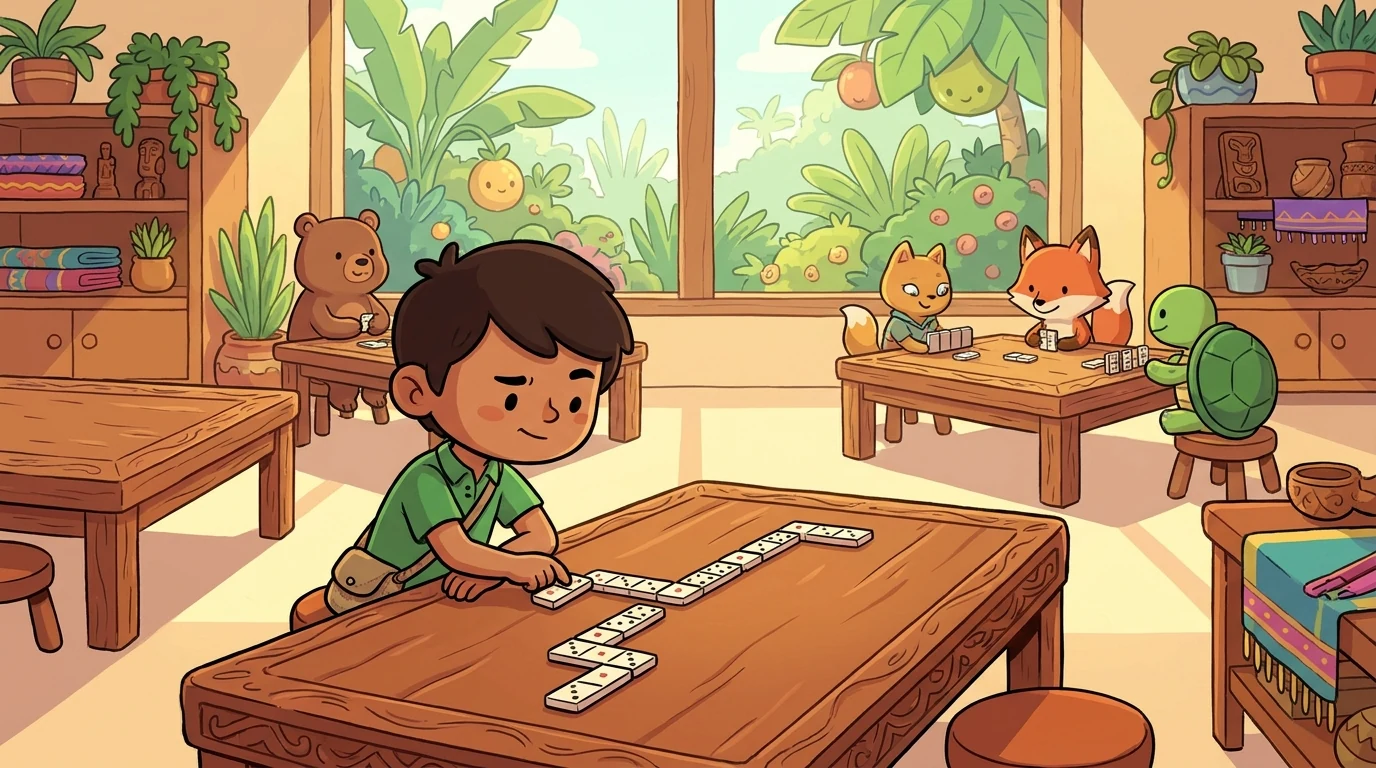
At the tamarind table there was a boy named Sunil who won more rounds than anyone, and he did it by the simplest goal in the whole game: he got rid of all his tiles first. In block and draw dominoes, that’s the win — not the biggest score on any single play, not the cleverest trap, but being the first to empty your hand. When you lay down your very last tile, you call “domino!” and the round is yours. Sunil was a shedder, and shedding, he knew, was the whole point.
But Sunil’s secret wasn’t speed — it was order. He didn’t just play whatever fit; he thought about which of his tiles would be hard to get rid of later, and he played those early, while there were still lots of open ends to accept them. The awkward tiles — the ones with numbers barely on the table, the heavy doubles — he shed first, when he had the most chances. The flexible tiles, the ones that fit almost anywhere, he saved for last. “Anyone can play a tile,” Sunil would say. “I play the one that’s hardest to play later, first — so that when it’s down to my last tiles, they all still fit.”
Sunil had once shed carelessly, playing whatever was easiest each turn. And it always went the same way: he’d play his flexible, friendly tiles early because they were easy, and end up holding one awkward tile — a stubborn double, or a number nobody had on the table anymore — stuck in his hand while everyone else emptied theirs. He’d lose the round holding a single tile he simply couldn’t place.
The change came when he started playing backwards in his mind — asking not “what’s easiest now?” but “what will be hardest at the end?” He noticed he was clinging to a five-five while fives were still open all over the table, saving it for no reason, and then getting stuck with it once the fives ran out. So he played it early, while it still fit, and saved his easy tiles for the tight endgame. Suddenly he was the one calling “domino!” — because he’d shed the hard tiles while shedding them was still possible.
Nana Fives set him the shedder’s test: a hand of five tiles, some easy, one obviously awkward — a double whose number was nearly gone from the table.
“Empty it,” said Nana.
Sunil looked not for the easiest play but for the hardest-later one. That double — its number almost spent on the table — would be impossible to shed in a few turns. So he played it now, while one last open end still accepted it. Then he shed his next-hardest, and his next, always clearing the stubborn tiles first, until all that remained were flexible tiles that fit anywhere — and he laid his last one down. “Domino,” he said quietly.
Nana Fives smiled. “Every child plays the easy tile and feels clever,” she said. “You play the hard tile first, while it can still go, and save the easy ones for when the table is tight. That is the whole craft of shedding — an empty hand isn’t won at the end; it’s won by the order you empty in. Do the hard part while it’s still possible, and the ending takes care of itself.”
A boy named Femi kept getting stuck one tile from winning. “I always have one left!” he groaned. “The same kind of tile, every time — one I can’t play.”
“Because you’re saving the hard ones for last,” Sunil said. “Flip it. Which of your tiles is going to be hardest to get rid of later?” Femi pointed at a six-six — and sixes were thinning out on the table. “Right — a double, and the sixes are nearly gone. In three turns you won’t be able to play that at all. So play it now, while a six is still open.” Femi played it, reluctantly. “Now what’s left is all easy tiles that fit lots of places — save those for the tight end.” Femi shed the rest smoothly and, for the first time, laid down his last tile. “Domino,” he breathed, astonished. “I did the hard one first.” “That’s the whole trick,” Sunil said. “Empty the awkward while you still can.”
That evening Sunil sat alone and dealt himself hand after hand, practising the order of emptying — hardest-to-shed first, flexible tiles last — until calling “domino” felt less like luck and more like a plan carried out.
He thought about the boy who used to play the easy tile every time and end up marooned with one stubborn piece he couldn’t place, and about the day he’d started thinking backwards — asking what would be hardest later and doing it now. He’d grown to love the quiet discipline of it: the win wasn’t a flashy trap or a lucky draw, just a hand emptied in the right order, the awkward tiles cleared while clearing them was still possible, the flexible ones held back for the tight finish. An empty hand, he’d decided, is built move by move, hardest-part-first, long before the last tile falls. He squared his tiles away, hand truly empty, and felt the calm pride of someone who had learned that “domino” is a plan, not a piece of luck.
The TileTales ensemble
Shed Sunil is part of TileTales's distributed-narrative cast. Each character embodies a different curricular primitive; together they teach the full subject.
-

Match Mateo
Matching ends: you may only add a tile whose end equals a number already open
-

Double Dev
Doubles and the spinner: a double is played crossways and opens new arms
-

Block Bianca
Blocking: steering the open ends so the opponent has no legal play
-

Draw Dilan
The boneyard: when you can't match, you draw a tile or pass
-

Count Bello
Pip-counting and subitizing: reading a tile's value at a glance
-

Fiver Odalys
All-fives scoring: land the open-ends total on a multiple of five
-

Threes Thandi
Multiples of three: scoring on multiples of 3 (and on both 3 and 5)
-

Tally Tunde
End-of-round counting-out: tally the pips left in hands, rounded to the nearest 5
-

Train Tomás
Mexican train: grow a personal train off the central hub
-
Chicken Cheo
Chickenfoot branching: a double must sprout three branches before play continues