
Tally Tunde
END-OF-ROUND COUNTING-OUT — when a round ends, each player adds up the pips still in their hand; in the Fives family the losers' leftover pips (often rounded to the nearest 5) become the winner's score
Chapter 10 — The One Who Counts What’s Left
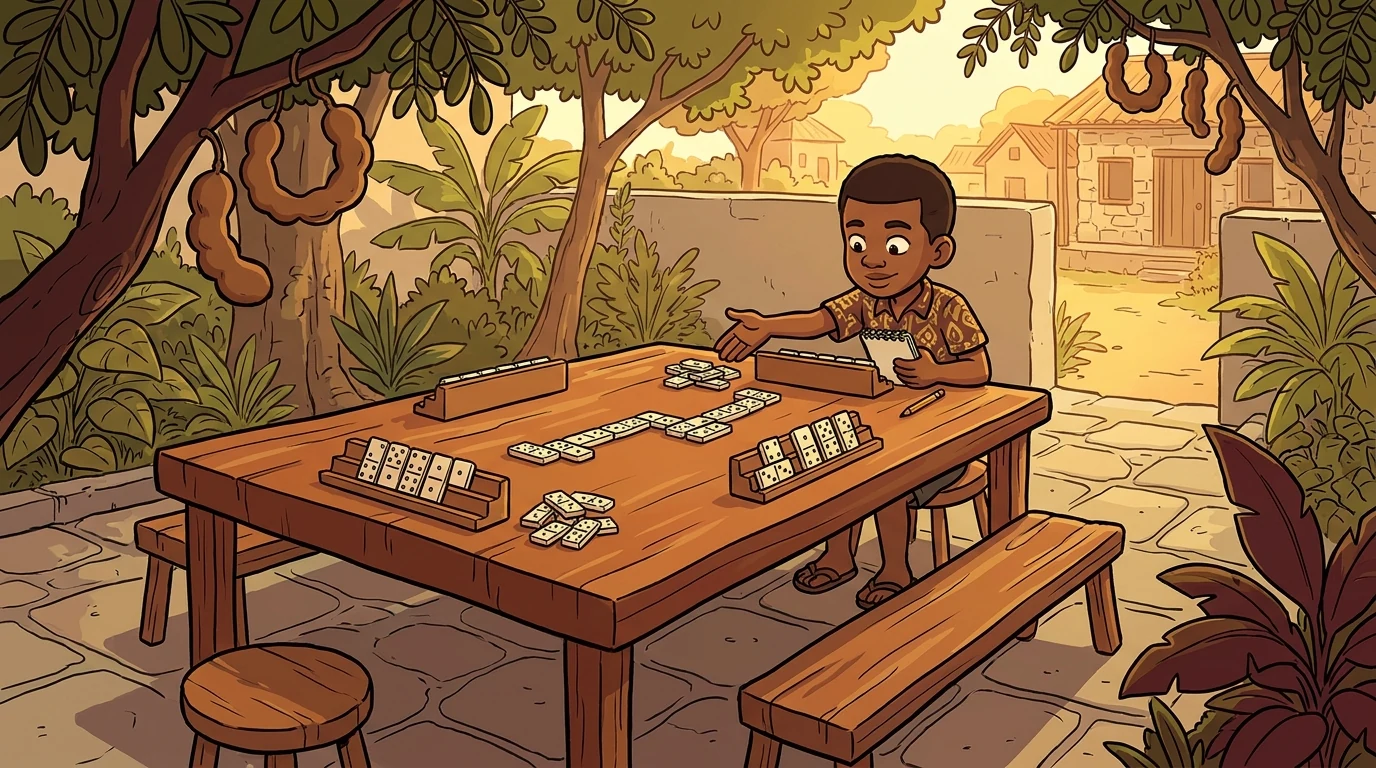
At the tamarind table, when a round finally ended — someone had shed their last tile, or the line was blocked and no one could move — there was a boy named Tunde whose job everyone trusted: he counted what was left. Because in these games, the round isn’t scored only by what you played; it’s scored by what still sits in your hand. When the round ends, every player adds up the pips on their leftover tiles, and those leftovers — often rounded to the nearest five — become points for the winner.
Tunde was fast and he was fair. He’d go around the table, adding each player’s stranded pips: “Eight here… twelve there… five for you…” — and in the Fives family, he’d round each total to the nearest five before it counted. A hand holding thirteen pips rounded to fifteen; a hand holding eleven rounded to ten. “The tiles you never played still speak at the end,” Tunde would say, tallying. “A double-six left in your hand is twelve points you’re handing to someone else. What’s left is the last word of the round.”
Tunde had once thought only the playing mattered — get your tiles down, chase your scores, and never mind the rest. Then round after round he’d end up holding heavy tiles, the big doubles he’d been saving, and gasp when Tunde-of-old (for even he had to learn this) tallied them up as a mountain of points for the other side. He’d been hoarding his most valuable tiles and, at round’s end, simply gifting their pips away.
The change came when he started thinking about his leftovers during the round, not just at the end. He began shedding his heavy tiles early — playing the double-six when he could, not clinging to it — so that if the round ended suddenly, his hand would be light. And he learned to count fairly and quickly, rounding each total to the nearest five without fuss. The endgame stopped being a nasty surprise and became something he’d planned for all along: keep the hand light, because the hand gets counted.
Nana Fives tested him not on playing but on tallying: she froze a blocked round and said, “Count the table. Round to the nearest five. Aloud.”
Tunde went round the ring. One hand held a six-five and a three: fourteen pips, rounded to fifteen. Another held a two-blank: two pips, rounded to nothing — zero. His own hand held a four-one: five, exactly. He announced each total honestly, his own included, rounded each to the nearest five, and summed the losers’ pips as the winner’s score. No tile uncounted, no total nudged.
Nana Fives nodded, pleased. “Every child watches the tiles go down,” she said. “You watch the tiles that stay. The round’s last truth is the count of what’s left in every hand — rounded, tallied, fair. A player who forgets the leftovers plays a fine game and loses at the counting. Keep your hand light, and count every hand true — your own most of all.”
A boy named Marco always argued at counting time, sure he’d been shorted. “That’s not fifteen!” he’d protest, or quietly not mention his own heavy double.
“Let’s count it together, out loud,” Tunde said, unbothered. “Your hand — six-six and a two. The double-six is twelve pips, both halves. Plus two is fourteen. Rounded to the nearest five, that’s fifteen.” Marco opened his mouth to argue and then, counting it himself, closed it. “And mine,” Tunde went on, turning his own tiles face-up without being asked, “is a three-one — four pips — rounds to five. I’m not hiding it.” Marco stared. “You counted your own against yourself.” “Of course. The count only means anything if it’s true for everyone, me included. And next round—” Tunde tapped Marco’s double-six, “—play that early. Don’t be caught holding twelve points at the end.” Marco did, the next round, and ended light. “I’ve been gifting away my best tiles,” he said.
That evening Tunde sat alone and practised the count on a set of pretend hands he dealt himself — adding leftover pips, rounding each to the nearest five, summing them true — just to keep his tallying quick and clean.
He thought about the boy who used to hoard his heavy doubles and hand their pips to the winner at every round’s end, and about the shift that came when he started keeping his hand light on purpose, shedding the big tiles early because he finally understood the leftovers get counted. And he thought about the other thing counting had taught him — that a tally is only worth anything if it’s honest, every hand true, his own turned face-up first. What’s left, he’d decided, is never nothing; it’s the last word of the round, and the fair reading of it is a kind of respect you pay the whole table. He squared the tiles away, the day’s totals still tidy in his head, and felt the steady satisfaction of someone who had learned to count what’s left — quickly, and true.
The TileTales ensemble
Tally Tunde is part of TileTales's distributed-narrative cast. Each character embodies a different curricular primitive; together they teach the full subject.
-

Match Mateo
Matching ends: you may only add a tile whose end equals a number already open
-

Double Dev
Doubles and the spinner: a double is played crossways and opens new arms
-

Block Bianca
Blocking: steering the open ends so the opponent has no legal play
-

Draw Dilan
The boneyard: when you can't match, you draw a tile or pass
-

Count Bello
Pip-counting and subitizing: reading a tile's value at a glance
-

Fiver Odalys
All-fives scoring: land the open-ends total on a multiple of five
-

Threes Thandi
Multiples of three: scoring on multiples of 3 (and on both 3 and 5)
-

Shed Sunil
Shedding to win: be first to play every tile and call 'domino!'
-

Train Tomás
Mexican train: grow a personal train off the central hub
-
Chicken Cheo
Chickenfoot branching: a double must sprout three branches before play continues