
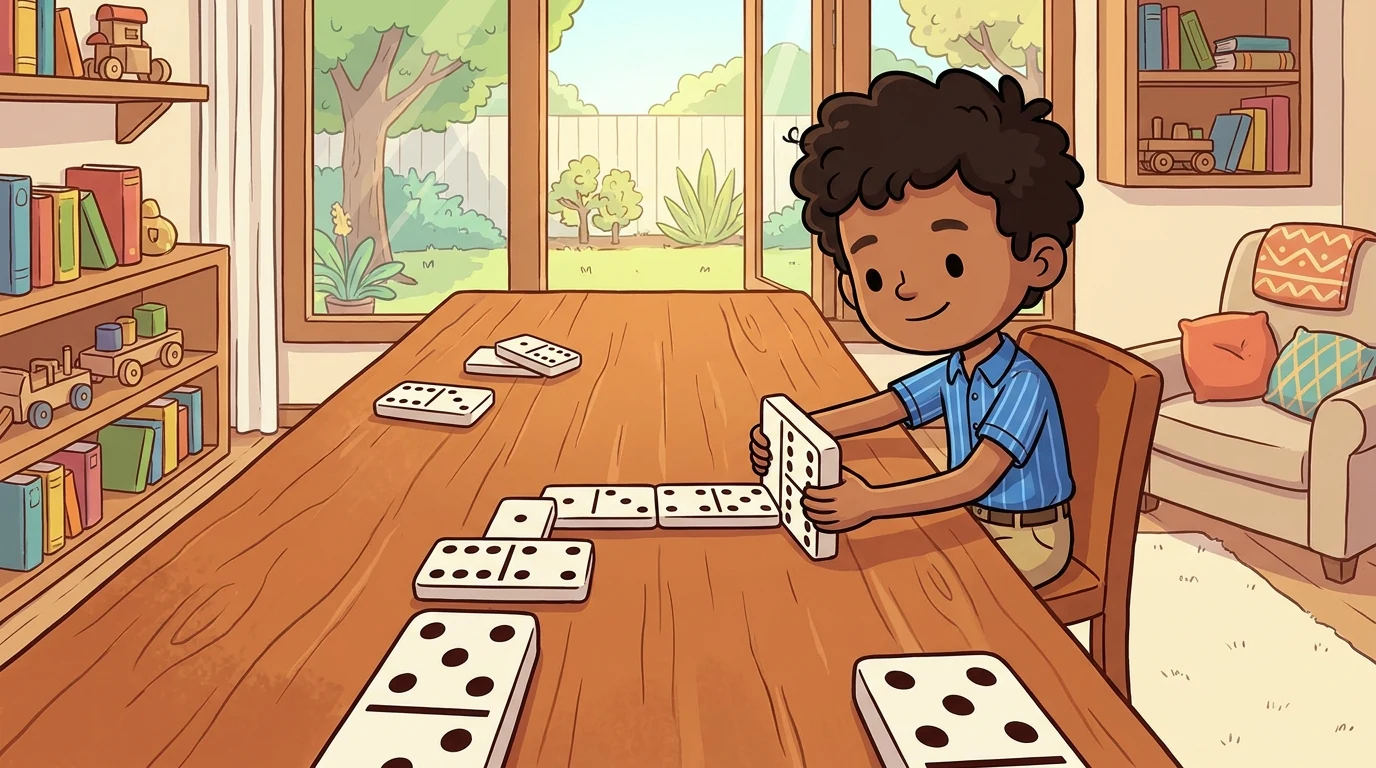
Double Dev
DOUBLES & THE SPINNER — a double (both ends the same) is laid crossways to the line, and it can open extra arms of play; in scoring games a double counts its FULL pips at an open end
Chapter 3 — The One Who Turns Sideways
At the tamarind table there was a boy named Dev who loved the doubles best — the tiles that carried the same number on both ends. The three-three, the five-five, the mighty six-six. And Dev knew the secret of doubles that younger players always missed: a double doesn’t lie flat along the line like other tiles. A double turns sideways. It sits crossways, its twin numbers sticking out to the sides, and where an ordinary tile only carries the line forward, a double can open new arms — fresh ends for the line to grow in more than one direction.
“Everyone else makes a straight road,” Dev would say, laying a four-four across the line so it stuck out both ways. “A double makes a crossroads.” When he set a double down sideways, suddenly there were more places to play — the game branched, opened, breathed. Other children saw a double as just another tile. Dev saw a door swinging open in two new directions at once.
Dev hadn’t always understood his beloved doubles. As a small boy he’d laid them flat, end-to-end like everything else, and wondered why the double-six felt so heavy and did so little. He was treating a crossroads like a straight road. He’d hold the six-six proudly, play it in a line, and it just sat there — twelve pips going nowhere special.
The lesson landed the day Nana Fives quietly turned one of his doubles sideways for him. “Look what it wants to do,” she said. Set crossways, the double suddenly had sides — and on the far side, a whole new arm of the line could begin. Dev played a tile off that new arm, then another off the first arm, and the line that had been one lonely road was now a growing crossroads with tiles running two ways. “It was never meant to lie flat,” he whispered. A double wasn’t a heavier straight tile. It was a turning point — literally a turn.
Nana Fives tested him with the game that counts. In All-Fives, she reminded him, the open ends are totalled, and you score when the total lands on a multiple of five. “But mind your doubles,” she said. “A double at an open end counts both its halves. Don’t forget the half you can’t see at a glance.”
Dev set his line so the open ends showed a five and a five-five double turned crossways at the other end. A younger player might have counted the double as five. Dev knew better: the double-five counts ten, both halves, full value. Five plus ten was fifteen — a clean multiple of five. He’d scored, and he’d scored precisely because he’d counted the whole double, not half of it.
Nana Fives nodded slowly. “The double is generous and the double is honest,” she said. “It opens new roads when you turn it right, and it makes you count all of itself when the score is tallied. A player who turns it sideways and counts it whole has understood the most important tile on the table.”
A quiet boy named Aabid struggled with doubles, laying them flat and then miscounting them at scoring time. “I played my double-four,” he said, frustrated, “but I only got four for it.”
“You got four because you counted four,” Dev said. “A double is both its halves. Four and four — that’s eight, always. And another thing — you laid it flat. Turn it sideways.” He rotated the tile so it crossed the line. “Now look — you’ve opened a new arm. You can play off the side now, not just the end.” Aabid tried a tile on the new arm; it fit. “And at scoring, count the whole double — both fours — eight.” Aabid added the ends again, this time counting the double whole, and his total jumped. “I was hiding half of it,” he said. “From myself.”
“Doubles don’t hide,” Dev said, grinning. “That’s the whole point of them. They turn sideways so everyone can see both halves at once.”
That evening Dev stayed and played out a long crossroads all by himself, setting double after double sideways, watching the line branch into arms that branched into more arms, and totalling each open end with every double counted full.
He thought about the small boy who had laid his beloved double-six flat and wondered why it felt so heavy and did so little — and about the moment Nana had turned it sideways and the whole game had opened like a crossroads at dawn. He’d grown fond of what doubles taught: that some things are meant to turn, not lie flat; that a turning point opens more directions than a straight road ever could; and that the honest tiles are the ones that make you count all of them, both halves, nothing hidden. He gathered his doubles last, stacking them square, and felt the steady contentment of someone who had learned to turn sideways at exactly the right moment — and to count the whole of a thing when the whole of it was what mattered.
The TileTales ensemble
Double Dev is part of TileTales's distributed-narrative cast. Each character embodies a different curricular primitive; together they teach the full subject.
-
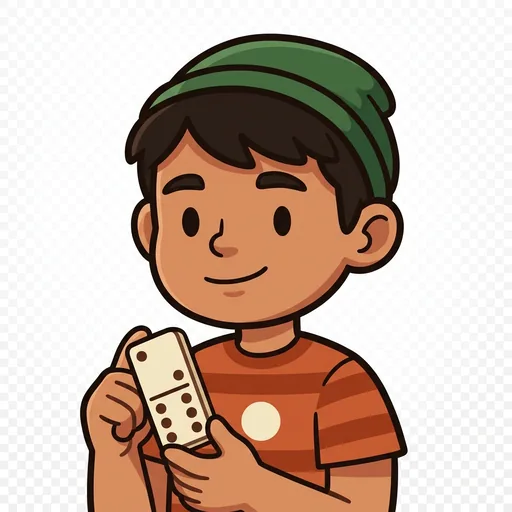
Match Mateo
Matching ends: you may only add a tile whose end equals a number already open
-
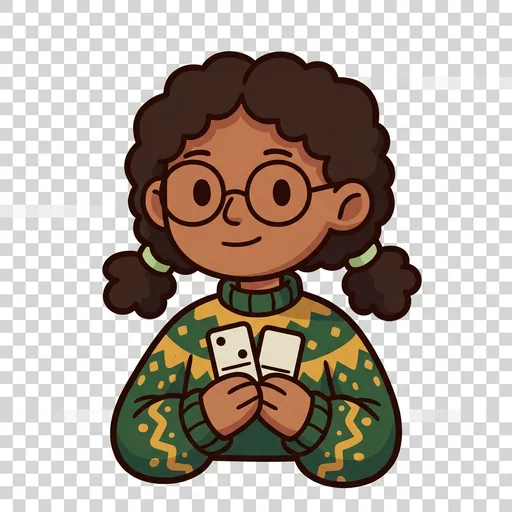
Block Bianca
Blocking: steering the open ends so the opponent has no legal play
-

Draw Dilan
The boneyard: when you can't match, you draw a tile or pass
-

Count Bello
Pip-counting and subitizing: reading a tile's value at a glance
-
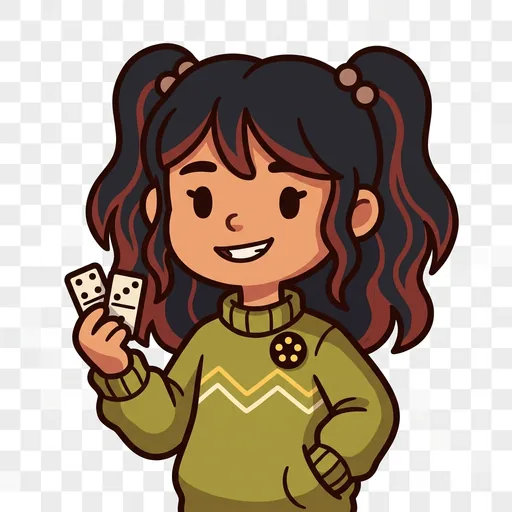
Fiver Odalys
All-fives scoring: land the open-ends total on a multiple of five
-
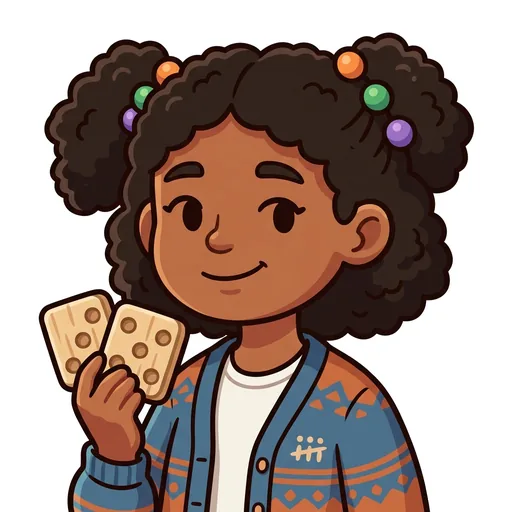
Threes Thandi
Multiples of three: scoring on multiples of 3 (and on both 3 and 5)
-
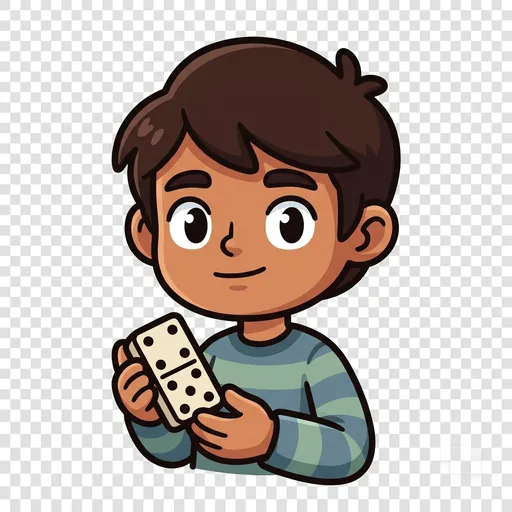
Shed Sunil
Shedding to win: be first to play every tile and call 'domino!'
-
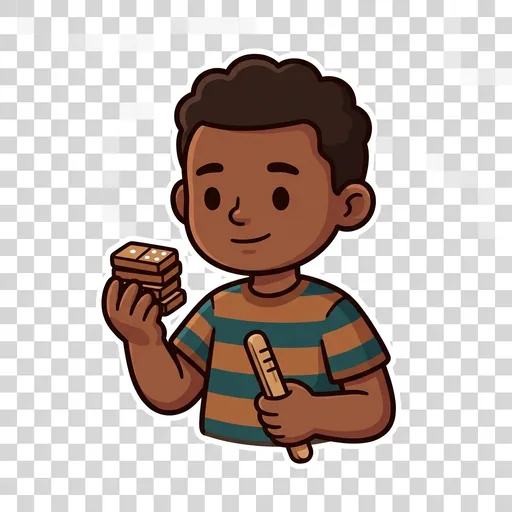
Tally Tunde
End-of-round counting-out: tally the pips left in hands, rounded to the nearest 5
-
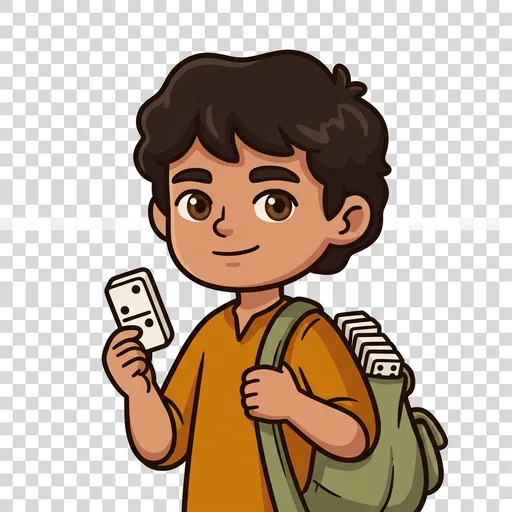
Train Tomás
Mexican train: grow a personal train off the central hub
-
Chicken Cheo
Chickenfoot branching: a double must sprout three branches before play continues