
Train Tomás
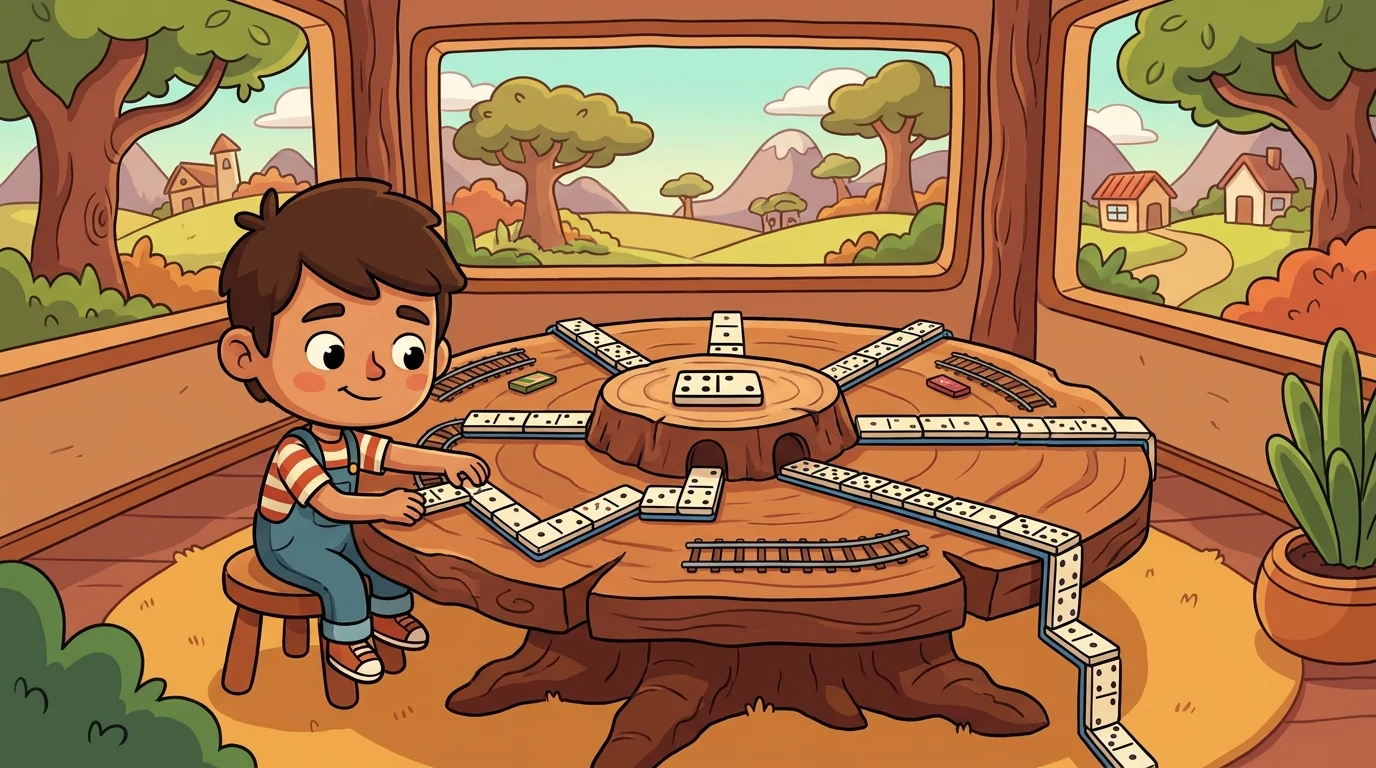
MEXICAN TRAIN LAYOUT — from a central hub each player grows their own 'train' of tiles end-to-end; an unsatisfied double must be covered before other plays continue, and an unattended train opens for everyone
Chapter 7 — The One Who Builds the Track
At the tamarind table, in the big branching game they called the Train, there was a boy named Tomás who built the finest tracks anyone had seen. In that game, a single starting double sits in the middle — the hub — and from it every player grows their own train: a line of tiles running outward, each new tile matching the end of the one before, like laying track ahead of a moving engine. Tomás loved it because it wasn’t one shared road; it was many, and he could plan his own.
Tomás didn’t just play the tile that fit right now. He sequenced. He’d look at his whole hand and see, several moves ahead, how one tile could lead to the next and the next — a five leading to a five-two, the two leading to a two-six, the six leading on. He built his train like someone laying rails toward a destination only he could see. “Anyone can add one tile,” Tomás would say, sliding a piece onto his growing line. “I’m not adding a tile. I’m laying track — and I already know where it’s going three stops from now.”
Tomás had once played the Train one tile at a time, with no plan at all, and it had cost him. He’d add whatever fit that turn, and then next turn find his train had run into a dead end — the tile he needed to continue was one he’d carelessly played somewhere else, or his line ended in a number he had nothing to follow with. His train would stall while everyone else’s rolled on.
The change came when he started looking at his whole hand before laying a single tile — planning the order, seeing the sequence. He noticed he held a three-one, a one-four, and a four-four, and realised: if he played them in that order, each would feed the next, three tiles of smooth track in a row. He laid them in sequence, and his train ran clean while others sputtered. That was the day he stopped adding tiles and started building track — seeing the route before he travelled it.
Nana Fives set him the Train’s trickiest test: his train ended in a double that he couldn’t yet cover, and the rule is strict — an unsatisfied double must be answered before normal play flows on.
“Solve your double,” said Nana.
Tomás knew the rule: a double left open is a demand. Until someone lays a matching tile onto it, that double blocks the smooth run of the game. He searched his hand, found a tile matching the double’s number, and covered it — satisfying the double — and only then did his planned sequence roll on behind it. He’d kept his track moving by answering the demand first.
Nana Fives nodded. “Every child builds a little train,” she said. “You build a railway — you see the order of the tiles before you lay them, and you answer a double the moment it demands answering, so your track never stalls. Planning the sequence is the whole art of the Train: a tile is a step, but a step only matters if you know where the next one lands.”
A daydreaming girl named Lena kept stalling her train and getting frustrated. “It just stops!” she said. “Every time, I run out of tiles that fit.”
“Because you’re playing one at a time,” Tomás said. “Look at your whole hand first. What number does your train end on?” A two. “Okay — do you have a tile with a two?” She had a two-five. “Play it — now your train ends on five. Do you have a five?” A five-five. “Play that — but careful, it’s a double; you’ll have to cover it. Do you have another five to satisfy it?” She did. “So you can lay three tiles of track in a row, in that order, and answer your own double. See it before you play it.” Lena laid them in sequence, her train rolling three stops clean, and lit up. “I planned the track,” she said. “It didn’t stall.” “That’s the Train,” said Tomás. “You lay the rails ahead of the engine.”
That evening Tomás sat alone at the hub and built a long solo train just to feel the planning of it — seeing four tiles ahead, laying them in order, answering each double as it came, the track unrolling smooth toward a station only he could see. And he practised the harder grace, too: leaving his train open — for in the real game, when you can’t tend your own line, it opens to everyone, and anyone may build on it.
He thought about the boy who used to play one careless tile at a time and watch his train die on a dead end, and about the day he’d first looked at his whole hand and seen the sequence, the order hidden in the tiles. He’d grown to love that long view — the pleasure of a route planned before it’s travelled, of a double answered right on time so the track never breaks. And he’d made peace with the sharing, too: a train you can’t tend becomes everyone’s, and that was fair, because a track is only worth building if it can carry more than one. He squared the hub tile in the centre, rails ready for tomorrow, and felt the deep contentment of someone who had learned to lay track toward a station three stops ahead.
The TileTales ensemble
Train Tomás is part of TileTales's distributed-narrative cast. Each character embodies a different curricular primitive; together they teach the full subject.
-

Match Mateo
Matching ends: you may only add a tile whose end equals a number already open
-

Double Dev
Doubles and the spinner: a double is played crossways and opens new arms
-

Block Bianca
Blocking: steering the open ends so the opponent has no legal play
-

Draw Dilan
The boneyard: when you can't match, you draw a tile or pass
-

Count Bello
Pip-counting and subitizing: reading a tile's value at a glance
-

Fiver Odalys
All-fives scoring: land the open-ends total on a multiple of five
-

Threes Thandi
Multiples of three: scoring on multiples of 3 (and on both 3 and 5)
-

Shed Sunil
Shedding to win: be first to play every tile and call 'domino!'
-

Tally Tunde
End-of-round counting-out: tally the pips left in hands, rounded to the nearest 5
-
Chicken Cheo
Chickenfoot branching: a double must sprout three branches before play continues