
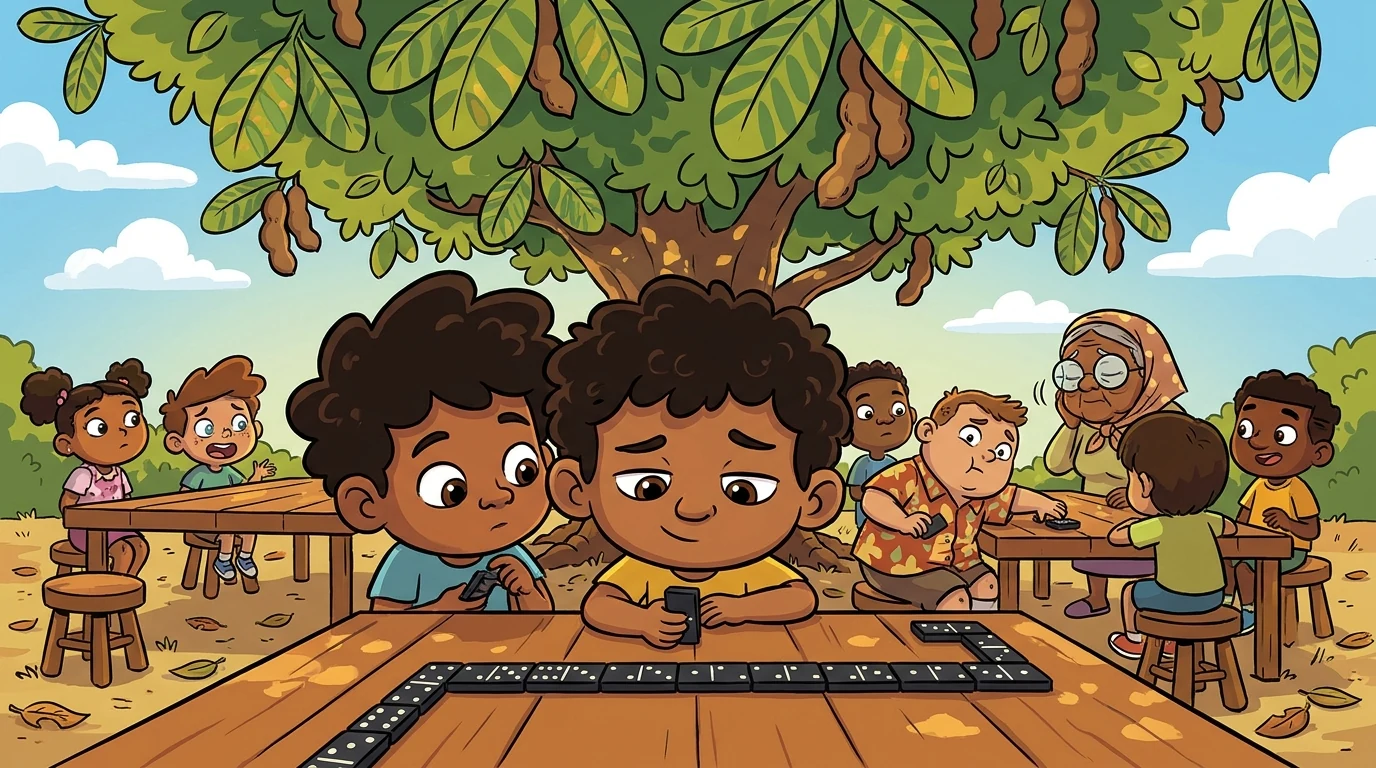
Match Mateo
MATCHING ENDS — you may only add a tile to the line if one of its pip-ends equals a number already open at the end of the line; the match is the whole rule of play
Chapter 1 — The One Who Fits the End
At the long table under the tamarind, where the tiles clicked all afternoon, there was a boy named Mateo who never played a tile that didn’t fit. Other children slapped their favourite tiles down wherever they liked and were surprised when Nana Fives shook her head. Not Mateo. Mateo looked at the ends of the line — the two open numbers waiting there — and he played only a tile that carried one of those numbers on it.
That was the whole rule, and Mateo lived by it. If the line ended in a five, he needed a tile with a five somewhere on it; he laid it so the fives touched, and now the other end of his tile became the new open number for the next player. A three touches a three. A blank touches a blank. “You don’t put down what you love,” Mateo would say, turning a tile in his fingers. “You put down what matches.” He wasn’t slow about it — he was careful. His eyes went to the ends of the line before they ever went to his own hand.
Mateo had not always played this way. When he was smaller he had a favourite tile — the double-six, twelve fat pips, the heaviest in the set — and he wanted to play it every single turn. He’d try to force it down next to a two, next to a blank, next to anything, and every time Nana Fives would gently slide it back to him. “It has no six to touch, child. It doesn’t fit here.” And Mateo would sulk, holding his beautiful useless six-six while the line marched on without him.
The turning point came on a rainy day when he finally couldn’t play his favourite and had to look — really look — at what the line was offering. The line ended in a four. He scanned his hand not for what he loved but for what carried a four, and found a humble four-one. He laid the four against the four, and suddenly the one on the far side opened a whole new run of tiles he could play next. “Oh,” he said quietly. The line had been telling him what it needed the whole time. He just hadn’t been listening to its ends.
Nana Fives set him a test on purpose one evening: a line with a six waiting at one end and a two waiting at the other, and a hand stuffed with tempting doubles that fit neither.
“Play,” she said.
Mateo did not reach for a single flashy double. He read the ends — six and two — and searched his hand for those numbers. He had a six-five: he laid the six against the six, and now a five opened where the six had been. Then, on his next turn, the far end was still a two, and he had a two-blank, so the two went down and a blank opened. Tile by tile he kept the line growing, each play a match, never a force. The doubles he loved stayed in his hand until, at last, a number came round that they actually touched.
Nana Fives tapped the table, pleased. “Every child at this table wants to play the tile in their heart,” she said. “You play the tile that fits the end, and so the line never stops for you. That is the first rule of the whole game — a tile only speaks where its number is already spoken.”
The next day a fierce girl named Priya sat down beside him, slapping tiles down wherever her hand landed. “Why won’t this one go?” she demanded, jamming a five-three against an open blank. “It’s a good tile!”
“It’s a good tile in the wrong place,” Mateo said. “Look at the end first. That end is a blank. Does your tile have a blank on it?” Priya looked. It did not. “Then it doesn’t matter how good it is — it can’t touch there. What’s your other open end?” A five. “And do you have a five?” She did — the very tile she was holding. “So turn it around. Lay the five against the five.” Priya turned it, laid it, and the tile clicked into place with a satisfying snap. “It fit,” she said, half annoyed, half delighted.
“It fit because you read the end,” Mateo said. “The line always tells you what it needs. You just have to check the ends before you check your hand.”
That evening Mateo stayed after the others and set up an old line for himself, just to watch the rule work: a two open on the left, a five open on the right, and a small pile of tiles he laid down one at a time, each one matching, each one opening a new number for the next.
He thought about the greedy little boy he’d been, clutching his double-six, furious that the world wouldn’t bend around the tile he loved. And he thought about how the moment he’d started reading the ends first, the game had opened up like a door he’d been pushing when he only had to pull. There was a calm in it he liked — not the thrill of forcing his favourite, but the steady satisfaction of a tile sliding home where its number was already waiting. A match wasn’t a compromise, he’d decided. A match was the whole point. He swept the tiles back into the boneyard, ends squared, ready for tomorrow, and felt the quiet pleasure of someone who had learned to look at the line before he looked at himself.
The TileTales ensemble
Match Mateo is part of TileTales's distributed-narrative cast. Each character embodies a different curricular primitive; together they teach the full subject.
-
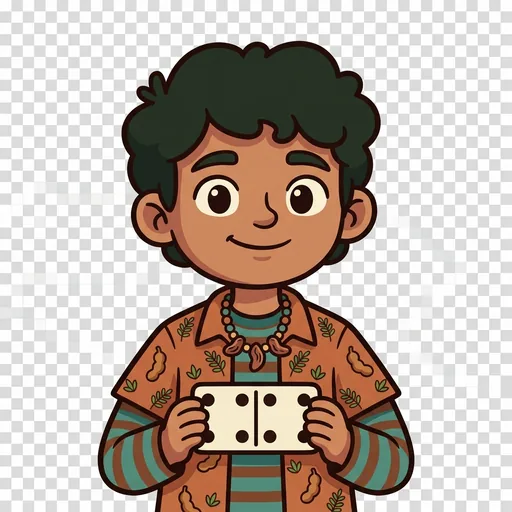
Double Dev
Doubles and the spinner: a double is played crossways and opens new arms
-
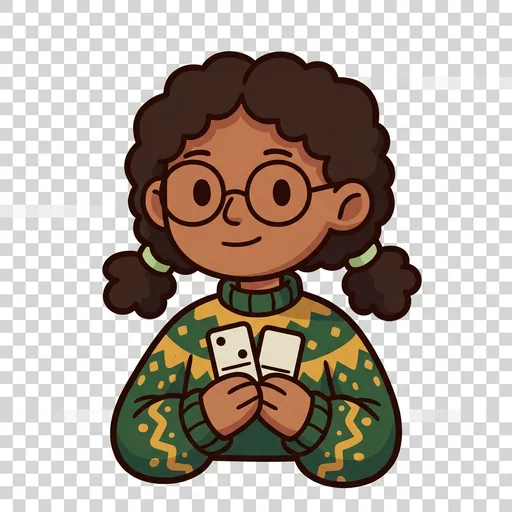
Block Bianca
Blocking: steering the open ends so the opponent has no legal play
-

Draw Dilan
The boneyard: when you can't match, you draw a tile or pass
-

Count Bello
Pip-counting and subitizing: reading a tile's value at a glance
-

Fiver Odalys
All-fives scoring: land the open-ends total on a multiple of five
-
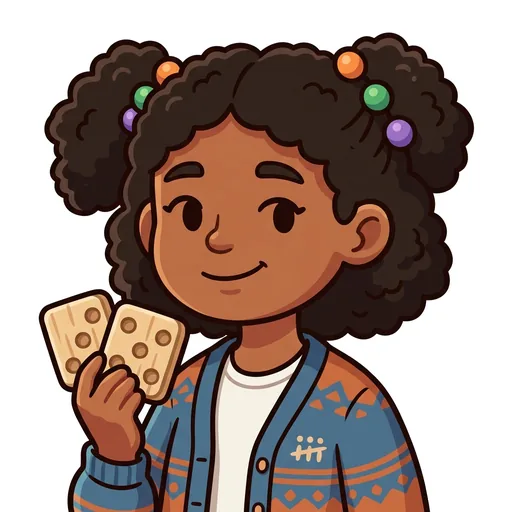
Threes Thandi
Multiples of three: scoring on multiples of 3 (and on both 3 and 5)
-
Shed Sunil
Shedding to win: be first to play every tile and call 'domino!'
-

Tally Tunde
End-of-round counting-out: tally the pips left in hands, rounded to the nearest 5
-

Train Tomás
Mexican train: grow a personal train off the central hub
-
Chicken Cheo
Chickenfoot branching: a double must sprout three branches before play continues