Vane
CLIMATE & GEOGRAPHY — what people wear is shaped first by the weather and terrain they live in, so clothing is evidence of a place's climate
Loading audio…
Press play to listen along. The line being read lights up as you go.
Show full transcript
Loading transcript…
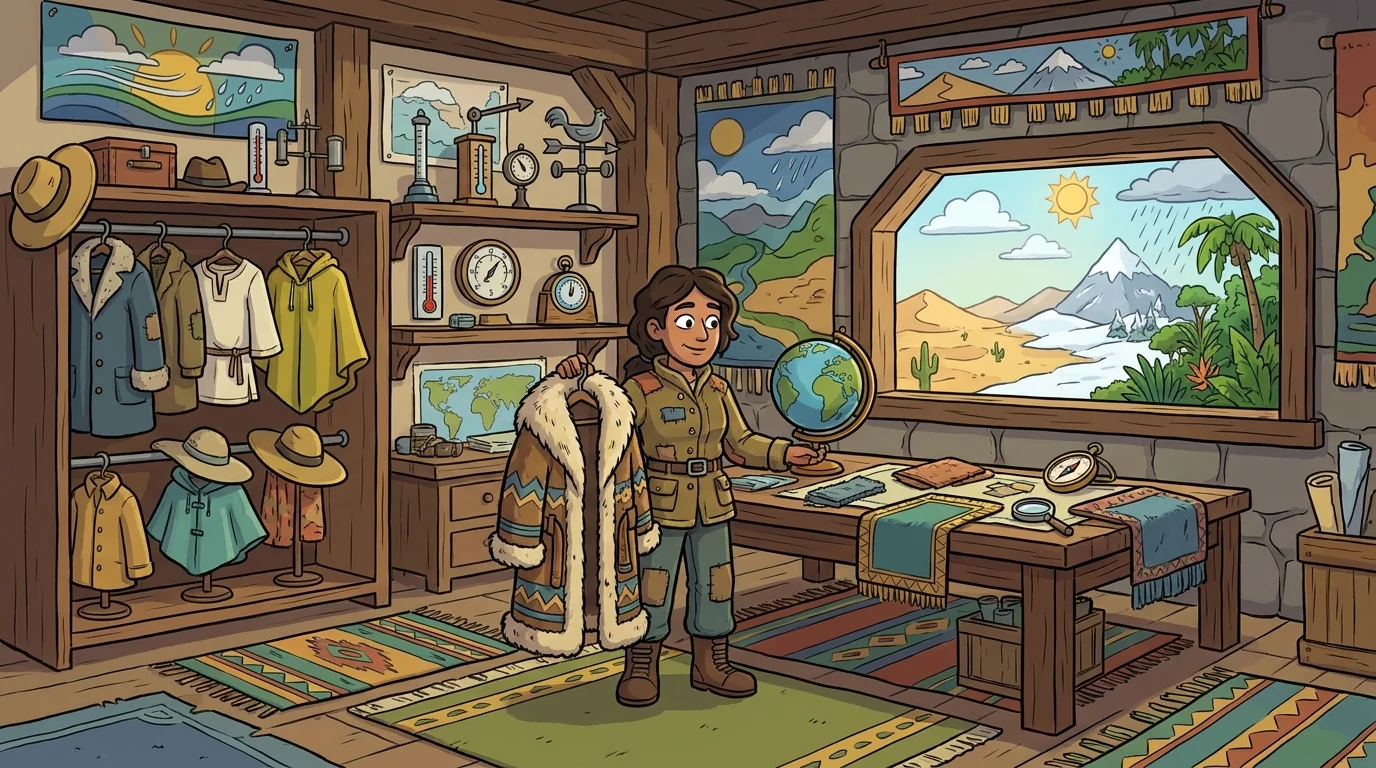
Vane thought about weather before she thought about anything else. Hand her a garment and her first question was never "is it pretty?" but "what was the weather like where this was worn?" Because to Vane, clothing was, first and most of all, a clever answer to a place.
She used to make fun of clothes she found "strange" — enormous robes, heavy layers in surprising places, coverings that seemed like too much or too little. It took an embarrassment to teach her better.
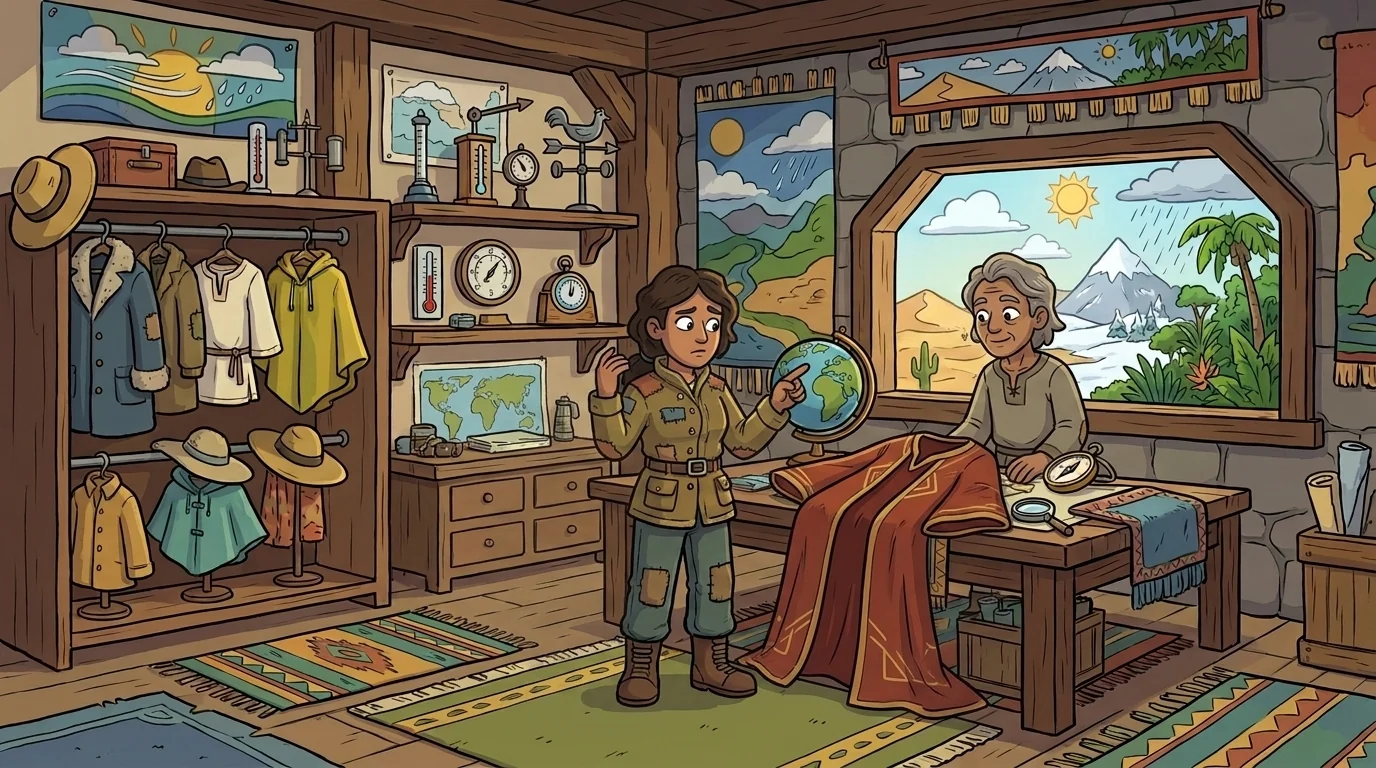
Relic laid out a long, loose, flowing robe that covered a person almost head to foot. "Wasteful," young Vane said. "So much cloth. And in a hot desert land, too — you'd roast."
Relic simply asked her to think it through. In a scorching desert, what actually keeps you cooler — bare skin in the blazing sun, or loose cloth that shades your skin, blocks the burning light, and lets air move underneath? Add blowing sand and fierce night-cold, and the "wasteful" robe became exactly right: shade by day, warmth by night, protection from sand always.
Vane went quiet. The robe wasn't strange. She had been — judging a smart answer without knowing the question it answered.
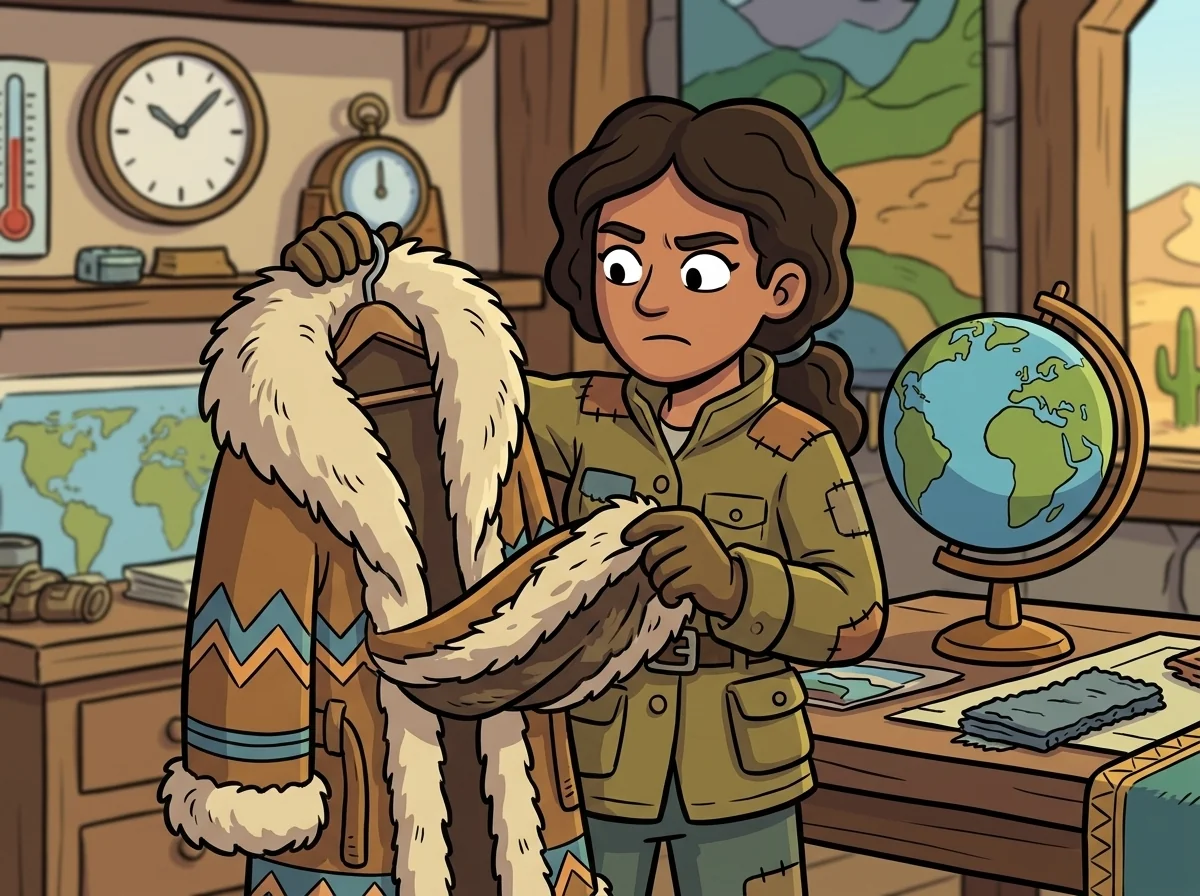
After that she read clothing as a reply to the land. Cold places meant layers, wool, fur, covered heads and hands, tight seams to trap warmth. Hot, wet places meant light, loose, breathable cloth and open weaves. Hot, dry places meant coverage against sun and sand, often loose and flowing. Wet, changeable places meant oiled or tightly-woven outer layers to turn the rain. Mountains meant sturdy footwear and wind-proof outer shells.
Terrain mattered as much as temperature. People who walked rocky ground built different footwear than people who paddled rivers. People in deep snow needed to keep it out; people in flooding fields needed clothes that dried fast. The land set the problem; the clothing was the solution.
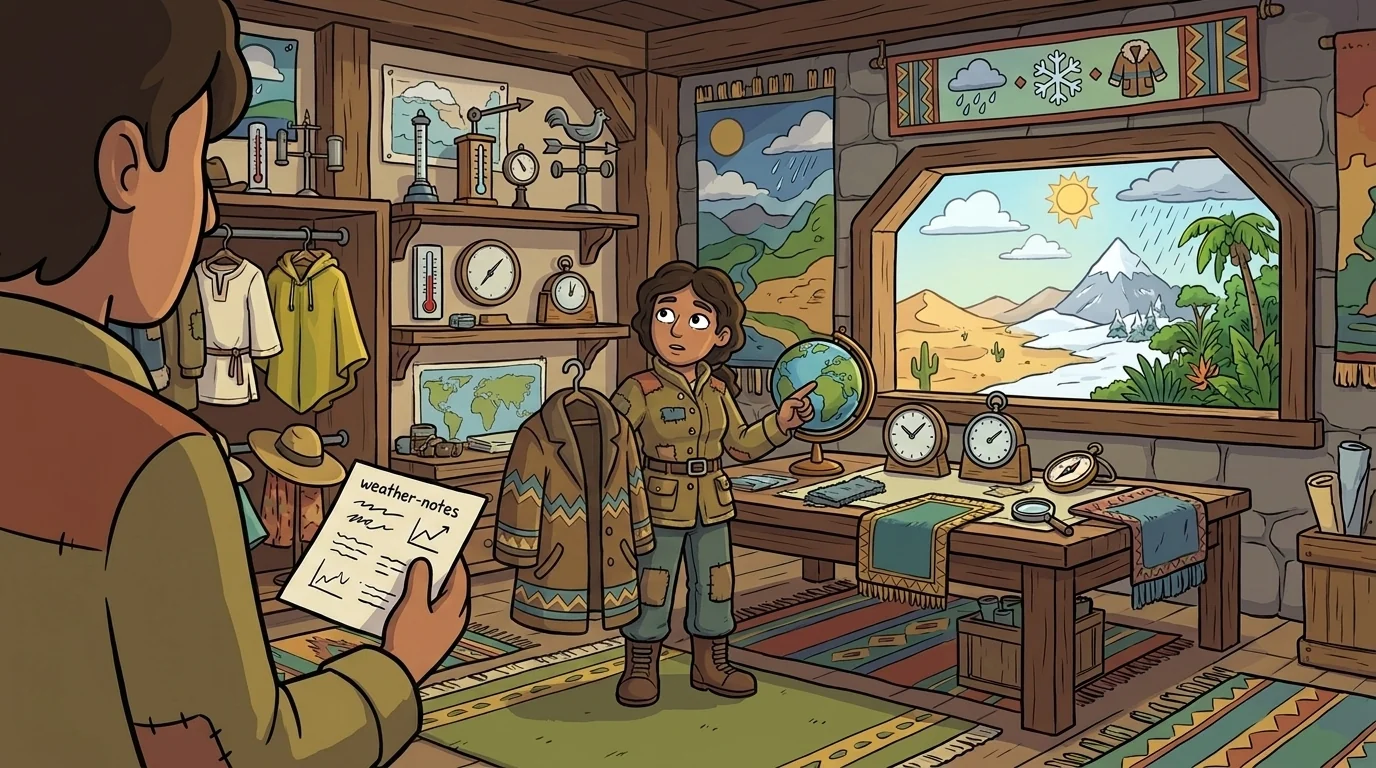
She tested her rule against everything and let it correct her. When a garment seemed to break the pattern — heavy fabric in a warm land — she'd learned not to sneer but to dig. Usually there was a reason: cold nights, high mountains, a ceremony that mattered more than comfort that day, or a material traded in from elsewhere.
That was her honest lesson: climate explains most of clothing, but not all. "Weather is the first reason," Relic told her, "and usually the biggest. But people also dress for status, for faith, for a festival — and sometimes comfort loses. Ask the weather first. Just don't stop there." Vane wrote first, not only at the top of her weather-notes.
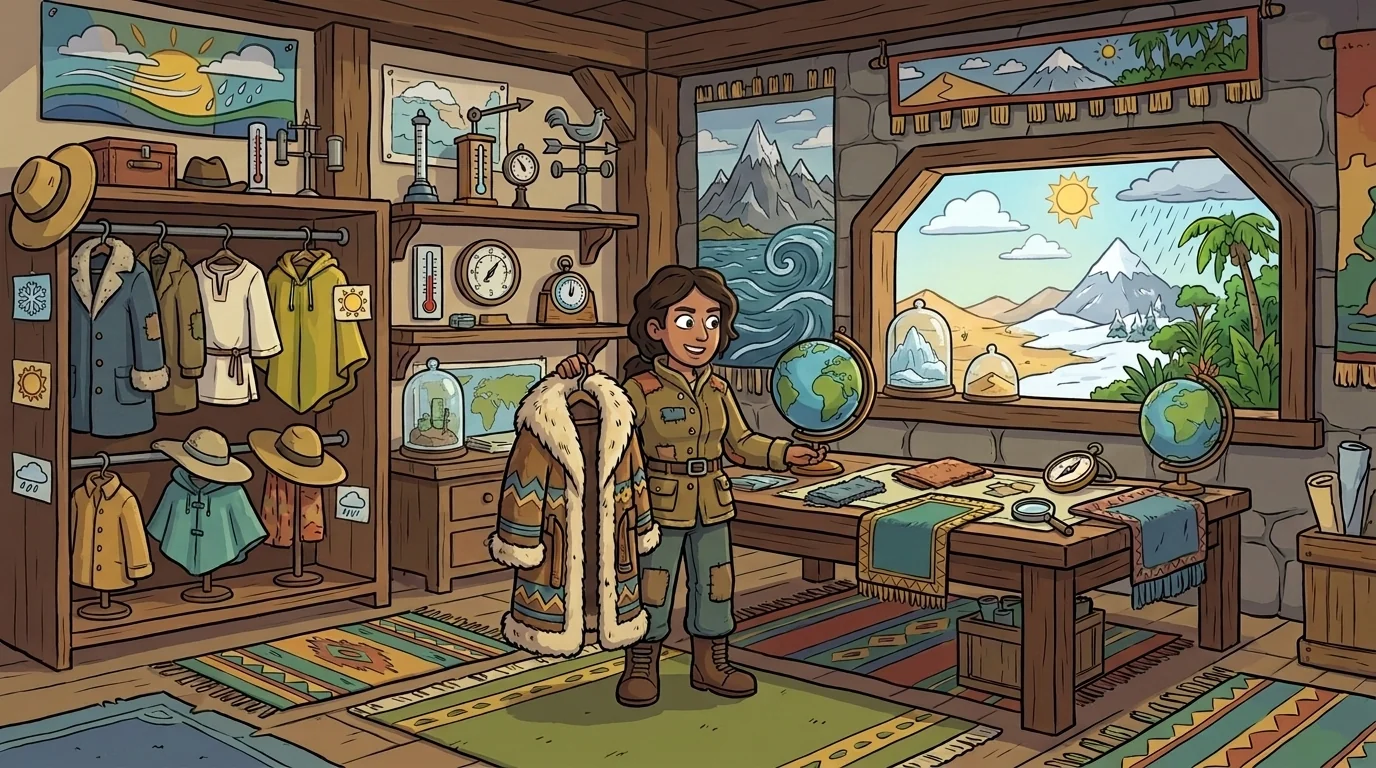
The test came when travelers argued about a mysterious people known only from a few surviving garments — thick, layered, fur-lined, tightly sewn.
"We can't know anything about where they lived," one traveler declared. "The clothes don't come with a map."
"They are a map," said Vane. She laid the reasoning out plainly: fur-lined and layered meant serious cold; tight seams meant wind and wet to keep out; sturdy covered feet meant rough, hard ground. "You don't need their map," she said. "Their clothes describe their weather. This is a cold, windy, rugged place — long winters, hard terrain. The garment is the forecast."
The travelers looked at the old clothes as if a window had opened onto a landscape none of them had ever seen.
"How did you read a whole climate off a coat?" one asked.
"I asked the weather first," said Vane. "Clothing is a clever answer to a place. Learn to hear the question, and even a scrap of cloth can tell you what the sky was doing."
The EraForge ensemble
Vane is part of EraForge's distributed-narrative cast. Each character embodies a different curricular primitive; together they teach the full subject.
-
Warp
Fiber → cloth — every cloth remembers the land whose plant or animal made it
-
Madder
Natural dye — before factories every colour came from a plant, root, or shell; a rare colour meant a long reach
-
Selvage
Silhouette → era — the outer shape a dressed figure makes dates the look, even from a shadow
-
Toile
A motif is a message — read a woven pattern on its own makers' terms, never guess
-

Argent
Status dress — what a person may wear encodes rank and role; read the whole society
-

Skein
Trade & exchange — where a fabric is worn traces the route that carried it, not just its source
-

Relic
Source-reading (the curator & mentor) — read an object as evidence: who made it, when, and why
-
Damask
Revival & anachronism — old styles return re-made; the out-of-time detail reveals the real age
-
Lexi
Design vocabulary — the exact word (silhouette, motif, drape, hue) lets you describe and compare