Selvage
SILHOUETTE → TIME — the outer SHAPE a dressed figure makes changes era to era, so the silhouette alone can date a look even from a shadow
Loading audio…
Press play to listen along. The line being read lights up as you go.
Show full transcript
Loading transcript…
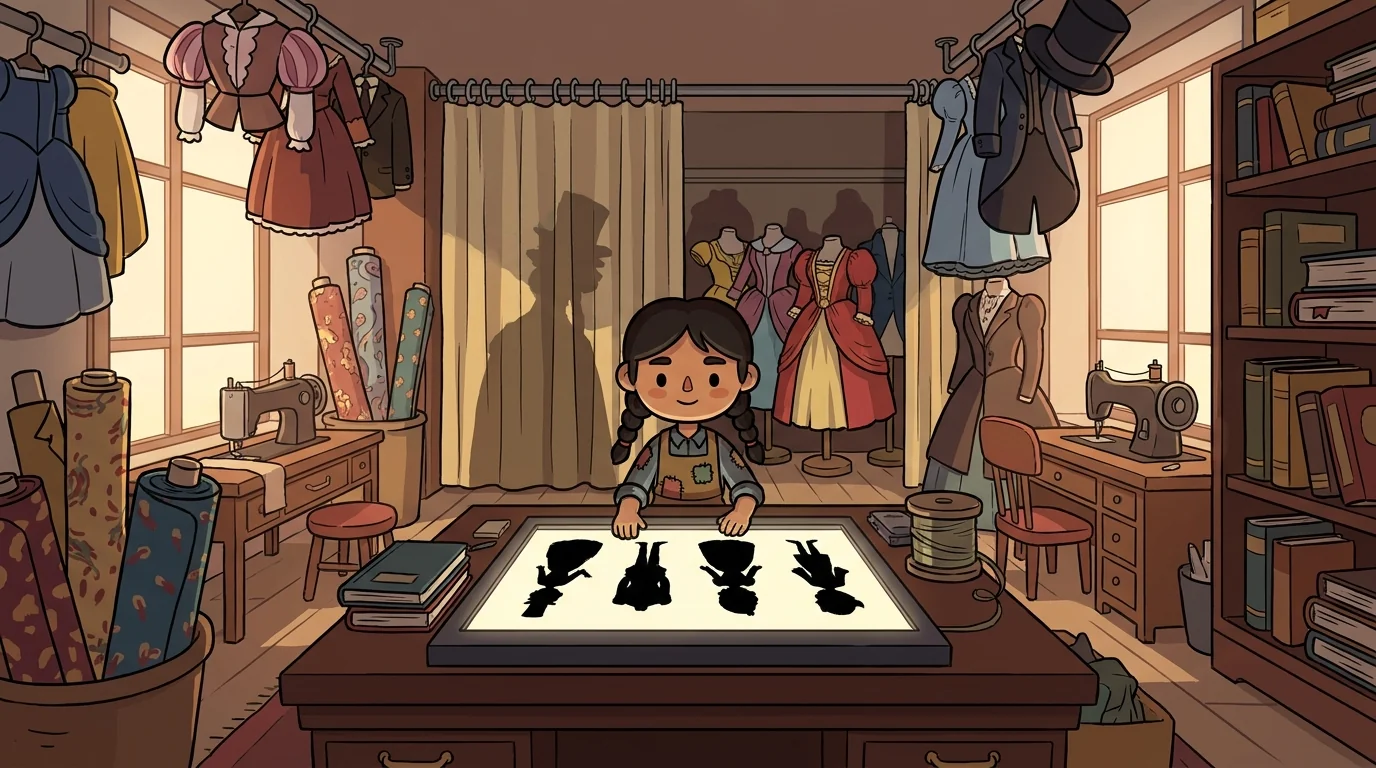
Selvage did not care much for embroidery or jewels. What she watched was the edge — the outer line a person cut against the light. Give her a figure in silhouette, all detail blacked out, and she could still tell you a surprising amount. That was her gift, though she'd had to earn it the hard way.
For a long while, the details fooled her. A gold thread here, a jewel there, and she'd lose herself in the sparkle and guess the era completely wrong.
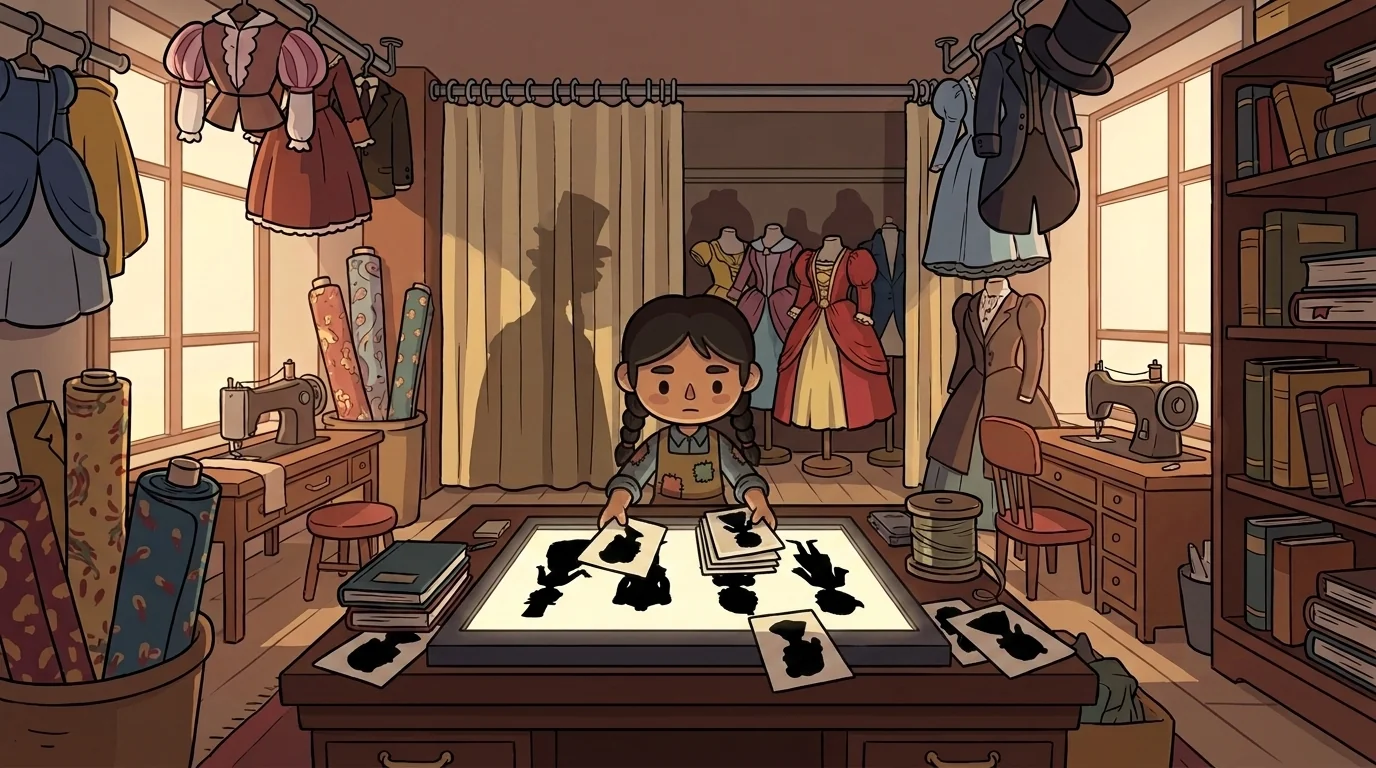
Relic cured her of it with a simple, maddening exercise: a stack of pictures with every detail painted out — no faces, no colours, no ornament. Only black shapes on white.
"Now date them," the curator said.
Selvage nearly protested that it was impossible. Then, out of stubbornness, she squinted — and the shapes began to sort themselves. Some figures were wide and stiff, like walking bells. Some were tall and narrow as candles. Some had shoulders built out huge; some had almost none. Some flowed loose; some were pinched tight at the waist and then flared.
She realized, with a small shock, that she'd been staring at the wrong thing her whole life. The outline was the clock. The details were just decoration hung on it.
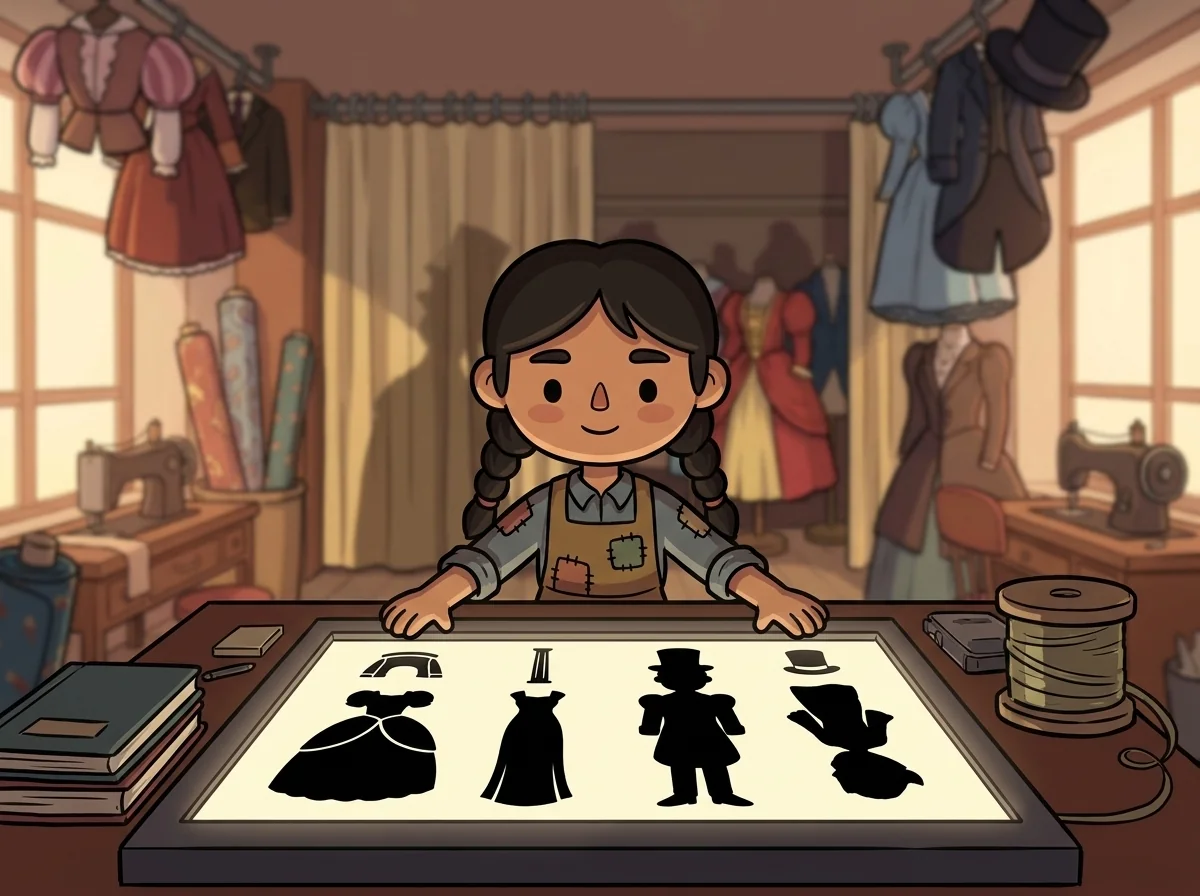
"The silhouette is the fashion of the age," Relic explained. "It's the shape people agreed looked right — and that agreement shifts every generation or two. A wide, structured shape in one century. A tall, slim column in another. Big built-up shoulders when a people wanted to look strong; soft, drooping lines when they wanted to look gentle. The details change with money and taste. The shape changes with the age."
Selvage practiced until she could do it fast. Show her a bell-shape and she thought: a time and place that wanted skirts held wide. Show her a straight, dropped column and she thought of an age that prized long, easy lines. She wasn't naming exact years like a show-off — she was narrowing, honestly, from the shape alone.
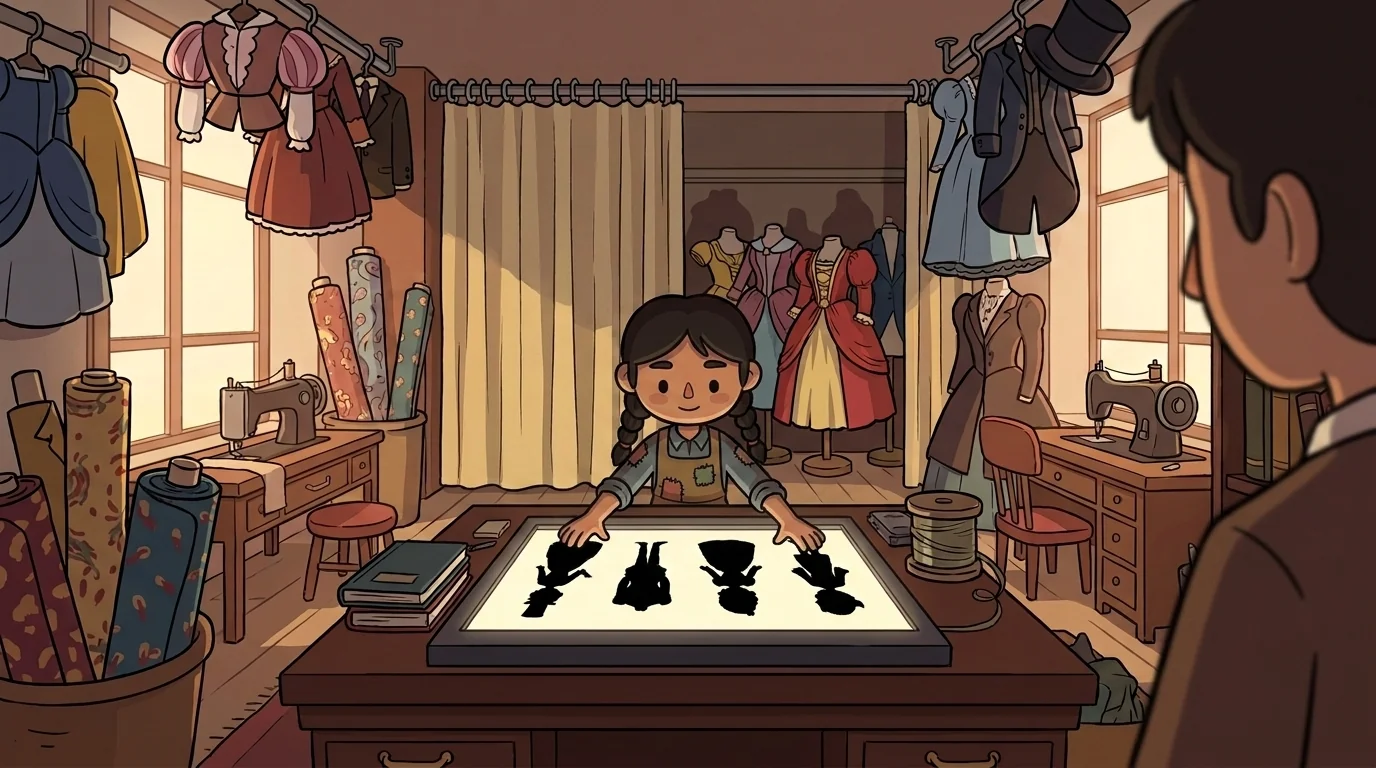
She tested it everywhere, even on shadows the afternoon sun threw on the Hall's wall. A visitor stood in the doorway, and from the pure shadow — no face, no colour — Selvage murmured the rough era of the cut of their coat. She was close. The visitor was startled; Selvage was calm. Shape doesn't hide in shadow. Shape is the shadow.
Her honest mistake came when she trusted the shape too far. She dated a figure confidently by its narrow column — then Relic showed her it was a modern revival, a new maker copying an old silhouette on purpose. "Shape narrows the era," Relic said, "but a clever revival can wear an old shape. Read the outline first — then check the making, in case someone's playing dress-up with time." (That, Relic added, was exactly what Damask down the hall studied.) Selvage added the caution to her notes and felt sharper for it.
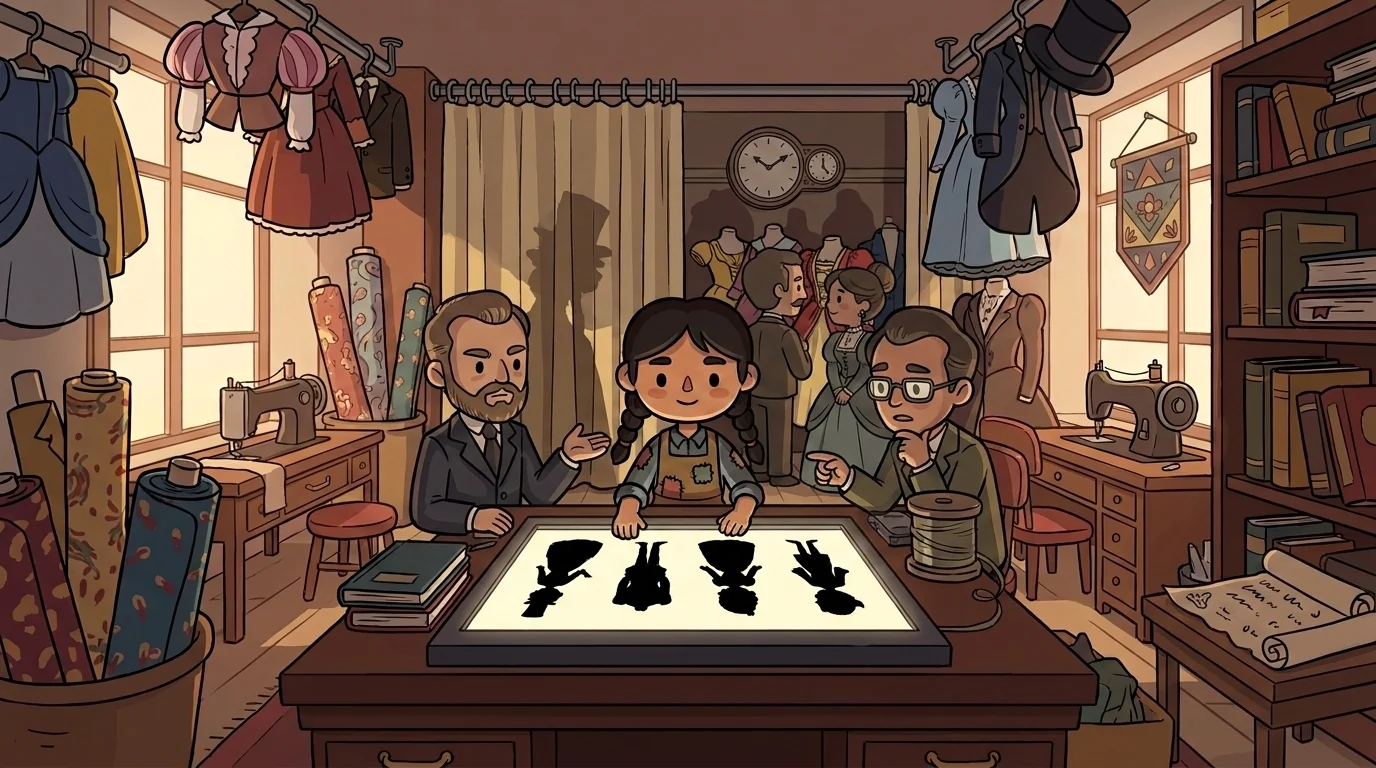
The test came when two scholars argued over a painting so worn its colours had all gone to brown, its details lost.
"Impossible to date," one said. "There's nothing left to see."
Selvage stepped up and traced the air along the figure's edge — the built-out shoulders, the tight waist, the stiff wide skirt. "You don't need the colours," she said. "You have the whole shape." And from the silhouette alone she gave a careful era, wide but honest, and explained each part of the outline that told her so.
"How could you possibly know," the scholar said, "when the picture's half gone?"
"Because I read the outline first," said Selvage, "not the sparkle. The shape a person makes is the era's signature — it survives even when everything else fades to a shadow."
The EraForge ensemble
Selvage is part of EraForge's distributed-narrative cast. Each character embodies a different curricular primitive; together they teach the full subject.
-
Warp
Fiber → cloth — every cloth remembers the land whose plant or animal made it
-

Madder
Natural dye — before factories every colour came from a plant, root, or shell; a rare colour meant a long reach
-
Toile
A motif is a message — read a woven pattern on its own makers' terms, never guess
-
Argent
Status dress — what a person may wear encodes rank and role; read the whole society
-

Vane
Climate & geography — clothing is a clever answer to a place's weather and terrain
-

Skein
Trade & exchange — where a fabric is worn traces the route that carried it, not just its source
-

Relic
Source-reading (the curator & mentor) — read an object as evidence: who made it, when, and why
-
Damask
Revival & anachronism — old styles return re-made; the out-of-time detail reveals the real age
-
Lexi
Design vocabulary — the exact word (silhouette, motif, drape, hue) lets you describe and compare