Lexi
DESIGN VOCABULARY — precise shared words for what you see (silhouette, motif, drape, hue) let people describe and compare things exactly, instead of waving vaguely
Loading audio…
Press play to listen along. The line being read lights up as you go.
Show full transcript
Loading transcript…
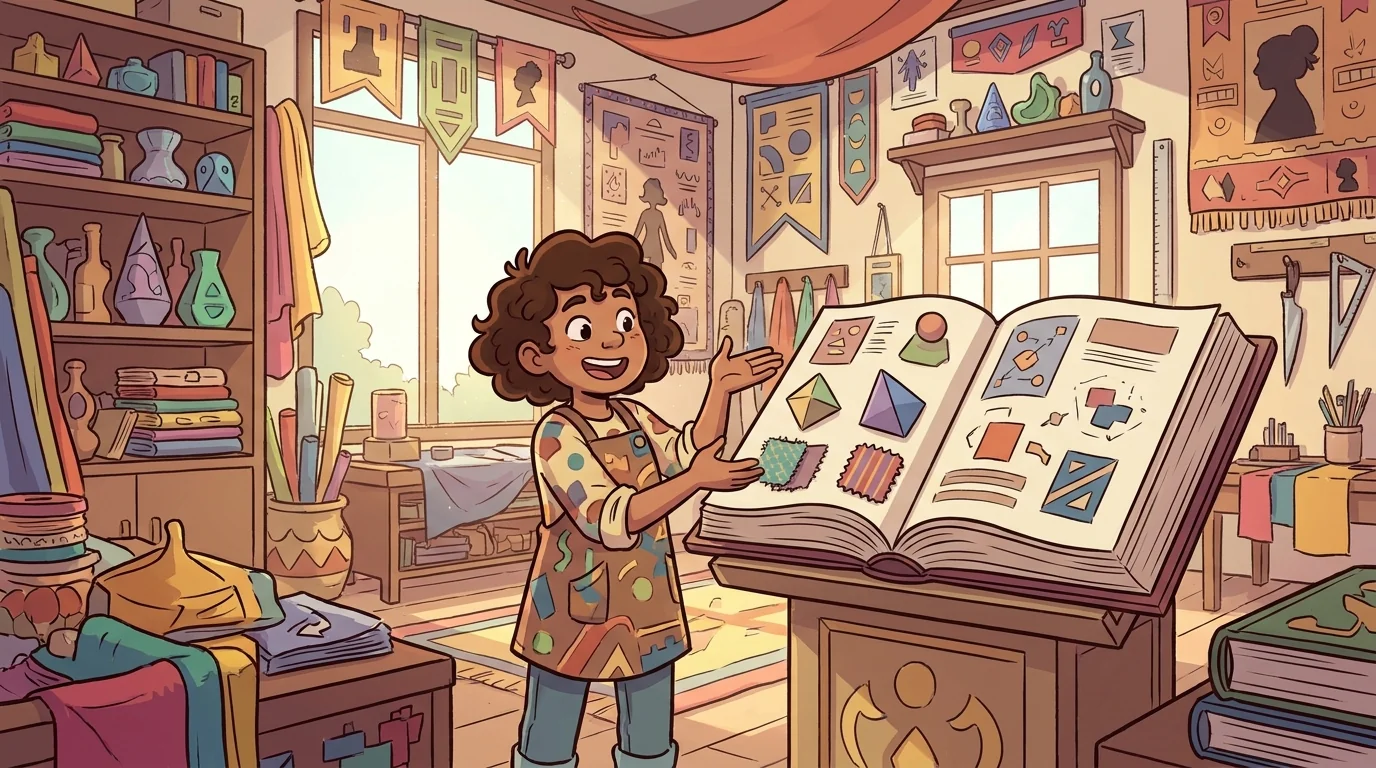
Lexi kept the Maker's Hall dictionary — not of ordinary words, but of the exact terms for what everyone else saw but struggled to say. She was the one who could turn "that pointy sort of shape, you know, the going-out bit" into a single precise word, and she believed, deeply, that having the right word was a kind of superpower.
She hadn't always. As a beginner she'd described everything with her hands and a lot of "you know, the swooshy part," and she'd noticed, with frustration, that she couldn't compare two things she couldn't name.
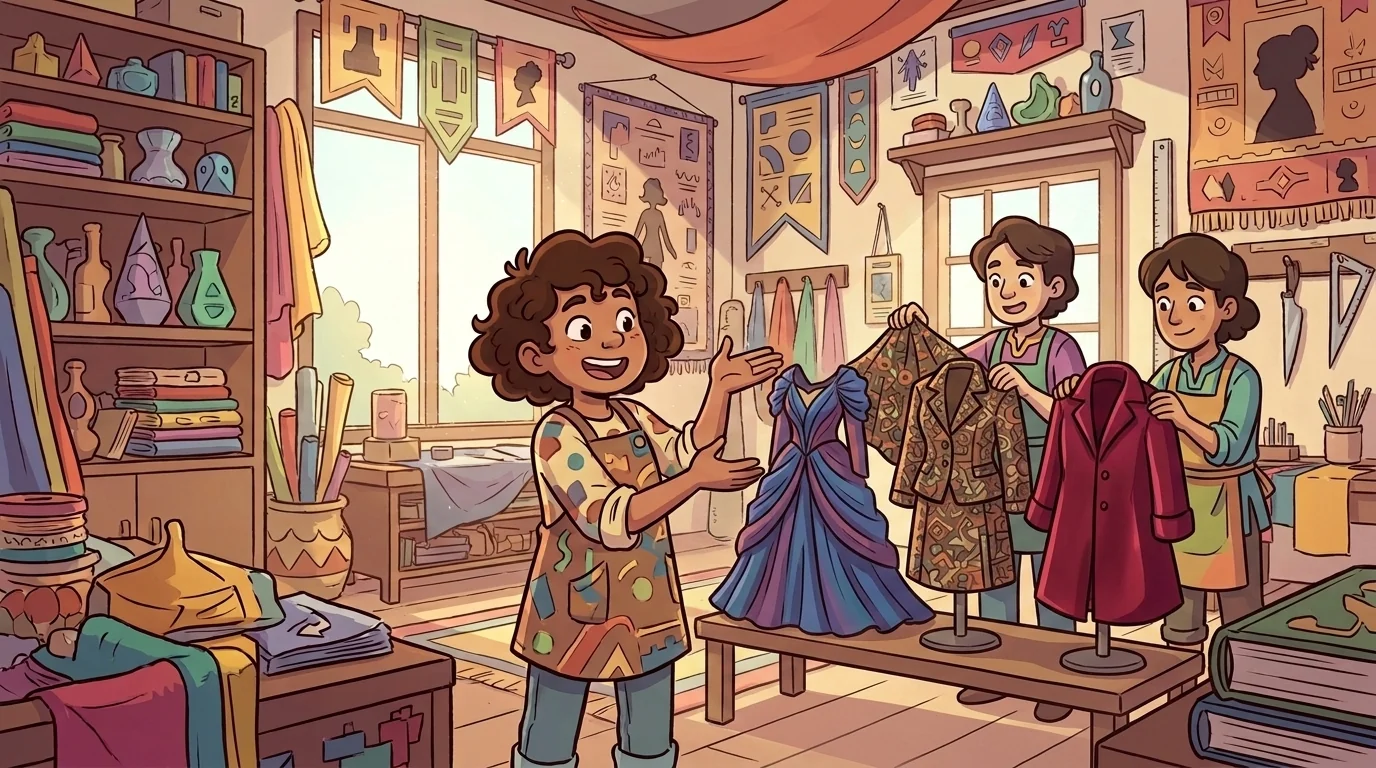
Relic gave her the lesson without meaning to. Two makers were arguing about two garments, going in circles: "This one's more fancy." "No, that one's fancier." They were using one vague word — fancy — for a dozen different things, and so they could never agree, because they weren't even talking about the same quality.
Lexi stepped in and did something small and powerful. She named the parts. "You mean this one has a more elaborate silhouette — a more dramatic overall shape. And that one has a busier motif — more pattern packed in. And this third has a richer hue — a deeper, costlier colour. Those are three different things. Which do you actually mean?"
The argument stopped. Suddenly they could see that they'd each meant something different by "fancy" — and now that each thing had its own name, they could compare them properly.
That was Lexi's craft: precise words let you see precisely. She built up the crew's shared vocabulary, one exact term at a time. Silhouette — the outer shape. Motif — a repeating design element. Drape — how cloth hangs and moves. Hue — the actual colour. Weave, nap, hem, seam, selvage. Each word was a little handle that let you pick a thing up and hold it steady while you thought about it.
She noticed something almost magical: once someone learned a word, they started seeing the thing everywhere. Teach a person the word "silhouette" and suddenly they couldn't stop noticing shapes. The name didn't just describe the thing — it switched on the eye that could find it.
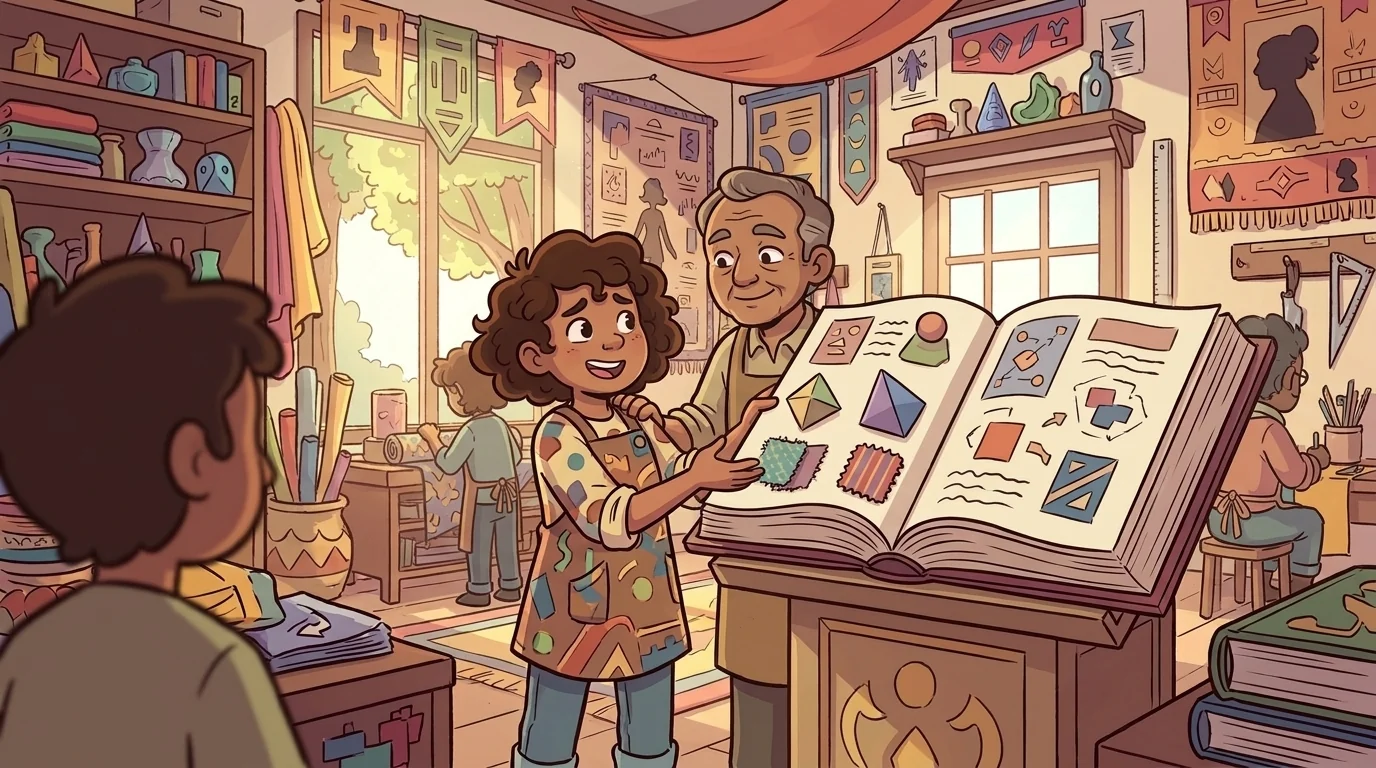
Her honest lesson was about not hiding behind words. She went through a phase of using fancy terms to sound clever, until Relic gently caught her burying a simple point under jargon. "The right word makes a thing clearer," Relic said, "never foggier. If your fancy word confuses the person you're talking to, it's the wrong word for that moment. Precise, not showy." Lexi wrote at the front of the dictionary: a good word opens a door; it never locks one.
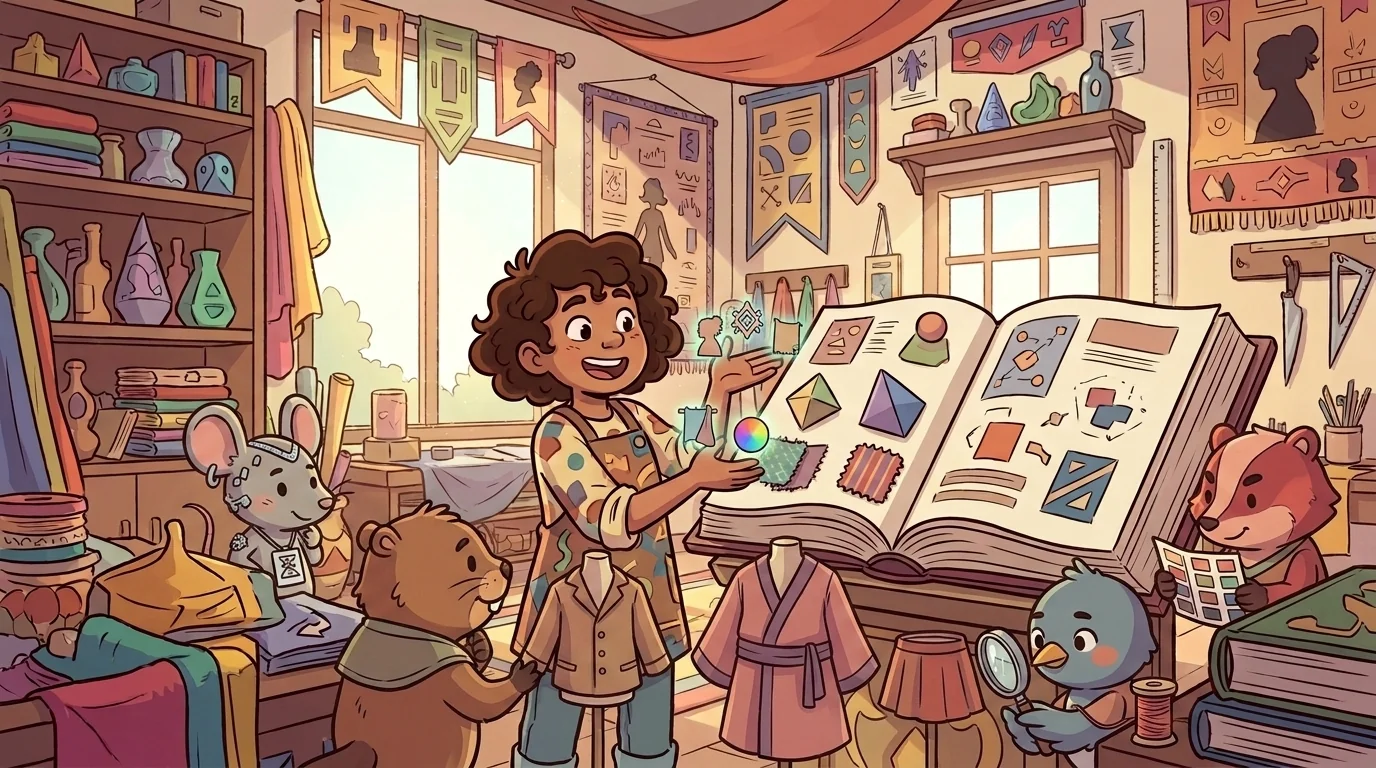
The real test came when the whole crew tried to compare their findings on three garments and dissolved into noise — everyone using different, mushy words for the same things.
Lexi didn't add to the noise. She gave everyone the same words. "Let's each report in the same terms," she said. "Silhouette first — the overall shape. Then motif — the pattern. Then hue — the colour. Then drape — how it hangs." One by one, in shared language, the crew's findings clicked into a single clear picture they could all see at once.
Warp read the fiber, Madder the colour, Selvage the shape, Argent the status — and because Lexi had given them all the same exact words, their separate readings finally fit together like a finished cloth.
"How did you get everyone to agree so fast?" a young maker asked.
"I gave them the right words," said Lexi. "Name what you see with the exact word — silhouette, motif, drape, hue — and suddenly you can describe it, compare it, and agree on it. Vague words keep you arguing. The precise word ends the argument and shows you the thing."
The EraForge ensemble
Lexi is part of EraForge's distributed-narrative cast. Each character embodies a different curricular primitive; together they teach the full subject.
-
Warp
Fiber → cloth — every cloth remembers the land whose plant or animal made it
-
Madder
Natural dye — before factories every colour came from a plant, root, or shell; a rare colour meant a long reach
-
Selvage
Silhouette → era — the outer shape a dressed figure makes dates the look, even from a shadow
-
Toile
A motif is a message — read a woven pattern on its own makers' terms, never guess
-
Argent
Status dress — what a person may wear encodes rank and role; read the whole society
-

Vane
Climate & geography — clothing is a clever answer to a place's weather and terrain
-

Skein
Trade & exchange — where a fabric is worn traces the route that carried it, not just its source
-

Relic
Source-reading (the curator & mentor) — read an object as evidence: who made it, when, and why
-
Damask
Revival & anachronism — old styles return re-made; the out-of-time detail reveals the real age