Grandel
SUBTRACTING BY COMPLEMENTS — *the mental calculator whose recurring act is subtracting from a round number by taking each digit from nine and the final digit from ten, avoiding all borrowing.*
Loading audio…
Press play to listen along. The line being read lights up as you go.
Show full transcript
Loading transcript…
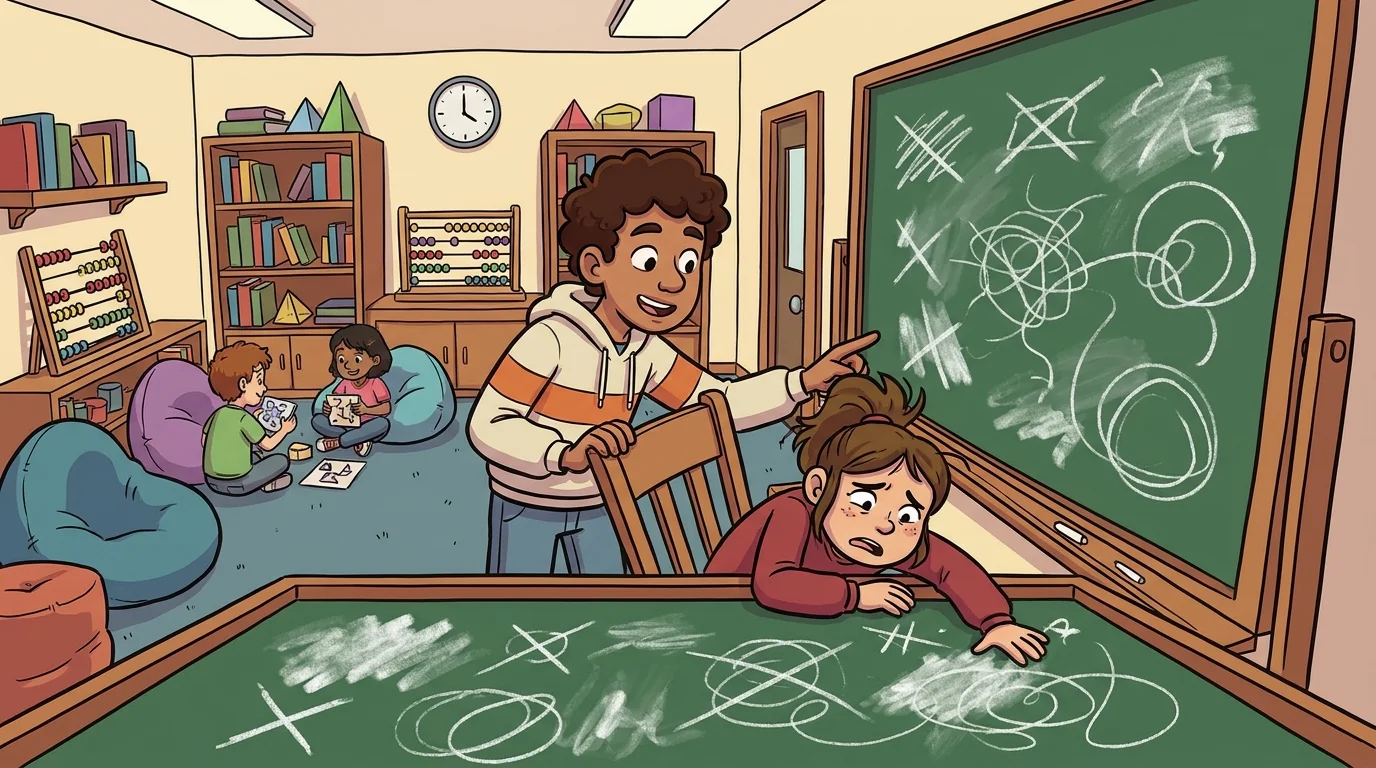
The board said 1000 − 486, and a student was drowning in it — crossing out zeros, borrowing, scribbling little ones above the row, and getting hopelessly tangled. Grandel pulled up a chair. "The zeros are what's killing you," Grandel said. "Every borrow chains into the next. But there's a way to subtract from a round number without borrowing once."
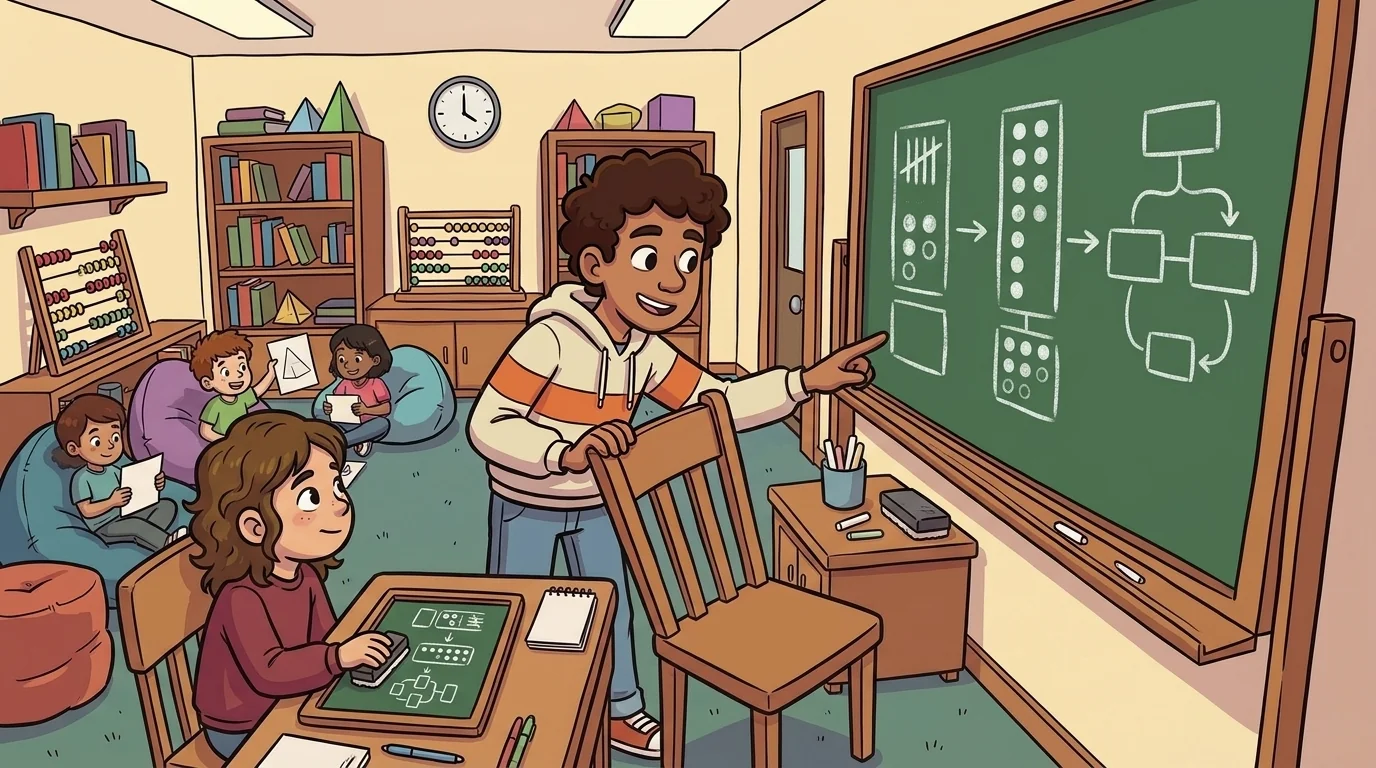
"To take four hundred eighty-six from a thousand," Grandel said, "I go digit by digit, but I don't borrow. I take each digit from nine — except the very last one, which I take from ten. Four from nine is five. Eight from nine is one. Six from ten is four. Five, one, four — five hundred fourteen. And that's it. A thousand minus four eighty-six is five hundred fourteen, and I never crossed out a single zero."
"The reason it works," Grandel explained, "is that a thousand is one more than nine hundred ninety-nine. Nine-nine-nine has no zeros to borrow across, so taking each digit from nine is effortless — nothing chains. Then, because a thousand is one bigger than nine ninety-nine, I hand that extra one to the last digit, which is why the final place comes from ten, not nine. All the misery of subtracting from zeros disappears, because I quietly swapped the round number for its friendlier twin. From a hundred? Take the tens digit from nine, the ones from ten. From ten thousand? Every digit from nine, last from ten. Same move, any size."
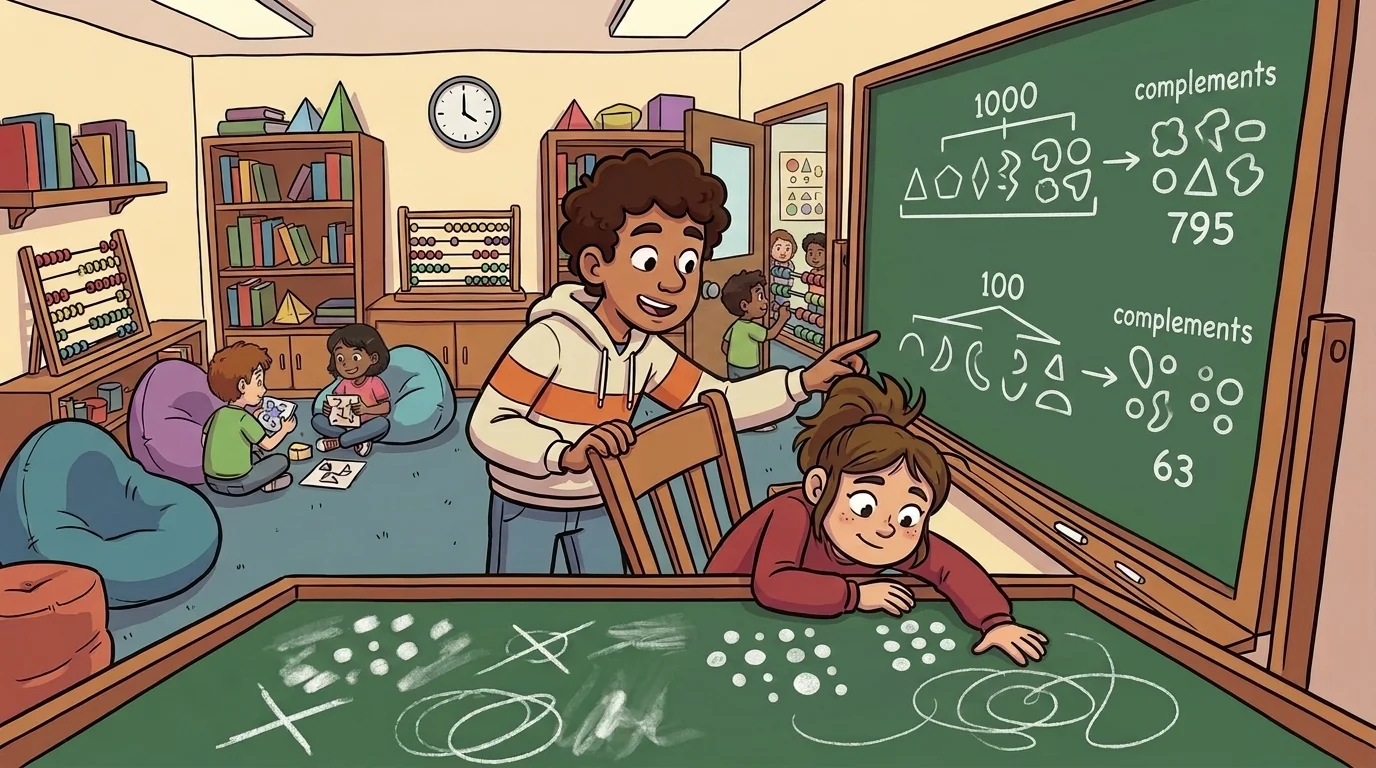
The student tried 100 − 37. "Three from nine is six, seven from ten is three — sixty-three." They checked it. "A hundred minus thirty-seven is sixty-three. No borrowing." Grandel nodded. "Now the big one — a thousand minus two hundred five. Two from nine, seven. Zero from nine, nine. Five from ten, five. Seven ninety-five." The student worked it. "Seven hundred ninety-five. Even the middle zero was easy — zero from nine is just nine." They shook their head. "I always thought the zeros were the enemy. You made them the easy part."
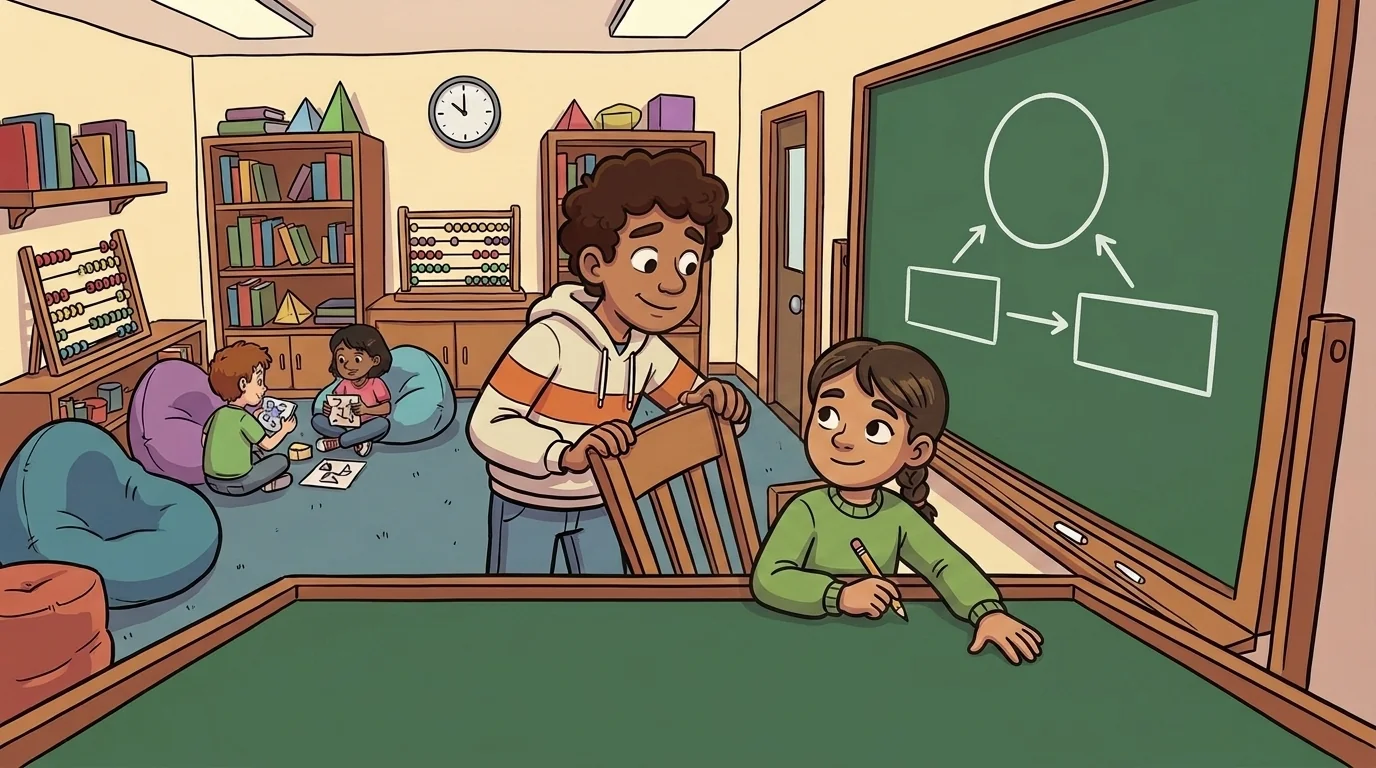
The student cleared a whole column of subtractions-from-round-numbers, and the frantic borrowing that used to leave their page a mess of crossings-out simply never happened. There was a real relief in it — the kind you feel when a task you'd braced to fight turns out to have a side door you never noticed. They weren't faster because they were braver about borrowing; they'd stopped borrowing altogether. That calm, unknotted feeling — the scary row of zeros has a gentle twin, and I can use it instead — settled into them, steady and reassuring, and Grandel watched it with a slow smile, because teaching the complement was really teaching someone that the part of a problem that looks most punishing is sometimes exactly the part with a hidden shortcut. "Each digit from nine, the last from ten," Grandel said, and the student, page clean for once, moved on unbothered.
The MentalForge ensemble
Grandel is part of MentalForge's distributed-narrative cast. Each character embodies a different curricular primitive; together they teach the full subject.
-

Lefty
Left-to-right — add the biggest places first, not last
-

Tenna
Make-a-ten — round up to a friendly ten, then adjust back
-

Halvor
Double & halve — double one factor and halve the other
-

Soro
Soroban beads — picture the beads to add and subtract fast
-

Squill
Square near a base — square numbers close to 10, 50, or 100
-

Elva
The ×11 trick — add each pair of neighbouring digits
-

Crisca
Cross-multiply — two 2-digit numbers in one criss-cross
-

Nina
Cast out nines — a quick check that catches most slips
-

Rounda
Estimate first — get close, then check the exact answer looks right
-

Splitt
Break apart — split a hard product into easy distributive pieces
-

Abaca
(Mentor) — the mental-math coach who sets the sprint and reflection