Tenna
MAKE-A-TEN — *the mental calculator whose recurring act is rounding a number up to a friendly ten, doing the now-easy calculation, then subtracting back exactly what was borrowed.*
Loading audio…
Press play to listen along. The line being read lights up as you go.
Show full transcript
Loading transcript…

The sum on the board was 47 + 8, and the kid at the front kept miscounting on their fingers — "forty-eight, forty-nine..." — and losing their place around fifty-two. Tenna, who was next in line, leaned in with a small, conspiratorial smile.
"Eight is an awkward number to add," Tenna said. "But it's so close to ten. What if, just for a second, we made it ten? Ten is the friendliest number there is."
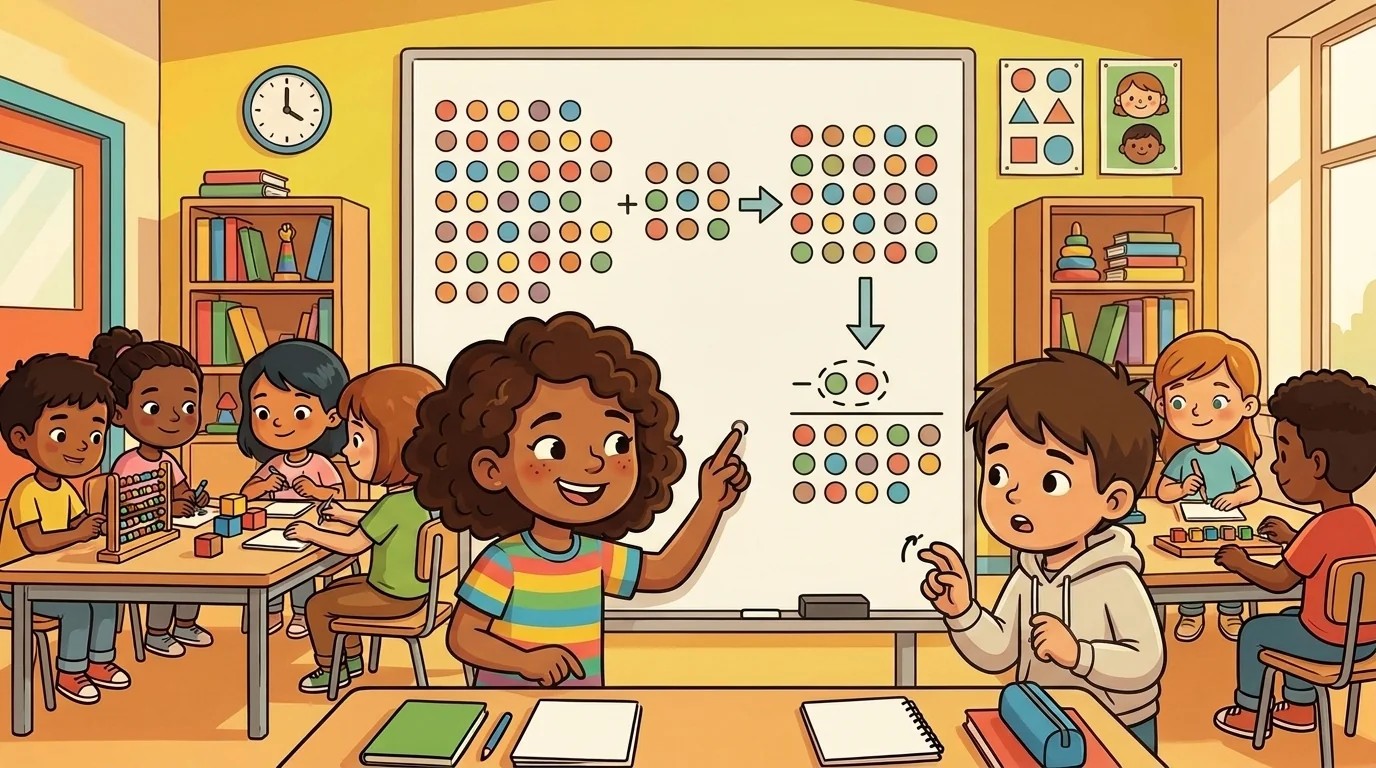
Tenna wrote it out. "Forty-seven plus ten — that's easy, that's fifty-seven, you don't even have to think. But I only wanted to add eight, and I added ten. I borrowed two extra. So I give the two back: fifty-seven minus two is fifty-five." Tenna tapped the board. "Forty-seven plus eight is fifty-five. I turned a hard little sum into an easy round one, then paid back the difference. Bump up to the friendly ten, do the easy thing, adjust back."

"I used to dread the numbers ending in seven, eight, nine," Tenna admitted. "They felt sticky — you can't just glide across them. Then I noticed something: a nine is only one away from ten, an eight is only two away. They're not far from friendly at all — they're practically leaning on the door of the next ten. So instead of fighting the sticky number, I nudge it over the threshold, do the sum in the easy land of round numbers, and then quietly return whatever I over-added. Nobody in the whole calculation ever has to do a hard step. There isn't one anymore."

The kid tried 38 + 6. "Thirty-eight is two away from forty," they said. "So... forty plus six is forty-six. But I added two too many. Forty-six minus two is forty-four." They looked up. "Thirty-eight plus six is forty-four. And I never once had to add six to an eight — I added six to a forty." Tenna beamed. "You found the friendly ten and let it do the heavy lifting. That's it exactly. The trick isn't being fast at hard sums — it's turning hard sums into easy ones and remembering to settle up afterward."

The kid ran through three more — 29 + 5, 58 + 7, 46 + 9 — each time reaching for the near ten first, and each time the answer came out smooth, with no white-knuckle counting across the awkward middle. What surprised them most wasn't the speed; it was how unbothered they felt. The numbers that used to make them tense had lost their sting, because they never met them head-on anymore — they just tipped them over into friendly territory and paid the small difference back. That easy feeling — I don't have to wrestle the hard number; I can make it kind for a moment — spread through them like warmth, and Tenna watched it happen with quiet delight, because teaching someone to reach for the friendly ten was really teaching them that a hard problem is often just an easy one wearing a disguise. "Up to ten, then settle up," Tenna said, and the kid was already trying it on the next one, unbothered and grinning.
The MentalForge ensemble
Tenna is part of MentalForge's distributed-narrative cast. Each character embodies a different curricular primitive; together they teach the full subject.
-

Lefty
Left-to-right — add the biggest places first, not last
-

Halvor
Double & halve — double one factor and halve the other
-

Soro
Soroban beads — picture the beads to add and subtract fast
-

Squill
Square near a base — square numbers close to 10, 50, or 100
-

Elva
The ×11 trick — add each pair of neighbouring digits
-

Grandel
Subtract from a round number — take from 100 or 1000 by complements
-
Crisca
Cross-multiply — two 2-digit numbers in one criss-cross
-

Nina
Cast out nines — a quick check that catches most slips
-

Rounda
Estimate first — get close, then check the exact answer looks right
-

Splitt
Break apart — split a hard product into easy distributive pieces
-

Abaca
(Mentor) — the mental-math coach who sets the sprint and reflection