Block Bodhi · Spoke Sami · Guard Gwen
THE DEFENSIVE COMBINATION — Bodhi's reading of the opponent's threat + Sami's grip on the strong high-mobility points + Gwen's sheltering of what matters, working together as perspective-taking defense
A story read by Block Bodhi · Spoke Sami · Guard Gwen
Loading audio…
Press play to listen along. The line being read lights up as you go.
Show full transcript
Loading transcript…
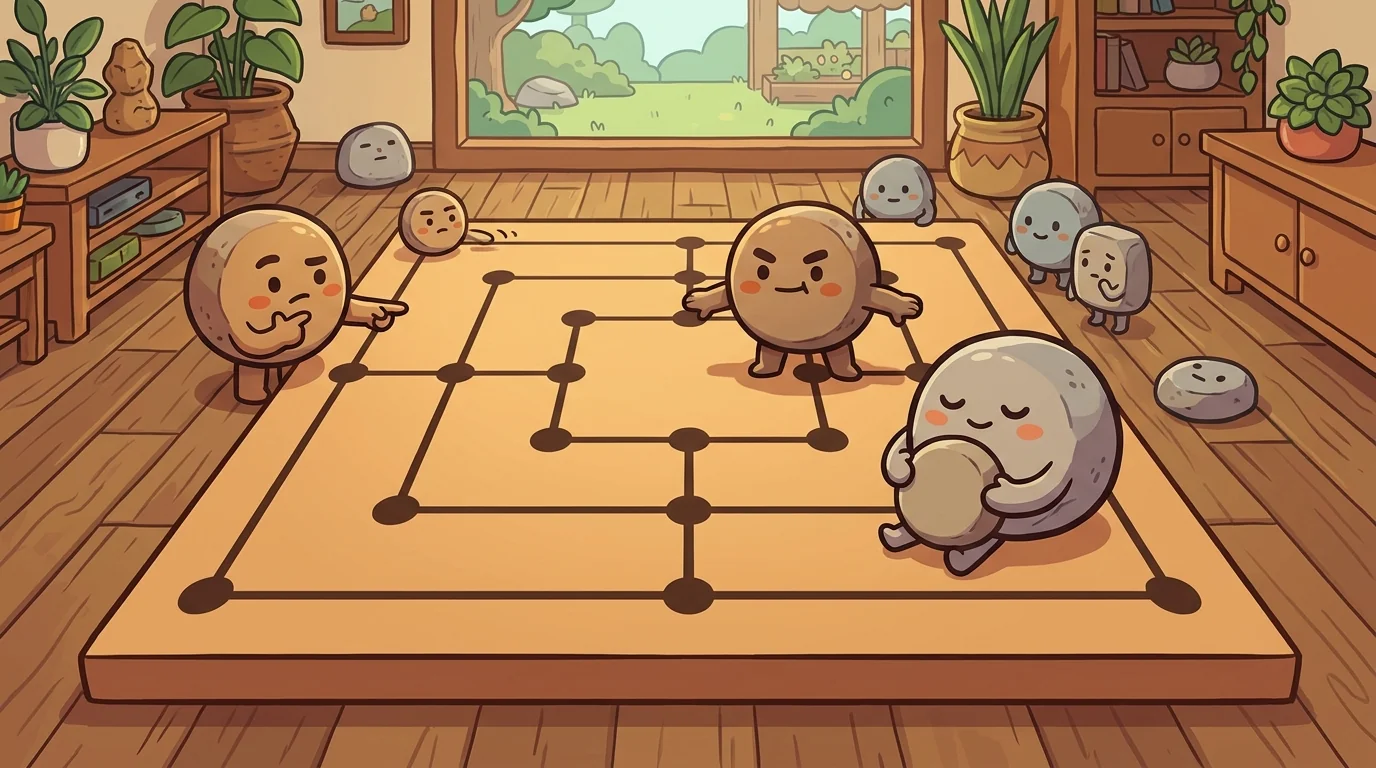
Everyone loved the pieces who attacked — who built the mills and snatched the stones and swung the running machine. Far fewer noticed the three pieces who quietly made sure the enemy's attacks came to nothing: Block Bodhi, who read the threat; Spoke Sami, who held the strong ground; and Guard Gwen, who kept the important pieces safe. Together, they were the reason a good player was so maddeningly hard to beat.
Defense, they'd learned, was not the panicky flailing most young players thought it was — not a frantic plugging of every hole. It was a calm, shared craft with three parts. First you read what the enemy was trying to do (Bodhi). Then you took the strong points that gave you the reach to answer them (Sami). And you sheltered what you couldn't afford to lose while you did it (Gwen). Each of them was good at one part. Only together did they turn defense from frightened reaction into something almost serene.
"People think defense is scary," said Gwen. "It's only scary if you flail. Watch what it looks like when you don't."
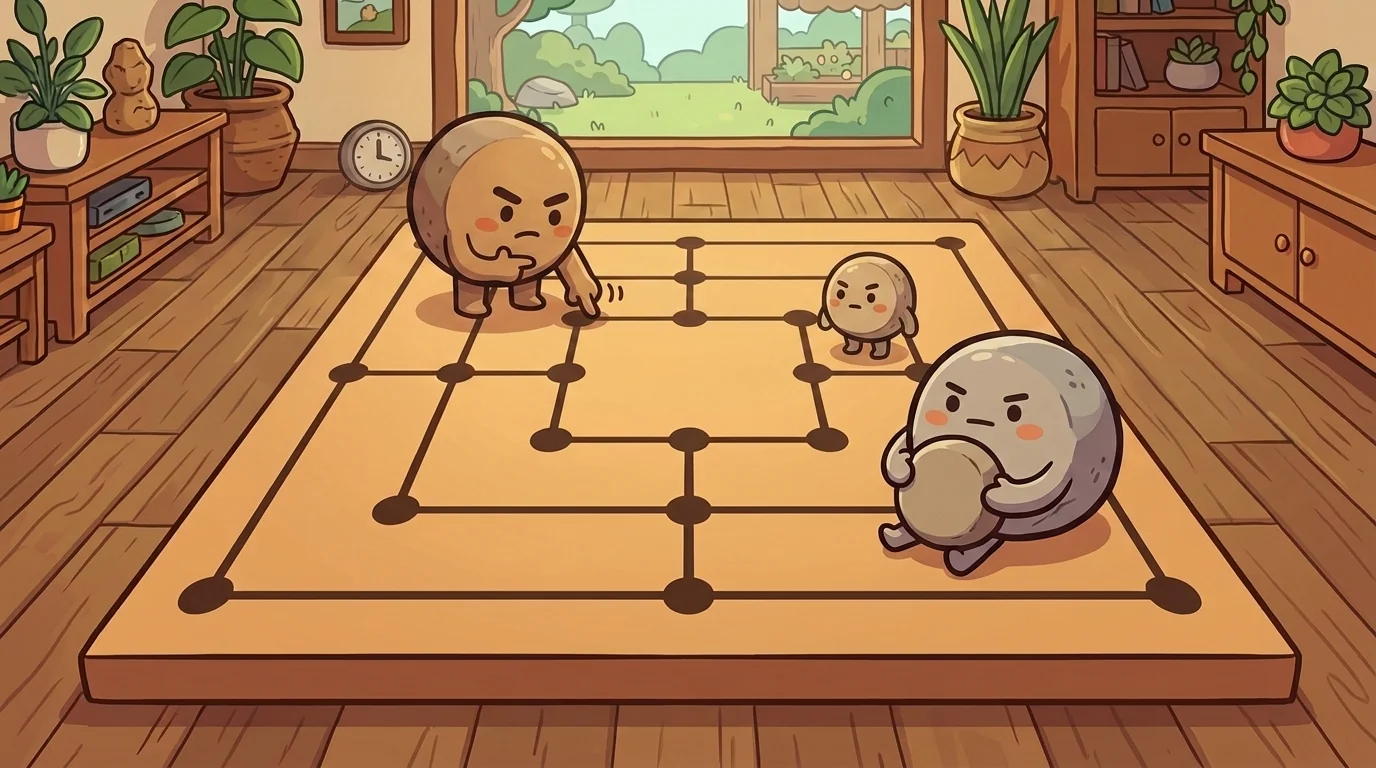
Bodhi went first, because all good defense begins with reading the other player.
"Before I move a single stone," he said, watching the enemy's board rather than his own, "I ask: what are they trying to do?" He studied the enemy's pieces — two here pointing at a third empty point, a stone edging toward a busy junction, a half-swing beginning to form. "There," he said, tapping the almost-mill that was truly dangerous, and pointedly not tapping two others that looked scary but couldn't actually complete. "That's the real threat. Those two are phantoms — they can't close this turn, or wouldn't hurt if they did. The whole craft of defense starts with seeing the board through the enemy's eyes: what do they want, what can they actually do, and which of their threats is real. Get that wrong and you'll spend the whole game blocking shadows."
Sami and Gwen waited for his read, because there was no point positioning or sheltering until they knew what they were defending against.
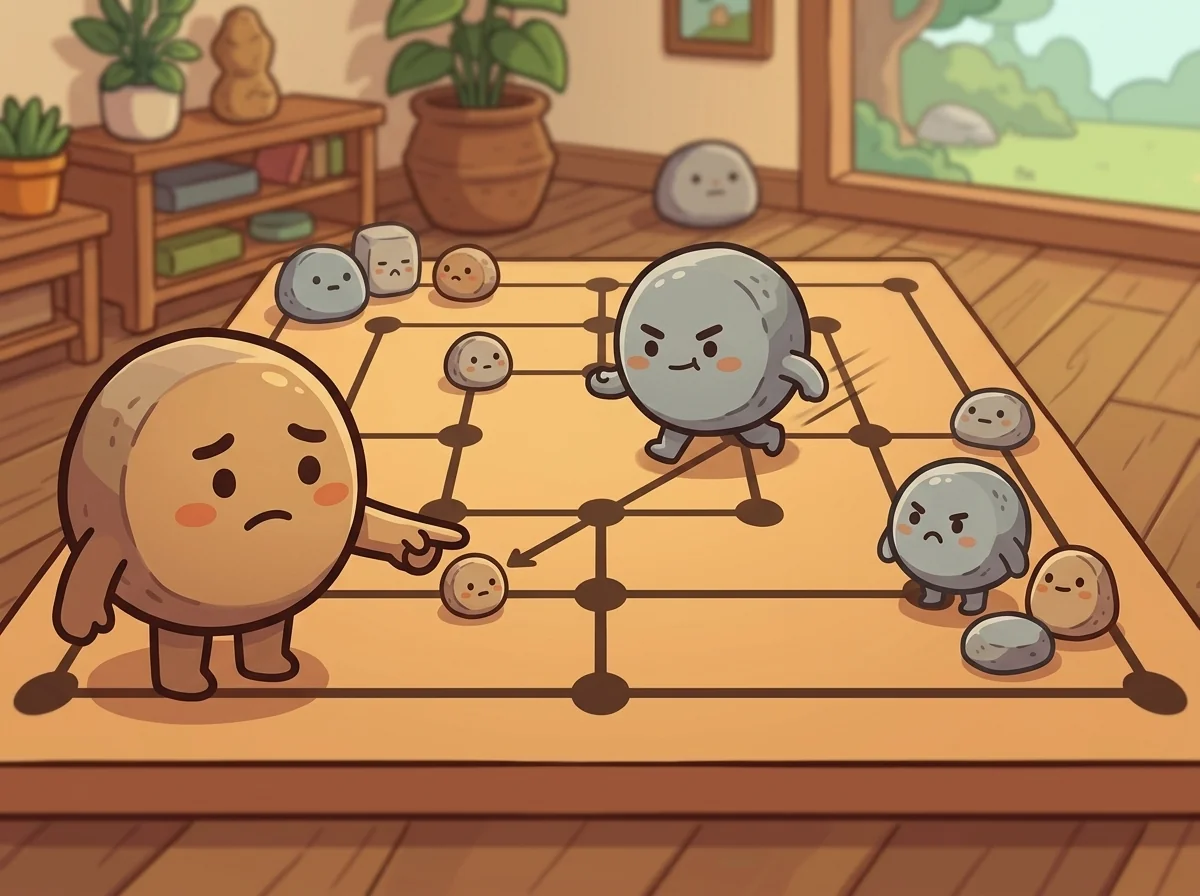
Then Sami moved, because reading a threat is useless if you don't have the reach to answer it.
"Bodhi's found the real threat," she said. "Now — can I even get to the point I need to block? That's about where my pieces stand." She had made sure, earlier, to hold the strong high-mobility points — the busy crossroads where four roads met — not because they touched more mills (every point touched exactly two, she'd remind you), but because from a four-road junction she could reach so much more of the board. "From a corner I've got two roads; I can barely answer anything. From a crossroad I've got four — I can slide to block the threat Bodhi spotted, and still threaten something myself." She slid a piece from a crossroad to the exact point that killed the enemy's real almost-mill. "Good defense needs good position. You can't block what you can't reach. I hold the strong ground so that when Bodhi says 'there,' I can actually get there."
The enemy's dangerous almost-mill died, blocked — and because Sami had answered from a strong point, she was still a threat herself, not merely a plugged hole.

And through all of it, Gwen did the quiet third part — she sheltered what they couldn't afford to lose.
"Bodhi reads, Sami reaches," said Gwen, "and I make sure that while we're busy defending, the enemy can't just snatch our most important pieces out from under us." As Bodhi and Sami worked, Gwen tucked the key stones — the ones holding their own plans together — safely inside completed mills, where the protection rule wrapped around them and no enemy capture could reach. But she was careful, the way she'd learned to be, not to shelter everything and freeze solid; she sheltered only what truly mattered and kept the rest free to move. "Defense isn't only about stopping their attack," she said, settling a keystone safely into a mill. "It's about making sure that while you're stopping it, they can't win somewhere else by grabbing what you left exposed. I keep the crown jewels safe so Bodhi and Sami can defend without fear."
Read, reach, shelter — the three parts folding into one calm motion, and the enemy's whole attack breaking against it like water on a wall.

Afterward, the enemy's attack spent and broken, the three of them sat in the quiet, and Gwen returned to the thing she'd said at the start.
"See?" she said. "Defense isn't scary. It's only scary when you do it alone and flailing — one panicky piece trying to read and reach and shelter all at once, and doing none of them well."
"The trick was splitting it up," said Bodhi. "I read. I'm good at reading — at seeing what the other player wants. But my reading's useless if nobody can reach the point I've found."
"Which is my part," said Sami, "and mine's useless if we're so busy blocking that they snatch our best pieces somewhere else—"
"—which is my part," Gwen finished, smiling. "Read, reach, shelter. Three of us, one calm craft."
There was a quiet, unshowy warmth between them — the warmth of the pieces nobody sings about, who make the songs possible. The attackers got the glory: the mills, the swings, the snatches. But an attack only works when the other side's defense has failed — and these three made sure their side's defense never did. They had learned the deepest secret of it together: that good defense is not fear and flailing, but perspective-taking — calmly seeing the board through the enemy's eyes, holding the ground to answer, and keeping safe what matters most. And there was a serene, shared pride in being the three who turned the scariest part of the game into the calmest — the quiet wall that every loud attack broke against, and never quite understood why.
The MillSong ensemble
Block Bodhi · Spoke Sami · Guard Gwen is part of MillSong's distributed-narrative cast. Each character embodies a different curricular primitive; together they teach the full subject.
-

Miller Mila
The mill: lining up three stones on a line
-

Snatch Nadia
Capture-on-mill: removing a piece the moment a mill closes
-

Guard Gwen
The not-in-a-mill rule: a stone inside a mill is safe
-

Block Bodhi
Blocking: dropping onto the empty point of an almost-mill
-

Spoke Sami
Prime points: the strong spoke midpoints (three mill lines each)
-

Corner Cato
Corner points: the low-value corners (two mill lines each)
-
Placer Pell
The placement phase: building a mill network with the nine
-

Slide Sile
The movement phase: sliding a stone to an adjacent point
-

Swing Sena
The swinging (running) mill: opening and re-closing to capture again
-

Flyer Faye
The flying phase: hopping anywhere once down to three men
-
Reduce Remy
The endgame: winning by reducing the opponent to two
-

Elder Merel
The mills-puzzle elder (mentor): find-the-mill / which-to-take puzzles