
Fiver Odalys · Count Bello · Double Dev
THE ALL-FIVES SCORING COMBINATION — Bello's instant pip-reading + Dev's full-value doubles + Odalys's aim at a multiple of five, working together so the score comes from seeing the ENTIRE layout's open-ends total, not one tile
Ensemble — The Count of Fives
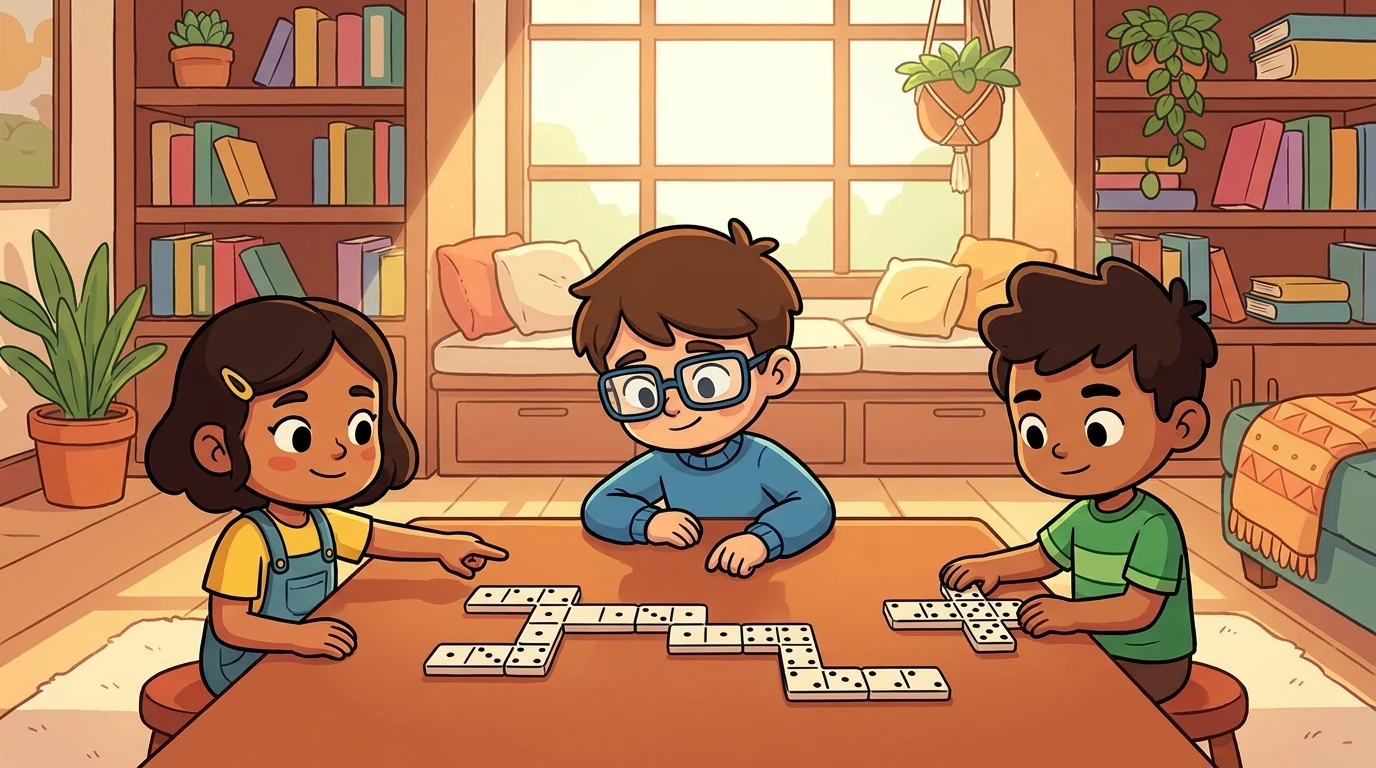
Three of them sat together at the tamarind table one long afternoon, and between them they held the whole secret of scoring: Count Bello, who could read any pip pattern at a glance; Double Dev, who knew a double counts both its halves; and Fiver Odalys, who aimed every total at a multiple of five. Alone, each was good. Together, they were something else — because scoring in the Fives family isn’t about any single tile. It’s about the total of every open end on the board at once, and no one of them could see all of that alone.
“Watch how we do it,” said Odalys, as the branching line spread across the table with three, then four open ends. “I can’t score if I can’t add the ends. And I can’t add the ends if I can’t read them fast — that’s Bello. And I’ll add them wrong if I forget a double counts double — that’s Dev. Scoring’s not a solo. It’s the three of us reading one board.”
The board had grown complicated: a double turned sideways had opened new arms, so now there were four open ends, and one of them was a double-five sitting crossways, its two fives facing out.
Bello’s eyes swept the ends first, naming each pattern the instant she saw it — no counting, just knowing. “That end’s a three. That one’s a two. That one’s a four.” Then she reached the double-five and paused, because a double is Dev’s specialty.
“Careful there,” Dev said, tapping the double-five. “That’s not a five. Both halves count at an open end — that’s ten. People forget the half they’re not looking at.” Bello nodded and corrected her running sum: three, two, four, and ten.
Odalys was already adding. “Three plus two plus four plus ten is nineteen,” she said. “One away from twenty. So I don’t score yet — I need a tile that nudges an end up by one without breaking the rest.” She found a tile, matched it to the four so the four became a five, and now the ends read three, two, five, ten — twenty. “There,” she said. “Twenty. A clean multiple of five.” She’d scored — but only because Bello had read fast, Dev had counted the double whole, and she’d aimed at the total of all four ends together.
Nana Fives, watching from the head of the table, decided to test whether they truly understood their own combination. She rearranged the board into a trap: a layout where any one of them, working alone, would miss the score.
“Score it,” she said, “and tell me who did what.”
They didn’t rush. Bello read all the ends aloud — “six, one, and the double-three crossways.” Dev jumped in: “Double-three is six, not three — both halves.” Odalys added: “Six plus one plus six is thirteen — two short of fifteen.” She scanned for a tile to lift an end by two. Bello spotted it first, reading a tile’s pattern before Odalys had finished the sentence — “that one’s a two-one, play the one on the six-end—” no, that dropped it; they caught the error together, tried the two on the one-end instead, and the ends became six, three, six — fifteen. “Fifteen,” said Odalys. “Bello read it, Dev counted the double true, I aimed the total. None of us scores that alone.”
Nana Fives clapped once. “Every scorer thinks the points live in their own clever tile,” she said. “You three have learned they live in the whole layout — and that seeing the whole takes more than one pair of eyes. Bello sees each end. Dev sees the doubles whole. Odalys sees the target. Together you see the board.”
It was Dev who put words to the real lesson, later, while they reset the tiles. “For the longest time I only looked at my own tile,” he said. “Was my double good? Could I play it? But the score was never about my one tile. It was about every open end added together — and I couldn’t see all of them by myself.”
“None of us could,” said Bello. “I read the ends fast, but I’d forget the doubles count double. Dev never forgets a double, but he adds slower than me. And Odalys sees the target from across the table but can’t read six ends at once.” She grinned. “Apart, we each see a piece. Together, we see the total.”
Odalys nodded. “That’s the whole thing. The score isn’t in a tile. It’s in the sum of everything open on the board — and you only really see that when you stop staring at the one piece in front of you and take in the whole layout at once.”
That evening the three of them stayed after the others and played one slow scoring game together, calling their parts aloud like a little three-person machine — Bello naming each end, Dev flagging every double as full value, Odalys announcing the running total and the target — “…six… plus the double, ten… sixteen… one more and it’s twenty…”
They thought about how each of them had once played alone and left points scattered everywhere unseen: Bello forgetting doubles, Dev staring at his own single tile, Odalys unable to read a crowded board fast enough. And they thought about how completely that changed the moment they pooled their eyes — one reading, one doubling, one aiming — until the total of the whole layout lay open to all three at once. The points had never been in any one tile, they agreed; the points were in the whole board, and seeing the whole board was something they did together. They squared the tiles away, still half-calling numbers back and forth, and felt the particular warmth of three people who had learned that some totals are too big to count alone.
The TileTales ensemble
Fiver Odalys · Count Bello · Double Dev is part of TileTales's distributed-narrative cast. Each character embodies a different curricular primitive; together they teach the full subject.
-

Match Mateo
Matching ends: you may only add a tile whose end equals a number already open
-

Double Dev
Doubles and the spinner: a double is played crossways and opens new arms
-

Block Bianca
Blocking: steering the open ends so the opponent has no legal play
-

Draw Dilan
The boneyard: when you can't match, you draw a tile or pass
-

Count Bello
Pip-counting and subitizing: reading a tile's value at a glance
-

Fiver Odalys
All-fives scoring: land the open-ends total on a multiple of five
-

Threes Thandi
Multiples of three: scoring on multiples of 3 (and on both 3 and 5)
-

Shed Sunil
Shedding to win: be first to play every tile and call 'domino!'
-

Tally Tunde
End-of-round counting-out: tally the pips left in hands, rounded to the nearest 5
-

Train Tomás
Mexican train: grow a personal train off the central hub
-

Chicken Cheo
Chickenfoot branching: a double must sprout three branches before play continues